Habit Building System I Wish I Had Learned Sooner
Based on Daily Atomic Steps's video on YouTube. If you like this content, support the original creators by watching, liking and subscribing to their content.
Choose a small set of habits to build over the next 365 days, then add new habits gradually rather than all at once.
Briefing
Building habits that actually survive real life hinges on a simple rule: never let a missed day break the chain. After years of failing to stick with even basic routines like exercise, teeth brushing, and consistent reading, the framework described here turns habit-building into a structured ramp—starting small, adding habits gradually, and using “backup” levels so the streak stays alive even on travel, sickness, or busy days.
The system starts with choosing which habits to build over the next 365 days (from whatever month the plan begins). If someone wants five habits in a year—say reading and exercising—the plan uses two growth patterns. Row-wise growth means increasing difficulty over time rather than jumping to the final target immediately. For reading, that might mean starting with 5 minutes per day for the first couple of months, then raising the daily goal later until reaching something like 30 minutes by months 11–12. Column-wise growth prevents starting everything at once: only two habits begin in month one, then one new habit is added each month so the workload ramps up gradually.
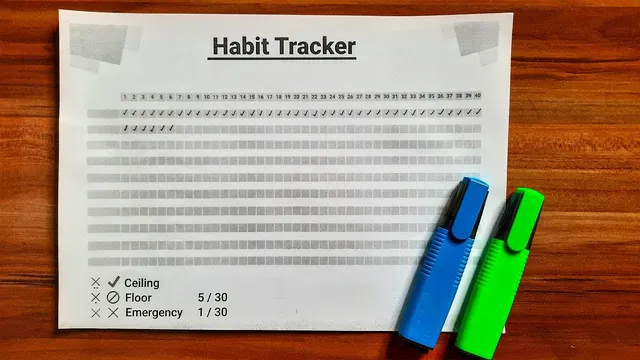
To keep habits from dying during unavoidable disruptions, each habit is defined with three versions: a ceiling version, a floor version, and an emergency version. The ceiling version is the “normal” target that increases month by month (for reading, the ceiling rises in steps: 5 minutes in months 1–2, 10 in months 3–4, 15 in months 5–6, 20 in months 7–8, 25 in months 9–10, and 30 in months 11–12). The floor version is a smaller, still-meaningful alternative—suggested as half the ceiling (rounded down to avoid fractions). The emergency version is the non-negotiable minimum that never changes: about 30 seconds, designed for sick days or when someone forgets and realizes at day’s end that the habit wasn’t done. Doing the emergency or floor version counts as “keeping the habit alive,” so streaks continue.
The habit tracker then turns these levels into streak logic. A streak increases as long as the person completes at least something—ceiling, floor, or emergency. But if a day passes without even the emergency version, the streak resets to zero and the person starts counting again. That reset triggers analysis: why did the emergency version get skipped? One personal example given is forgetting to check the habit tracker, which led to a practical fix—placing habit trackers where they’ll be seen before bed so they act as a reminder to complete at least the emergency level.
Finally, the system adds guardrails: there are limits on how often floor and emergency versions can be used within a 30-day window (e.g., only five floor uses and one emergency use per 30 days in the example). If those limits are exceeded, the plan calls for adjustment—often lowering the ceiling or floor—so the habit remains achievable rather than constantly rescued. The framework is credited largely to Muhammad Hussein, with the creator describing personal modifications and pointing toward a future video on making habits more effortless using habit analysis and the BJ Fogg behavior model (from Tiny Habits).
Cornell Notes
The habit-building system focuses on keeping streaks alive by scaling effort and adding “backup” levels. Habits ramp up in two ways: row-wise growth increases the daily target gradually over months, while column-wise growth adds new habits one at a time rather than all at once. Each habit has three tiers: a ceiling target that rises monthly, a floor version (suggested as half the ceiling) for low-energy days, and a fixed emergency version of about 30 seconds that never changes. Streaks count any day where at least the floor or emergency level is completed; missing even the emergency level resets the streak, which then prompts analysis and plan adjustments. Limits on floor/emergency usage in a 30-day period help prevent chronic over-reliance and encourage recalibrating the targets.
How does row-wise growth prevent habit failure when the final goal is far away?
What does column-wise growth do differently from row-wise growth?
Why introduce ceiling, floor, and emergency versions for each habit?
How does the streak system treat days when only the emergency or floor version is completed?
What should someone do after a streak reset?
What happens if someone uses the floor or emergency versions too often in a 30-day period?
Review Questions
- If someone’s long-term goal is 30 minutes of reading daily, what would row-wise growth recommend for the first months, and why?
- Under what condition does a habit streak reset, and how should that reset change the next month’s plan?
- How do ceiling, floor, and emergency versions work together to handle travel or illness without breaking consistency?
Key Points
- 1
Choose a small set of habits to build over the next 365 days, then add new habits gradually rather than all at once.
- 2
Use row-wise growth to ramp daily effort upward over months instead of starting at the final target immediately.
- 3
Define three tiers for every habit—ceiling, floor, and a fixed emergency minimum (about 30 seconds)—so disruptions don’t kill the routine.
- 4
Count a day as successful if at least the floor or emergency version is completed; reset the streak only when even the emergency version is missed.
- 5
Treat streak resets as data: identify why the emergency level was skipped and adjust the system (e.g., tracker placement) to prevent repeat failures.
- 6
Set limits on how often floor and emergency versions can be used in a 30-day window; if limits are exceeded, lower the ceiling/floor to match reality.