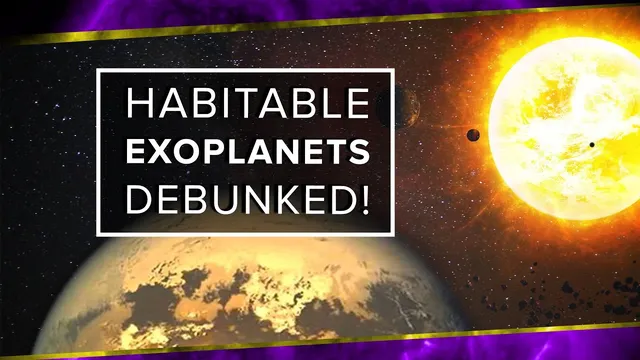
Habitable Exoplanets Debunked!
Based on PBS Space Time's video on YouTube. If you like this content, support the original creators by watching, liking and subscribing to their content.
“Habitable exoplanet” in astronomy often means “in the habitable zone,” not “proven capable of supporting human life.”
Briefing
Headlines often sell “habitable” exoplanets as Earth twins, but the core reality is much narrower: astronomers currently define a “habitable exoplanet” mainly as one orbiting in the habitable zone—the distance range where starlight could keep surface water liquid, assuming the planet has a surface and enough atmospheric pressure. That definition is a useful starting filter, not a measurement of whether the world actually has water, oxygen, or conditions that would let humans live there.
The mismatch starts with what “habitable” means in practice. In orbital terms, the habitable zone is a temperature-and-physics guideline: the star’s energy at that distance might allow liquid water to persist on a planet’s surface. But Venus illustrates why orbital placement alone can’t guarantee habitability. Venus has a solid surface and substantial atmospheric pressure, and if its orbit were shifted slightly outward, it would fall into the Sun’s habitable zone—yet it still lacks liquid water. Even the habitable zone’s boundaries can shift if a planet’s atmosphere is unusually thick, allowing water to exist farther from the star than expected. So the zone helps narrow targets; it does not confirm habitability.
A more definitive assessment would require atmospheric data—yet that’s where current observations hit a wall. For many widely reported “Earth-like” candidates, astronomers have not measured anything about their atmospheres at all. Kepler 186F, for example, drew major attention in April 2014 as the first confirmed Earth-sized planet in its star’s habitable zone. But the only direct information comes from Kepler’s transit measurements: a tiny dip in starlight that reveals the planet’s radius and orbital characteristics. Kepler 186F is about 10% larger than Earth in radius, orbiting a dim red dwarf at roughly Mercury-like orbital distances. At 500 light-years away, current and planned telescopes can’t determine its mass or probe its atmosphere. The planet could have an Earth-like air, a thin Mars-like atmosphere, a Venus-style carbon dioxide super-greenhouse, or no atmosphere at all.
Even for closer habitable-zone planets, the observational methods struggle with a “catch-22.” Atmospheric spectroscopy needs enough contrast between planet and star to isolate the planet’s light across wavelengths. Direct imaging works best for planets far from their stars, where contrast is higher; habitable-zone rocky planets are typically too close and get washed out. Transit spectroscopy can subtract the star’s spectrum when the planet passes in front, but it tends to favor planets close enough to heat up and boost the signal. The result is a gap: planets that are small and rocky enough to be in the habitable zone are often neither close enough for strong transit signals nor far enough for direct imaging.
A proposed solution—Terrestrial Planet Finder (TPF), a space telescope designed to analyze Earth-sized planets around Sun-like stars—was cut from funding. Without missions like that, confirming true Earth analogs remains out of reach for the foreseeable future. Still, narrowing the search and improving the exoplanet census matter, because the field needs better targets and better statistics—even if “Earth 2.0” is not something current data can actually verify.
Cornell Notes
“Habitable” exoplanets are often oversold. Astronomers use “habitable zone” as a first-pass filter: the orbital distance where starlight could keep surface water liquid, assuming a surface and enough atmospheric pressure. Venus shows why this doesn’t guarantee habitability—orbital placement can be compatible with liquid-water temperatures while the planet still lacks liquid water. For many celebrated candidates like Kepler 186F, observations provide only radius and orbital information from transit dips, not atmospheric composition, mass, or surface conditions. Even when atmospheric spectroscopy is possible, the methods favor either planets far from their stars (direct imaging) or planets close enough to produce strong transit signals, leaving Earth-sized habitable-zone worlds in a measurement gap.
Why does “habitable zone” not equal “human-habitable”?
What do astronomers actually know about Kepler 186F, and what do they not know?
How does atmospheric spectroscopy work for exoplanets?
Why is measuring atmospheres of Earth-sized habitable-zone planets so difficult?
What happened to the Terrestrial Planet Finder (TPF), and why does it matter?
Review Questions
- What assumptions are built into the definition of the habitable zone, and how can real planets violate those assumptions?
- Compare direct imaging and transit spectroscopy: for what kinds of exoplanets does each method work best, and why does that leave a gap for Earth-sized habitable-zone worlds?
- Using Kepler 186F as an example, explain what transit data can reveal and why it cannot currently determine atmospheric composition at its distance.
Key Points
- 1
“Habitable exoplanet” in astronomy often means “in the habitable zone,” not “proven capable of supporting human life.”
- 2
The habitable zone is a temperature-and-pressure guideline based on starlight, not a measurement of water, oxygen, or surface conditions.
- 3
Venus demonstrates that orbital placement alone can fail to produce liquid water even with a solid surface and substantial atmospheric pressure.
- 4
Kepler 186F’s transit observations provide radius and orbital characteristics, but not mass or atmospheric composition at its distance (~500 light-years).
- 5
Atmospheric spectroscopy requires separating planet light from star light; current methods struggle with Earth-sized rocky planets in habitable-zone orbits.
- 6
Direct imaging favors planets far from their stars, while transit spectroscopy favors planets close enough to generate strong signals—both miss many habitable-zone Earth analogs.
- 7
The Terrestrial Planet Finder (TPF) concept was cut from funding, delaying the ability to confirm habitability for true Earth analogs.