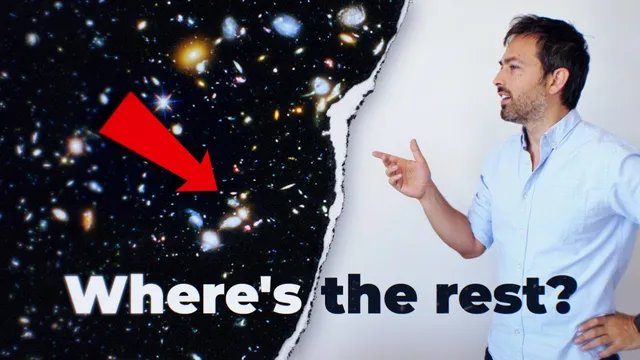
Half the universe was missing... until now
Based on Veritasium's video on YouTube. If you like this content, support the original creators by watching, liking and subscribing to their content.
Big Bang nucleosynthesis plus cosmic microwave background measurements imply the universe should contain about 5% baryonic matter.
Briefing
Half the universe’s ordinary matter—baryons made of protons and neutrons—was long thought to be “missing” because telescopes and other observations only account for about half of the expected amount. The shortfall isn’t dark matter or dark energy; it’s normal matter that’s hard to detect because it sits between galaxies in a diffuse, ionized state. Recent measurements using fast radio bursts now line up with the missing-baryon predictions, putting the total baryonic matter at roughly 5% of the universe and showing that about half of those baryons reside in the warm-hot intergalactic medium (WHIM).
The expected baryon fraction comes from the early universe’s chemistry. In the first minutes after the Big Bang, the universe cooled enough for protons and neutrons to fuse, but only after a brief bottleneck: deuterium (a proton–neutron nucleus) had to form first. Once deuterium became stable against being immediately smashed apart, it rapidly fused into helium-4. This “freeze-out” locked in element abundances—about 75% hydrogen and 25% helium by mass. Deuterium is especially important because it’s stable and isn’t produced in large quantities by later astrophysical processes. By counting deuterium relative to hydrogen—about 26 deuterium nuclei per million hydrogen nuclei—and combining that with measurements of the cosmic microwave background radiation (the Big Bang’s afterglow), cosmologists infer that baryonic matter should make up about 5% of the universe.
In the late 1990s, astronomers attempted a census: adding up baryons in stars, planets, gas, dust, and other luminous or inferable structures. That inventory came up short, finding only about 2.5% of the universe in baryons—roughly half of what early-universe physics predicts. One part of the solution is straightforward: much ordinary matter isn’t glowing brightly. Neutral hydrogen can be traced using distant quasars as backlights. Their spectra show a “Lyman-alpha forest” of absorption lines—tiny notches caused by neutral hydrogen clouds along the line of sight. Summing those absorbers nearly doubles the baryon tally, bringing it close to 50% of the expected total.
The remaining baryons were predicted by simulations to be spread through intergalactic filaments at extremely low densities (about 1–10 particles per cubic meter) and at temperatures between roughly 100,000 and 10 million Kelvin. At those temperatures the gas is ionized, so it doesn’t produce the same absorption signatures and instead interacts mainly with high-energy ultraviolet and low-energy X-rays—making it notoriously difficult to detect.
A new approach uses radio waves instead of X-rays. Lightning-like dispersion in Earth’s magnetosphere can turn a pulse into a “whistler,” and the same physics applies in space: free electrons slow lower-frequency radio waves more than higher-frequency ones. Fast radio bursts (FRBs)—millisecond-long, extremely bright pulses discovered in 2007—provide the needed backlight. By measuring how much an FRB’s signal is dispersed and comparing the dispersion measure to the redshift of its host galaxy, researchers can estimate how many ionized electrons—and therefore how many ionized baryons—lie between Earth and the source. A recent Nature paper reported that this method recovers the missing baryons, finding a total baryonic fraction near 5% and placing about half of the baryons in the WHIM. The result largely vindicates decades-old simulations, while also underscoring how inefficiently the early universe’s ordinary matter ends up concentrated in stars and galaxies.
Cornell Notes
The universe should contain about 5% ordinary baryonic matter, inferred from Big Bang nucleosynthesis and the cosmic microwave background. Observations, however, found only about half that amount in stars, gas, and other detectable structures—creating the “missing baryon problem.” Neutral hydrogen accounts for much of the gap via quasar absorption spectra (the Lyman-alpha forest), but the rest was expected to be ionized and diffuse in the warm-hot intergalactic medium (WHIM). A Nature study used fast radio bursts and their dispersion to count ionized electrons along the line of sight, estimating that the missing baryons are real and that roughly half of baryons live in the WHIM. This confirms long-standing simulation predictions about where ordinary matter is hiding.
Why does Big Bang physics predict a specific baryon fraction (about 5%)?
How does the quasar “Lyman-alpha forest” help find baryons?
What makes the remaining baryons hard to detect with traditional methods?
How does dispersion in radio waves let astronomers count ionized baryons?
What did the Nature study using fast radio bursts conclude?
Review Questions
- What early-universe process creates deuterium, and why does deuterium serve as a strong clue to the baryon fraction?
- How do quasar absorption spectra differ for neutral hydrogen versus ionized gas, and why does that matter for the missing baryons?
- What observable property of fast radio bursts is used to infer the amount of ionized matter between Earth and the source?
Key Points
- 1
Big Bang nucleosynthesis plus cosmic microwave background measurements imply the universe should contain about 5% baryonic matter.
- 2
A late-1990s baryon census found only about half that amount in detectable structures, creating the missing baryon problem.
- 3
Neutral hydrogen baryons are traced using quasar spectra via the Lyman-alpha forest of absorption lines.
- 4
Simulations predict the remaining baryons are ionized and diffuse in the warm-hot intergalactic medium (WHIM), making them difficult to detect with neutral-hydrogen methods.
- 5
Fast radio bursts provide a backlight whose radio-wave dispersion reveals the amount of free electrons along the line of sight.
- 6
A Nature study using dispersion measure versus host-galaxy redshift estimated the missing baryons and found that roughly half of baryons reside in the WHIM.