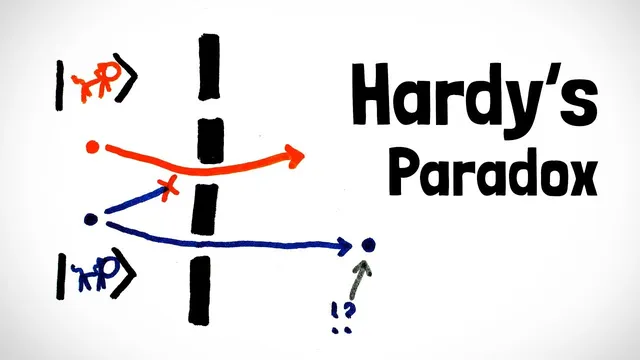
Hardy's Paradox | Quantum Double Double Slit Experiment
Based on minutephysics's video on YouTube. If you like this content, support the original creators by watching, liking and subscribing to their content.
In the standard double-slit setup, destructive interference creates detection regions with zero probability for a single quantum particle.
Briefing
Hardy’s paradox emerges from a “double double-slit” setup where two quantum particles share a slit and, despite each particle individually producing destructive interference (so certain wall spots should be impossible), simultaneous shots can yield events in those previously forbidden regions. The core finding is that the interference pattern changes when both particles are present together, making it possible—without violating quantum mechanics—for both particles to land in locations that would be “cat-dark” if either particle were sent alone.
In the standard double-slit experiment, wave-like superposition through two slits produces bright and dark regions on a detection wall. Quantum particles reproduce the same logic: a single particle’s probability distribution comes from interference between the amplitudes for passing through each slit. In the transcript’s “cat” version, sending one cat repeatedly yields “cat darkness” at some points because the cat’s wavefunction interferes with itself to give zero probability there.
The twist comes when a second, competing double-slit experiment is added. The second cat shares one of the slits with the first setup. When the two cats are sent one at a time, the shared slit still enforces destructive interference, so the same “cat-dark” points remain impossible for each individual cat. But when the cats are sent simultaneously, the shared slit becomes a mutual constraint: the top cat and bottom cat can’t both traverse the middle/shared slit at the same time. The transcript frames this as either a geometric impossibility (two cats can’t fit) or a physics-based impossibility (an antimatter version would annihilate if both attempt the shared path). Either way, the joint quantum state lacks the “both cats in the middle” component.
That missing component matters because interference depends on which path combinations exist in the superposition. With the “both in the middle” option removed, the remaining superposition terms—top cat through top/middle, bottom cat through bottom/middle, and top/bottom combinations that avoid simultaneous middle traversal—produce a different interference pattern on the wall. The result is that probability can reappear in regions that were previously dark for each cat individually.
The paradoxical tension is then spelled out using a logic chain tied to interference. If the bottom cat lands in a previously dark spot, it must not have been able to interfere with itself, implying it did not traverse both slits; instead, the other cat must have blocked the shared middle slit. Similarly, if the top cat lands in its own previously dark spot, the bottom cat must have blocked the middle slit. Yet the experiment sometimes yields both cats in their respective “forbidden” regions simultaneously, which would require each cat to have blocked the middle slit at the same time—something that seems impossible because the cats can’t both occupy the shared middle path.
Despite the name, the transcript emphasizes that the setup is fully consistent with quantum mechanics: superposition and interference work together in a way that can generate outcomes that look contradictory under classical, locally realistic reasoning. The takeaway is less about a failure of physics and more about how quantum superposition can make “paradox” outcomes real while still matching experimental predictions.
Cornell Notes
Hardy’s paradox arises in a double double-slit experiment where two quantum particles share a slit. Sent individually, each particle’s wavefunction interferes with itself so certain detection regions on the wall have zero probability (“cat darkness”). When both particles are sent simultaneously, the shared slit cannot be traversed by both at once, so the joint superposition lacks the “both in the middle” path. Removing that path changes the interference pattern, allowing both particles to sometimes land in regions that were forbidden when either particle was sent alone. The apparent contradiction comes from applying classical logic about blocking and interference to outcomes that quantum mechanics permits through superposition.
Why do “cat-dark” regions appear in the ordinary double-slit experiment?
What changes when a second cat shares one slit with the first setup?
How does removing the “both in the middle” component alter the interference pattern?
Why does the outcome look paradoxical under classical reasoning?
Why is the situation still consistent with quantum mechanics?
Review Questions
- In the transcript’s logic, what specific path component is absent from the joint superposition when both cats are sent simultaneously, and why is it absent?
- Explain how destructive interference for a single particle leads to zero probability at certain wall points, and then describe what changes when two particles are present.
- What classical inference about “blocking” becomes inconsistent with the observed simultaneous detections in Hardy’s paradox?
Key Points
- 1
In the standard double-slit setup, destructive interference creates detection regions with zero probability for a single quantum particle.
- 2
Hardy’s paradox uses two simultaneous double-slit experiments that share a middle slit, making simultaneous middle traversal impossible.
- 3
When both particles are sent together, the joint superposition lacks the “both in the middle” path, which changes the interference pattern.
- 4
The changed interference can produce detections in regions that were previously forbidden (“cat-dark”) when either particle was sent alone.
- 5
The paradox arises when classical blocking logic is applied to quantum interference outcomes, leading to an apparent contradiction.
- 6
Quantum mechanics remains consistent because the full multi-particle superposition governs interference, not classical either-or path reasoning.