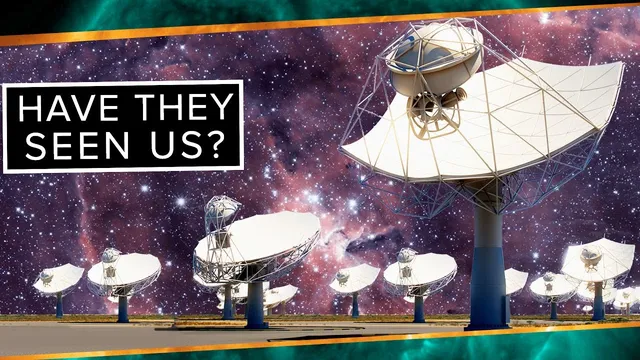
Have They Seen Us? | Space Time | PBS Digital Studios
Based on PBS Space Time's video on YouTube. If you like this content, support the original creators by watching, liking and subscribing to their content.
Earth’s radio transmissions have expanded into a light-speed bubble, with the outer edge now beyond 100 light-years and a brighter shell around 80 light-years carrying recognizable historical broadcasts.
Briefing
Earth’s century-long radio transmissions have expanded into a light-speed “bubble” that now reaches thousands of star systems, raising a sharp question: which alien civilizations could realistically detect it—and even decode it? The core constraint is timing and technology. A nearby, technologically advanced civilization would have seen Earth as radio-quiet until roughly a century ago, when wireless experiments and then TV and radar turned the planet into a continuous, detectable source. That chatter spreads outward at the speed of light, with the outer edge now more than 100 light-years away and carrying early broadcast milestones, including Marconi’s first transatlantic radio transmission. Closer in, a brighter shell—about 80 light-years out—includes recognizable cultural broadcasts such as the 1936 Berlin Olympics, episodes of “The Lone Ranger,” and Orson Welles’ “War of the Worlds.” If an alien receiver can isolate narrow, artificial signals from the cosmic and local noise, Earth becomes a candidate technological target.
The transcript then pivots from “who might see us?” to “who could we see?” SETI searches since the 1960s have mostly targeted a quiet radio region nicknamed the “water hole,” between hydrogen and hydroxyl emission lines, roughly within 1–10 gigahertz. Those efforts—using major radio telescopes such as Arecibo and Parkes—have largely found nothing repeatable, with the famous exception of the 1977 “Wow!” signal, a narrowband burst that still lacks a broadly accepted explanation. The searches also highlight a key asymmetry: detecting intentional beacons is easier than detecting unintentional leakage. A targeted beacon could be strong enough to notice at large distances, but leakage from ordinary broadcasts would only be detectable at very short ranges unless the alien transmitter power and receiver sensitivity are far beyond ours.
That’s where the Square Kilometer Array (SKA) enters as a potential game-changer. SKA is designed primarily for cosmology—catching redshifted hydrogen emission from the early universe at 21 centimeters (1420 megahertz)—but its interferometry architecture makes it unusually good at filtering out local radio noise. By combining thousands of dishes in Africa and hundreds of thousands of antennas in Australia, SKA would act like a giant telescope with over a square kilometer of collecting area and extremely fine angular resolution. Calculations by Avi Loeb and Matias Zaldarriaga suggest SKA could detect Earth’s TV “bubble” from 100 light-years or more, but detection would not equal decoding. Artificial signals would likely appear as narrow frequency spikes that drift due to Doppler shifts from orbital motion—enough to flag technology, not enough to reconstruct content.
Decoding requires vastly more collecting power and faster sensitivity than SKA’s month-long integration. The transcript estimates that tuning in to something like the first season of “Star Trek” at 50 light-years would demand a telescope trillions of times larger in effective area—an investment more consistent with a Type II civilization. Even so, probability cuts both ways: Earth’s radio footprint covers only a few thousand stars, so another civilization close enough to have noticed us may be rare. Still, any civilization within roughly 40–50 light-years could have sent a return signal that might reach us soon, meaning “first contact” could arrive as a delayed reply rather than a newly detected broadcast. The episode closes by shifting to follow-up questions about black holes and event horizons, but the central takeaway remains: the universe may already be carrying faint traces of Earth, waiting for the right kind of receiver to separate them from noise.
Cornell Notes
Earth’s radio transmissions from about a century ago have expanded into a galaxy-wide “bubble” of artificial radio noise, reaching thousands of star systems. SETI searches have mostly targeted the “water hole” (a quiet band between hydrogen and hydroxyl lines) and have found little repeatable evidence of alien signals, with the notable but unexplained 1977 “Wow!” burst. The Square Kilometer Array (SKA), built mainly to study early-universe hydrogen, could use interferometry to filter out local noise and potentially detect Earth’s TV bubble from 100+ light-years away. However, detection would likely stop at identifying narrowband, Doppler-shifted artificial emission—not decoding programs—unless an alien civilization had far greater collecting area and much faster sensitivity than SKA.
Why does Earth’s “radio bubble” become detectable only after about a century, and how far has it spread?
What is the “water hole,” and why has SETI focused on it?
Why is detecting unintentional radio leakage harder than detecting a deliberate beacon?
How does interferometry help separate alien signals from Earth’s own radio noise?
What would SKA likely be able to do for detecting Earth, and what would it probably not be able to do?
What scale of telescope would be needed to actually decode a distant TV show?
Review Questions
- What assumptions about signal strength and receiver sensitivity determine whether an alien civilization would detect Earth’s radio leakage versus a deliberate beacon?
- Why does the “water hole” strategy depend on natural radio quietness, and how did early SETI results (including the “Wow!” signal) shape expectations?
- What technical limitation separates “detecting” an artificial radio source from “decoding” the information it carries?
Key Points
- 1
Earth’s radio transmissions have expanded into a light-speed bubble, with the outer edge now beyond 100 light-years and a brighter shell around 80 light-years carrying recognizable historical broadcasts.
- 2
SETI’s “water hole” searches target a relatively quiet band between hydrogen and hydroxyl emission lines, but decades of targeted listening have produced few repeatable detections.
- 3
Unintentional radio leakage is far harder to detect than intentional beacons because leakage strength drops with distance and would only stand out at very short ranges for receivers comparable to current capabilities.
- 4
Interferometry—using widely separated radio telescopes—can filter out local transmissions, making it easier to isolate distant artificial signals that overlap in frequency with Earth’s own broadcasts.
- 5
The Square Kilometer Array (SKA) is designed for early-universe hydrogen studies, but its extreme sensitivity and noise rejection could also detect Earth’s TV bubble from 100+ light-years away.
- 6
Detecting a technological source likely requires long integration and would reveal narrowband, Doppler-shifted spikes; decoding broadcast content would demand vastly greater collecting area and much faster sensitivity than SKA.
- 7
Even if detection is possible, the chance of another civilization being close enough to notice Earth may be limited because Earth’s radio footprint covers only a few thousand stars. If another civilization exists within 40–50 light-years, a return signal could reach us soon.