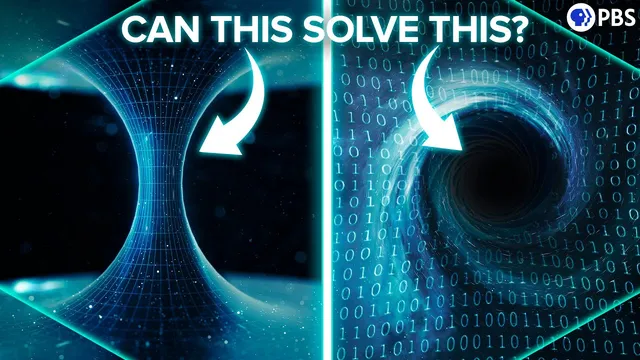
Have We SOLVED The Black Hole Information Paradox with Wormholes?
Based on PBS Space Time's video on YouTube. If you like this content, support the original creators by watching, liking and subscribing to their content.
Hawking’s evaporation picture appears to erase information, conflicting with quantum mechanics’ requirement of unitary quantum-information conservation.
Briefing
The most consequential claim emerging from recent work on the black hole information paradox is that Hawking radiation can recover the correct quantum-information accounting—specifically, by reproducing the Page curve—without relying on string theory. The mechanism hinges on treating gravity with a “gravitational path integral” that sums not just over ordinary spacetime histories, but also over exotic spacetime topologies that effectively behave like wormholes connecting multiple copies (“replicas”) of an evaporating black hole. If that calculation is right, the von Neumann entropy of the radiation rises at first and then turns over, matching what unitary quantum mechanics demands.
The paradox begins with Hawking’s result that black holes radiate and slowly evaporate, seemingly erasing the information that formed them. In the standard picture, Hawking radiation is thermal and carries no detailed correlations with the interior, consistent with the no-hair theorem. But quantum mechanics requires conservation of quantum information, which can be tracked through entanglement entropy. As a black hole evaporates, the interior shrinks while the radiation grows; under Hawking’s original assumptions, the entanglement entropy of the radiation would keep increasing, leaving a permanent, unrecoverable entropy—an apparent violation of unitarity.
Earlier resolution attempts tried to encode information directly into the outgoing radiation so that each new quantum is entangled with earlier emissions. That logic leads to the Page curve, named after physicist Don Page: the entropy of the radiation should increase until roughly half the black hole’s lifetime, then decrease as information begins to leak out in a way that restores unitarity. Any successful theory must reproduce that exact entropy evolution.
For years, the most powerful route to the Page curve came from holography, especially AdS/CFT correspondence, where calculations in a higher-dimensional gravitational setting map to a lower-dimensional quantum field theory. Yet AdS/CFT depends on assumptions that may not apply to our universe, and it also rests on string theory. In 2020, two teams—described as “east-coast” and “west-coast”—reported Page-curve predictions using only general relativity and accepted quantum mechanics, drawing on holographic insights but avoiding AdS/CFT’s strongest assumptions.
The key technical move is the gravitational path integral, the gravitational analog of Feynman’s path integral. Instead of summing over particle trajectories, it sums over spacetime geometries, including transitions that are classically implausible. To compute von Neumann entropy, the work uses Rényi entropies via the replica trick: one calculates entropy for n identical black hole replicas and then takes the limit as n approaches 1. Most geometries treat replicas as independent and reproduce Hawking’s original entropy behavior. But an additional class of geometries—where replicas are connected by wormhole-like topologies—changes the answer.
In these “replica wormhole” configurations, regions of the interior across replicas can be effectively replaced by “islands,” and the resulting entropy formula is known as the island rule. Remarkably, even though wormholes seem to vanish in the single-replica limit, the mathematical imprint of their possibility survives. Using this framework, researchers find that the radiation’s von Neumann entropy follows the Page curve exactly, implying that information can escape from the black hole interior through these non-classical contributions.
Whether this constitutes a true physical resolution remains contested. The calculations are sophisticated and have drawn skepticism about certain mathematical steps. Still, the replica-wormhole/island-rule framework has triggered a surge of follow-up work, effectively turning the problem into a broader theoretical search over which spacetime topologies correctly capture quantum gravity’s information flow.
Cornell Notes
Recent 2020 calculations reproduce the Page curve for black hole evaporation using only general relativity plus standard quantum mechanics. The method uses a gravitational path integral summed over many spacetime geometries, including topologies that act like wormholes connecting multiple replicas of an evaporating black hole. Through the replica trick (Rényi entropies with n copies, then taking n→1), a new contribution appears: “replica wormholes” create “islands” that change the entropy formula. The resulting von Neumann entropy of Hawking radiation rises and then decreases exactly as the Page curve predicts, aligning with unitary quantum information conservation. The physical interpretation is still unclear, and parts of the approach remain debated, but it has become a central direction for resolving the paradox.
What exactly makes the black hole information paradox a quantum-information problem rather than just a thermodynamics puzzle?
Why does matching the Page curve become a “must” for any proposed resolution?
How do gravitational path integrals change what counts as a relevant spacetime history?
What role do the replica trick and Rényi entropies play in deriving the island rule?
Why do wormholes matter even when the calculation is ultimately reduced to a single black hole?
What is the current status of the replica-wormhole/island-rule approach—solved or unresolved?
Review Questions
- How does entanglement entropy (von Neumann entropy) diagnose the information paradox during black hole evaporation?
- What is the Page curve, and why does reproducing it constrain any viable resolution?
- In the replica trick approach, what changes when the gravitational path integral includes replica wormhole topologies?
Key Points
- 1
Hawking’s evaporation picture appears to erase information, conflicting with quantum mechanics’ requirement of unitary quantum-information conservation.
- 2
The paradox can be framed using von Neumann entropy as entanglement entropy, tracking how correlations shift between the black hole interior and the emitted radiation.
- 3
Any resolution must reproduce the Page curve, the specific entropy evolution required for information to escape consistently with unitarity.
- 4
The 2020 approach uses a gravitational path integral that sums over spacetime geometries, including exotic topologies that effectively generate wormhole connections.
- 5
The replica trick computes Rényi entropies for n black hole copies and takes the limit n→1; connected replica topologies introduce “islands” that alter the entropy formula.
- 6
Using the island rule within this framework yields a von Neumann entropy that matches the Page curve exactly, suggesting information can leak out through non-classical contributions.
- 7
Despite the success in reproducing the Page curve, the physical interpretation and some mathematical steps remain debated, driving ongoing research.