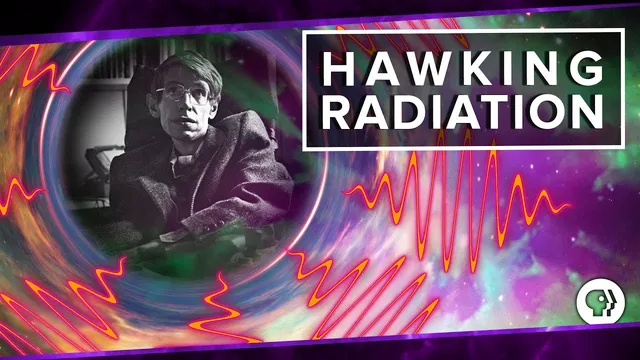
Hawking Radiation
Based on PBS Space Time's video on YouTube. If you like this content, support the original creators by watching, liking and subscribing to their content.
General relativity predicts event horizons are one-way boundaries, so classical black holes should not lose mass.
Briefing
Black holes aren’t perfectly black: quantum effects in curved spacetime make them emit radiation and slowly evaporate. That insight, first formalized by Stephen Hawking in 1974 and refined in 1975, overturned the earlier expectation from general relativity that an event horizon would trap everything forever.
The story begins with Einstein’s general relativity, which allows catastrophic gravitational collapse. When matter becomes dense enough, spacetime can be dragged inward so strongly that an event horizon forms—a one-way boundary in spacetime. Once inside, nothing can return to the outside universe, so black holes seemed destined to grow without end. Hawking’s key move was to combine quantum mechanics with this curved spacetime setting, even though a complete theory of quantum gravity didn’t exist.
A popular explanation imagines empty space “seething” with virtual particle–antiparticle pairs. Near an event horizon, one partner is swallowed while the other escapes, and the black hole “pays” for the energy budget by losing mass. The transcript treats this as a useful heuristic, but not the most accurate description of Hawking’s original calculation.
Hawking’s approach relies on quantum field theory in curved spacetime. In flat space, quantum fields in a vacuum state have a balance between positive- and negative-frequency modes, so fluctuations cancel and no real particles appear. Curvature and horizons disrupt that balance: horizons cut off access to certain field modes, changing what counts as “vacuum.” Hawking then considers a special lightlike path (a null geodesic) that skims the moment just before the event horizon forms. A quantum field assumed to be in vacuum before the black hole forms evolves so that, when traced back out to distant flat space, the field fluctuations look like real particles to a faraway observer.
Because there was no full quantum gravity theory, Hawking used a workaround: Bogoliubov transformations. These mathematical tools effectively describe how curved spacetime mixes positive- and negative-frequency modes when regions of spacetime are matched across the black hole’s formation. The result is that some modes are scattered and lost behind the horizon, while others escape. The “missing” modes distort the vacuum state, and the escaping radiation has a characteristic wavelength comparable to the black hole’s size—so larger black holes radiate at lower frequencies and appear colder, while smaller ones radiate more intensely.
Crucially, Hawking’s calculation yields a spectrum matching thermal radiation. The apparent temperature depends on the black hole’s mass (and is tied to the event horizon’s properties), implying that black holes should evaporate over time.
The transcript also notes why the simple pair-splitting picture is incomplete: the radiation isn’t localized to a tiny patch of the horizon. Its wavelengths are set by the horizon scale, and an infalling observer would see a locally flat vacuum with no dramatic particle creation at the horizon. Still, the core conclusion survives multiple derivations. In 2001, Parikh and Wilczek reproduced the same thermal spectrum using quantum tunneling, reinforcing the idea that quantum uncertainty—whether in energy or in spacetime trajectories—drives particle emission.
Even so, the calculations remain “hacks” in the absence of quantum gravity. The fate of the trapped modes, how evaporation reduces mass rather than increases it, and the information paradox—where Hawking radiation seems to erase quantum information—remain unresolved. For now, the central takeaway stands: black holes radiate, and that radiation implies they evaporate.
Cornell Notes
Hawking radiation arises because quantum fields in curved spacetime do not preserve the flat-space notion of vacuum. In ordinary space, positive- and negative-frequency modes balance so fluctuations cancel; near a forming event horizon, that balance breaks as horizons remove access to certain modes. Hawking used Bogoliubov transformations to track how the vacuum state evolves across the black hole’s formation, finding that the escaping radiation has a thermal spectrum. The radiation’s wavelength is tied to the event horizon size, so massive black holes radiate slowly and appear cold, while smaller ones radiate more strongly and appear hot. Multiple independent derivations (including quantum tunneling) reproduce the same thermal result, but the deeper explanation awaits a complete quantum theory of gravity.
Why did general relativity alone suggest black holes should never shrink?
What changes in quantum fields when spacetime curvature and horizons appear?
How do Bogoliubov transformations fit into Hawking’s calculation?
Why does the radiation look thermal, and how does temperature depend on black hole mass?
What’s the limitation of the common “virtual particle pairs split by the horizon” story?
What supports the robustness of Hawking’s result beyond the original derivation?
Review Questions
- How does the horizon disrupt the vacuum-state balance of positive- and negative-frequency modes in quantum field theory?
- What role do Bogoliubov transformations play in turning vacuum fluctuations into an outgoing thermal spectrum?
- Why does the radiation’s wavelength being comparable to the event horizon size undermine a strictly local “pair-splitting at the horizon” picture?
Key Points
- 1
General relativity predicts event horizons are one-way boundaries, so classical black holes should not lose mass.
- 2
Hawking radiation emerges from quantum fields in curved spacetime, where horizons break the flat-space vacuum balance between positive- and negative-frequency modes.
- 3
Bogoliubov transformations provide a practical method to approximate how curved spacetime mixes field modes during black hole formation.
- 4
The escaping radiation has a thermal spectrum whose apparent temperature depends on black hole mass, making small black holes hotter and large ones colder.
- 5
The radiation is not sharply localized to the horizon; its wavelength scale implies large quantum uncertainty and a locally vacuum-like experience for infalling observers.
- 6
Multiple derivations, including Parikh and Wilczek’s quantum tunneling approach, reproduce the same thermal result, suggesting the effect is robust.
- 7
A complete explanation still requires quantum gravity, leaving open questions about trapped modes, evaporation mechanics, and the information paradox.