Helping a Professional Learn Faster - Private Coaching Call
Based on Justin Sung's video on YouTube. If you like this content, support the original creators by watching, liking and subscribing to their content.
Overwhelm often signals missing anchor knowledge: new information feels unusable when it can’t connect to existing mental patterns.
Briefing
Learning while working full-time—especially when the subject is technical and constantly changing—breaks down for two predictable reasons: learners don’t have enough structured “anchor knowledge” to make new information feel connected, and they often consume information without converting it into usable skill. In a coaching call with a non-technical startup employee trying to learn AI, the central fix is to treat overwhelm and poor results as signals about missing connections, then build expertise in layers so new developments slot into an expanding mental map.
Julian’s problems were concrete: no clear curriculum at a startup, information overload from daily AI headlines and tools, and a frustrating gap between conceptual understanding and job-ready outcomes. The coaching reframed overwhelm as a brain-level pattern recognition issue. When someone lacks baseline expertise, new facts arrive without obvious links to existing knowledge, so the mind interprets them as “I don’t know what to do with this.” Experts feel less overwhelmed because their internal network already provides relevance—new ideas look like extensions, similarities, or predictable impacts.
That leads to the first practical principle: build a foundation that creates “anchor points of relevance.” Starting from ground-zero resources like first-principles textbooks is one route, but the coaching warns that much of that learning becomes irrelevant if it’s not structured around how it will later be used. Julian’s current approach—skimming AI overviews, using ChatGPT for key concepts, and mind-mapping connections—was judged as strong for building a big-picture frame. The weak spot was timing: applying the knowledge too quickly before adding enough lower-level detail to make it actionable.
The recommended adjustment is a layered learning loop. Keep the big-picture mapping, but delay immediate application by inserting a “seeking” phase: spend a few hours (then expand to days) deliberately hunting for the lowest-hanging points of relevance—small, concrete gaps that matter for real work. After each seeking block, calibrate by testing whether the new understanding changes how problems are solved. If application still feels disconnected, either more depth is needed or the connections aren’t forming correctly.
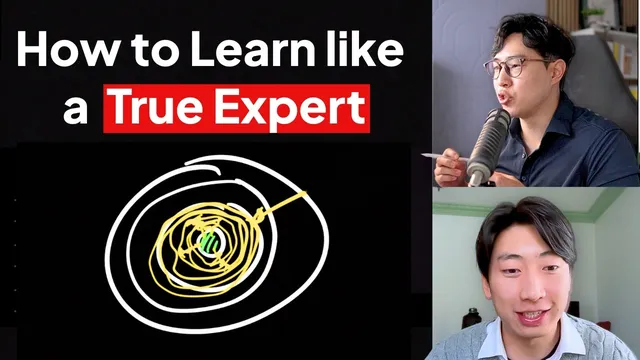
Two learning strategies are contrasted. A problem-based, task-first approach can deliver faster short-term output by filling gaps needed for a specific deliverable, but it can produce a narrow “wedge” of expertise and increases the risk of errors in the underlying schema. A relevance-led, broader approach builds holistic expertise more slowly but more safely—like concentric layers that start shallow and become increasingly detailed as connections grow. The coaching argues that for high-stakes, complex decision-making under time pressure, the narrow approach can be tempting, yet it often costs more later because it delays the broader expertise required to handle unpredictable future problems.
Finally, the call addresses using AI tools to learn. The guiding rule is “save time, not effort.” AI can speed up low-effort tasks (keyword extraction, summarizing transcripts, generating alternative perspectives), but it should not replace the cognitive work that creates durable understanding—especially for beginners. Overreliance can create an “understanding trap,” where content sounds right but fails to stick because the learner didn’t do the mental work of building connections. The coaching recommends using AI as an assistant to thinking—challenging assumptions, suggesting missing perspectives—while still making the key decisions personally and repeatedly testing recall and performance to detect when learning has been offloaded rather than internalized.
Cornell Notes
The coaching frames learning overwhelm as a lack of existing knowledge connections: when new information can’t be mapped onto prior expertise, the brain treats it as unusable and feels overwhelmed. Julian’s big-picture AI mapping (skimming, ChatGPT prompts, mind maps) was seen as a strong start, but applying too soon left him without enough lower-level detail to use AI effectively at work. The recommended method is a layered loop: build a high-level frame, then delay application to “seek” the lowest-hanging points of relevance, filling specific gaps for a few hours or days before testing whether problem-solving improves. Over time, this creates a snowball effect where new details connect quickly, improving retention and job performance. AI tools can help with time-saving tasks, but beginners should avoid offloading the cognitive work that builds durable understanding.
Why does information overload feel worse for someone without a technical background?
What’s the core difference between Julian’s current approach and the improved one?
How does the coaching suggest calibrating whether learning is actually working?
When should a learner use problem-based learning versus relevance-led learning?
What does “save time, not effort” mean for using AI tools while learning?
How can mind maps help, and what limitation is emphasized?
Review Questions
- How does the coaching define overwhelm, and what mental mechanism is responsible for it?
- Describe the layered learning loop recommended for Julian. What happens before application, and how is calibration performed?
- What are the risks of using AI to generate explanations or analogies for a beginner, and how does testing help detect those risks?
Key Points
- 1
Overwhelm often signals missing anchor knowledge: new information feels unusable when it can’t connect to existing mental patterns.
- 2
Build a big-picture frame first, but delay immediate application until lower-level “points of relevance” are filled.
- 3
Use a layered loop: seek lowest-hanging relevance for a few hours (then expand to days), then test whether application and problem-solving actually improve.
- 4
Differentiate knowledge gaps from connection gaps: a mind map can reveal missing depth, while poor recall during use can reveal weak integration.
- 5
Problem-based learning can deliver faster short-term outputs, but relevance-led learning builds broader expertise more safely for unpredictable, high-stakes decisions.
- 6
AI tools should save time on low-effort tasks, not replace the cognitive effort that creates durable understanding—especially for beginners.
- 7
Regular calibration via testing is essential to ensure learning changes performance rather than producing “sophisticated photocopies” of AI instructions.