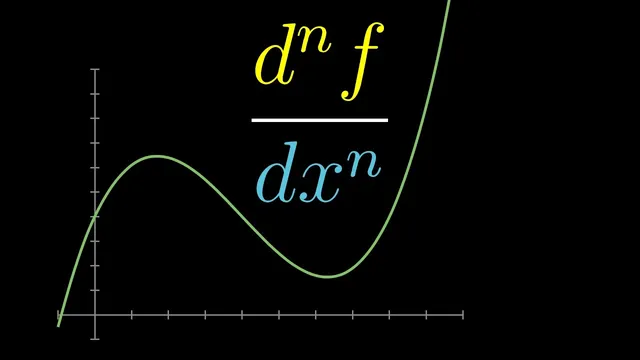
Higher order derivatives | Chapter 10, Essence of calculus
Based on 3Blue1Brown's video on YouTube. If you like this content, support the original creators by watching, liking and subscribing to their content.
The second derivative d²f/dx² measures how the slope (first derivative) changes with x, not just the slope itself.
Briefing
Higher order derivatives—especially the second derivative—are best understood as “derivatives of derivatives”: they measure how a function’s slope changes, and that shift in slope translates directly into physical acceleration. The second derivative of a function f(x) is positive where the graph curves upward because the slope is increasing, and negative where the graph curves downward because the slope is decreasing. Where the graph has little or no curvature, the second derivative drops to 0. This curvature-based sign rule lets you read second-derivative behavior straight off a graph: a point where the slope ramps up quickly corresponds to a large positive second derivative, while a point where the slope still increases but more gently corresponds to a smaller positive second derivative.
The notation reinforces the “change of change” idea. Writing d²f/dx² means: take two tiny steps in x, each of size dx. The first step produces a small change in the function (df1), and the second step produces another small change (df2). The difference between those changes—denoted ddf—captures how the function’s rate of change itself shifts. The second derivative is then the size of that “change to the change” divided by dx², interpreted as a limit as dx shrinks toward 0. In other words, d²f/dx² is not just a ratio for finite steps; it’s the ratio that the finite-step approximation approaches in the infinitesimal limit.
That geometric picture becomes especially concrete in motion. If a function gives distance traveled versus time, then its first derivative is velocity. The second derivative is acceleration: it tells how quickly velocity is increasing or decreasing. A distance graph that rises steadily can still produce different acceleration patterns—such as a “bump” in velocity where velocity climbs to a maximum and then falls back toward zero—because acceleration corresponds to the slope of the velocity curve. The third derivative is then the next layer up: it’s called jerk, and a nonzero jerk means the acceleration’s strength is changing over time. So while acceleration describes how the motion is being pushed, jerk describes how that push is itself varying.
Beyond intuition, higher order derivatives matter because they feed into function approximation. Taylor series rely on successive derivatives to build increasingly accurate polynomial approximations. The second derivative indicates whether the function is speeding up or slowing down (positive vs. negative acceleration), while the third derivative (jerk) captures how the acceleration trend is changing. That chain of derivative information is exactly what the next chapter on Taylor series will leverage, turning curvature and its higher-order variations into practical approximations.
Cornell Notes
Higher order derivatives extend the idea of “slope” to “how slopes change.” The second derivative d²f/dx² measures the change in the first derivative as x changes, and its sign matches graph curvature: upward curvature means the slope increases (second derivative positive), downward curvature means the slope decreases (second derivative negative), and flat/linear regions give second derivative 0. In motion problems where distance is a function of time, the first derivative is velocity and the second derivative is acceleration. The third derivative is jerk, which indicates whether acceleration itself is changing. These derivatives also become the ingredients for Taylor series, which approximate functions using successive derivative information.
How can someone tell whether the second derivative is positive, negative, or zero just by looking at a graph?
What does the notation d²f/dx² mean in terms of “change of change”?
In a distance-versus-time scenario, how do derivatives translate into physical quantities?
What does the third derivative represent, and why is it called jerk?
Why are higher order derivatives useful for approximating functions?
Review Questions
- When does the second derivative become 0, and what does that imply about the slope of the original function?
- Using the “two tiny steps” interpretation, what quantity does d²f/dx² measure relative to df and dx?
- In motion terms, what physical meaning does the third derivative (jerk) have, and how does it relate to acceleration?
Key Points
- 1
The second derivative d²f/dx² measures how the slope (first derivative) changes with x, not just the slope itself.
- 2
Upward curvature on f(x) corresponds to a positive second derivative because the slope increases; downward curvature corresponds to a negative second derivative because the slope decreases.
- 3
Regions with little curvature behave like linear segments, where the second derivative is approximately 0.
- 4
The notation d²f/dx² can be interpreted by taking two small x-steps of size dx and forming a “change to the change” ratio that approaches a limit as dx → 0.
- 5
In distance-versus-time problems, the first derivative is velocity and the second derivative is acceleration.
- 6
The third derivative is jerk: a nonzero jerk means acceleration’s magnitude is changing over time.
- 7
Higher order derivatives are the building blocks for Taylor series, enabling polynomial approximations that incorporate curvature and beyond.