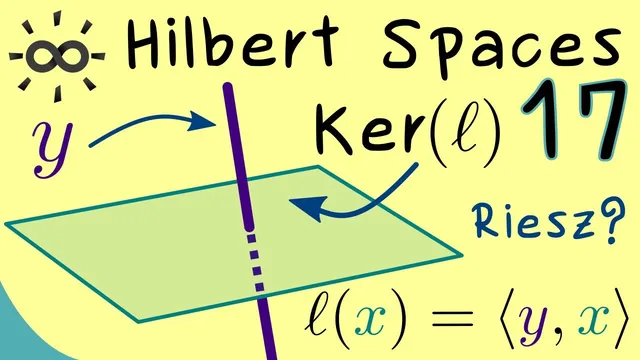
Hilbert Spaces 17 | Riesz Representation Theorem
Based on The Bright Side of Mathematics's video on YouTube. If you like this content, support the original creators by watching, liking and subscribing to their content.
A bounded linear functional L on a Hilbert space satisfies .
Briefing
Riesz representation turns every bounded linear functional on a Hilbert space into an inner product with a single fixed vector—complete with uniqueness and an exact match of norms. That matters because it converts an abstract “function that eats vectors and spits out scalars” into a concrete geometric object inside the space, setting up later operator-theory arguments.
Start with a Hilbert space X over a field F (real or complex). A functional is a linear map L: X → F that is continuous, equivalently bounded—meaning its operator norm stays finite: . In an example from , a functional can take a sequence x = (x1, x2, …) and return a scalar like x1 + 2x2. Boundedness follows from the norm constraint: if , then each component cannot exceed 1 in absolute value, giving a finite bound (here, at most 3).
The key insight is that such a functional can be rewritten using the inner product. In , the coordinate functionals are realized by inner products with standard basis vectors: the first component is , the second is . So the functional x1 + 2x2 becomes . The Riesz representation theorem generalizes this: for any Hilbert space X and any bounded linear functional L, there exists a unique vector y in X such that Moreover, the functional’s operator norm equals the vector norm: . In other words, the representation preserves the “size” of the functional.
The proof strategy leans on orthogonality. The kernel of a continuous linear map is always a closed linear subspace, which allows use of orthogonal complements. If the kernel is all of X, then L is the zero map and y = 0 works immediately. Otherwise, the orthogonal complement of the kernel is nontrivial, so one can pick a unit vector z orthogonal to ker(L). Because z is not in the kernel, L(z) ≠ 0. Scaling z by the complex conjugate of L(z) (in the complex case) produces a vector y that forces to match L(x) for every x.
Uniqueness is straightforward: if two vectors y and both satisfy for all x, then for every x, forcing y = by positive definiteness of the inner product.
Finally, the norm identity follows from Cauchy–Schwarz. With , one gets , so . The reverse inequality comes by testing x in the direction of y (normalized), yielding . Together these give . The result turns functional analysis into geometry inside Hilbert spaces, paving the way for studying operators built from these inner-product structures.
Cornell Notes
Riesz representation theorem says that every bounded linear functional L on a Hilbert space X can be written uniquely as an inner product with a fixed vector y in X: L(x)=⟨y,x⟩ for all x. The theorem also matches sizes exactly: the operator norm of L equals the norm of y, so \|L\|=\|y\|. The construction uses orthogonal complements: if ker(L) is not all of X, pick a unit vector z orthogonal to ker(L), scale it using L(z) (with complex conjugation in the complex case), and obtain y. Uniqueness follows because if ⟨y−ỹ,x⟩=0 for all x, then y−ỹ must be the zero vector. Cauchy–Schwarz then yields the norm equality.
Why does continuity of a linear functional on a Hilbert space reduce to boundedness?
How does the example foreshadow Riesz representation?
What role do kernels and orthogonal complements play in the proof?
How is the representing vector y constructed when ker(L) is not all of X?
Why is the representing vector y unique?
How does Cauchy–Schwarz produce the norm identity \|L\|=\|y\|?
Review Questions
- Given a bounded linear functional L on a Hilbert space X, what is the exact formula for L(x) in terms of the representing vector y?
- Explain how the orthogonal complement of ker(L) guarantees the existence of a vector z with L(z)≠0.
- How do Cauchy–Schwarz and the choice x=y/\|y\| combine to prove \|L\|=\|y\|?
Key Points
- 1
A bounded linear functional L on a Hilbert space satisfies .
- 2
Riesz representation guarantees a unique y in X such that for all x.
- 3
If ker(L)=X, then L is the zero functional and the representing vector is y=0.
- 4
If ker(L) is a proper closed subspace, its orthogonal complement is nontrivial, enabling a construction of y from a unit vector z in (ker(L))⊥.
- 5
Uniqueness follows because ⟨y−ỹ,x⟩=0 for all x forces y=ỹ by positive definiteness.
- 6
The operator norm matches the representing vector norm exactly: .
- 7
Cauchy–Schwarz gives , and testing x in the direction of y gives the reverse inequality.