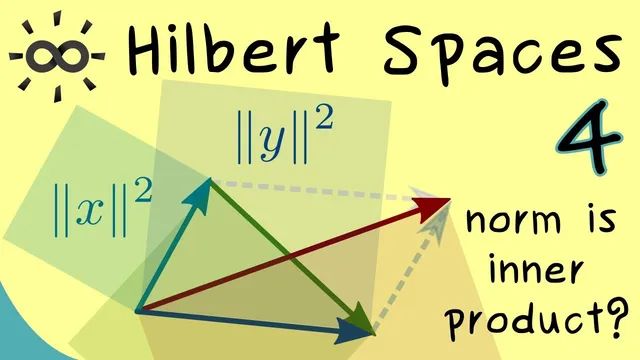
Hilbert Spaces 4 | Parallelogram Law
Based on The Bright Side of Mathematics's video on YouTube. If you like this content, support the original creators by watching, liking and subscribing to their content.
In any inner product space, the squared norm satisfies ‖x + y‖² + ‖x − y‖² = 2‖x‖² + 2‖y‖² for all vectors x and y.
Briefing
The parallelogram law links geometry to algebra: in any inner product space, the squared lengths of the sum and difference of two vectors always satisfy
‖x + y‖² + ‖x − y‖² = 2‖x‖² + 2‖y‖².
That identity matters because it turns a geometric pattern—what happens to sides in a parallelogram—into a precise constraint on the norm. The derivation is straightforward once the norm is defined from the inner product: ‖x‖ = √⟨x, x⟩. Squaring removes the square root, and expanding ‖x + y‖² and ‖x − y‖² using bilinearity (or sesquilinearity) makes the cross terms cancel, leaving only 2⟨x, x⟩ + 2⟨y, y⟩, i.e., 2‖x‖² + 2‖y‖².
The name “parallelogram law” comes from the picture: if x and y are adjacent sides, then x + y and x − y relate to the diagonals. The law can be read as a statement about how the “areas” represented by squared lengths add up. In an inner product space, the same total emerges whether one computes from the diagonal lengths (‖x + y‖ and ‖x − y‖) or from the side lengths (‖x‖ and ‖y‖), with a factor of two in the side-based expression.
More importantly, the transcript highlights a converse: the parallelogram law is so restrictive that it characterizes inner product norms. The discussion shifts to a general normed space where the norm is not assumed to come from an inner product. If that norm satisfies the parallelogram law for all vectors x and y, then the geometry still behaves “as if” it came from an inner product. In fact, there is no freedom left: one can construct an inner product on the vector space whose induced norm matches the original norm. So, while the parallelogram law itself is written purely in terms of the norm (no inner product appears in the statement), satisfying it forces the norm to be inner-product-generated.
This yields an equivalence: a norm comes from an inner product exactly when the parallelogram law holds. The transcript also points to the polarization identity as the mechanism for recovering the inner product from the norm. In the real case, the polarization identity expresses ⟨x, y⟩ using only values of the induced norm applied to combinations of x and y (such as x + y and x − y). The complex case requires a slightly longer formula with additional terms, but the same principle applies: the norm determines the inner product.
Finally, the video reframes Hilbert spaces through this lens. A Hilbert space can be viewed as a normed space where the parallelogram law holds (and, in the broader functional-analytic setting, completeness is added). The proof of the converse direction—showing that the parallelogram law guarantees an inner product—gets deferred to the next installment, but the takeaway is clear: parallelograms in normed spaces aren’t just a visual metaphor; they encode exactly the structure of inner products.
Cornell Notes
In an inner product space, the norm satisfies the parallelogram law: ‖x + y‖² + ‖x − y‖² = 2‖x‖² + 2‖y‖² for all vectors x and y. The identity follows by expanding the squared norms using the inner product’s linearity and the cancellation of cross terms. The key insight is the converse: if a normed space’s norm satisfies the parallelogram law for every x and y, then the norm must be induced by some inner product. That inner product can then be recovered from the norm via the polarization identity (with a longer expression in the complex case). This equivalence lets one characterize Hilbert spaces through the parallelogram law, alongside completeness.
Why does the parallelogram law hold automatically in any inner product space?
What geometric intuition is tied to the parallelogram law?
How can a statement that mentions only norms force the existence of an inner product?
What role does the polarization identity play?
Why does the transcript say Hilbert spaces can be viewed as special normed spaces?
Review Questions
- State the parallelogram law and explain how it follows from the definition of the norm in terms of an inner product.
- Explain the converse: what does it mean for a normed space if the parallelogram law holds for all x and y?
- How does the polarization identity relate the norm to the inner product, and why is it different in the real and complex cases?
Key Points
- 1
In any inner product space, the squared norm satisfies ‖x + y‖² + ‖x − y‖² = 2‖x‖² + 2‖y‖² for all vectors x and y.
- 2
The cancellation of mixed inner-product terms is what makes the parallelogram law work when expanding ‖x ± y‖².
- 3
The parallelogram law can be interpreted geometrically using a parallelogram whose sides correspond to x and y and whose diagonals relate to x + y and x − y.
- 4
A normed space whose norm satisfies the parallelogram law for all x and y must have a norm induced by an inner product.
- 5
The polarization identity reconstructs the inner product from the induced norm, with a shorter formula in the real case and a longer one in the complex case.
- 6
Hilbert spaces can be characterized as (complete) normed spaces where the parallelogram law holds, linking completeness to inner-product geometry.