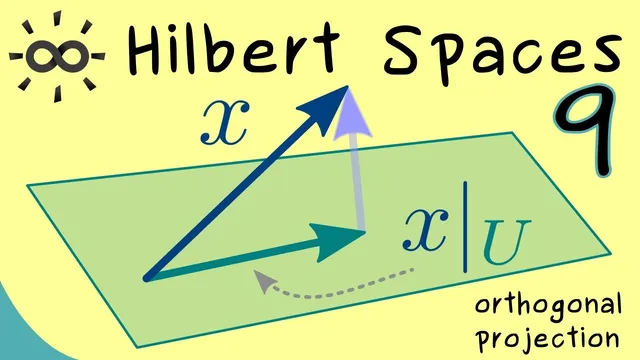
Hilbert Spaces 9 | Projection Theorem
Based on The Bright Side of Mathematics's video on YouTube. If you like this content, support the original creators by watching, liking and subscribing to their content.
Every vector x in a Hilbert space X and every closed subspace U admit a unique decomposition x = p + n with p ∈ U and n ∈ U⊥.
Briefing
Hilbert spaces guarantee a clean geometric split: every vector can be written as the sum of a component lying in a closed subspace and a component orthogonal to that entire subspace. This “projection theorem” matters because it extends the familiar linear-algebra idea of orthogonal projection to infinite-dimensional settings, where existence and uniqueness are far from automatic.
Start with a Hilbert space X and a closed subspace U (closedness is essential). For any vector x in X, there is a unique decomposition x = p + n, where p belongs to U and n belongs to the orthogonal complement U⊥. The right-angle relationship is the key geometric fact: p is orthogonal to every vector in U⊥, and equivalently n is orthogonal to every vector in U. The vector p is called the orthogonal projection of x onto U, often denoted proj_U(x) or x|_U.
Uniqueness follows from how U intersects U⊥. If a vector y lies in both U and U⊥, then it is orthogonal to itself: ⟨y, y⟩ = 0. Positive definiteness of the inner product forces y to be the zero vector, so U ∩ U⊥ = {0}. With that in hand, suppose x has two decompositions x = p + n = p~ + n~ with p, p~ in U and n, n~ in U⊥. Subtracting gives (p − p~) = (n~ − n). The left side lives in U, the right side lives in U⊥, so their common value must be in the intersection, hence must be 0. Therefore p = p~ and n = n~.
Existence is where the infinite-dimensional case earns its keep. The argument uses the approximation (best-approximation) property of Hilbert spaces: because U is closed and convex, there is a unique “closest point” p in U to x, minimizing the distance ||x − u|| over all u in U. Define n = x − p. The remaining task is to show n actually lies in U⊥, i.e., that it is orthogonal to every direction v in U.
To prove that orthogonality, the proof tests the minimizing property against perturbations of p along any v in U. Any u in U can be written as p + Λv for scalars Λ, so the distance from x to p + Λv cannot be smaller than the distance to p. Translating this inequality into inner-product form and choosing a specific scaling Λ tied to ⟨v, n⟩ forces the inequality to collapse into the statement ⟨n, v⟩ = 0 for all v in U. Since this holds for every v, n belongs to U⊥, completing the decomposition x = p + n.
With existence and uniqueness established, orthogonal projections become reliable tools in Hilbert spaces—provided the subspace being projected onto is closed. That condition is the gatekeeper that makes the best-approximation step work and, in turn, makes the projection theorem hold in full generality.
Cornell Notes
The projection theorem in Hilbert spaces says that for any vector x and any closed subspace U of a Hilbert space X, there is a unique split x = p + n where p ∈ U and n ∈ U⊥. The uniqueness comes from the fact that U ∩ U⊥ = {0}: if a vector lies in both, then ⟨y, y⟩ = 0, so y must be the zero vector. Existence relies on the best-approximation property: since U is closed (hence suitable for approximation), there is a unique p in U minimizing ||x − u||. Setting n = x − p, the minimizing inequality against perturbations p + Λv forces ⟨n, v⟩ = 0 for every v ∈ U, so n ∈ U⊥. This turns orthogonal projection into a guaranteed, well-defined operation in infinite dimensions.
Why does uniqueness of the decomposition x = p + n reduce to proving U ∩ U⊥ = {0}?
How does the best-approximation property produce the candidate projection p?
What inequality is used to prove that n = x − p lies in U⊥?
Why is testing only unit vectors v (with ||v|| = 1) enough?
How does choosing a special scalar Λ force the inequality to imply ⟨n, v⟩ = 0?
What role does closedness of U play in the theorem?
Review Questions
- State the projection theorem for a Hilbert space X and a closed subspace U, including the roles of U and U⊥.
- Explain why U ∩ U⊥ must equal {0} and how that fact proves uniqueness of the decomposition x = p + n.
- Outline how the best-approximation property leads to n = x − p being orthogonal to every v ∈ U.
Key Points
- 1
Every vector x in a Hilbert space X and every closed subspace U admit a unique decomposition x = p + n with p ∈ U and n ∈ U⊥.
- 2
The orthogonal projection of x onto U is the unique element p ∈ U such that x − p is orthogonal to all of U.
- 3
Uniqueness follows because U ∩ U⊥ = {0}, which is forced by positive definiteness of the inner product.
- 4
Existence relies on the best-approximation property: closed subspaces provide a unique closest point p to x.
- 5
Defining n = x − p, the minimizing inequality against perturbations p + Λv implies ⟨n, v⟩ = 0 for every v ∈ U.
- 6
Orthogonal projection in infinite-dimensional Hilbert spaces works for closed subspaces because approximation arguments remain valid there.
- 7
Closedness of U is not cosmetic; it is the condition that makes the closest-point step—and thus the projection—exist.