Hiring (5) - ML Teams - Full Stack Deep Learning
Based on The Full Stack's video on YouTube. If you like this content, support the original creators by watching, liking and subscribing to their content.
AI hiring is intensified by a large gap between people who can build AI systems and the broader software developer population, driving fierce competition for top talent.
Briefing
AI hiring is being squeezed by a widening talent gap: estimates suggest only thousands to a few hundred thousand people can build AI systems, far fewer than the global software developer workforce. That imbalance has turned recruiting into a high-stakes competition—described as “frenzied meat markets” driven by corporate recruiters—where ML hiring is slower, more effort-intensive, and harder than many teams expect.
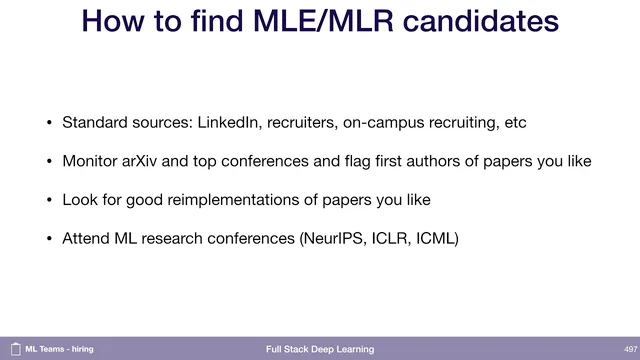
Against that backdrop, sourcing starts with where ML talent already lives. Several common ML roles can be pulled from existing hiring pipelines, but it helps to screen for a demonstrated interest in AI to increase the odds candidates have adopted the right mindsets for ML work. For other roles, the transcript warns against a “unicorn” job description that bundles everything at once: keeping up with state-of-the-art research, implementing models from scratch, deep math and model invention, building ML infrastructure and toolchains, creating data pipelines, deploying and monitoring in production, plus requirements like a PhD, years of TensorFlow experience, publications across top conferences, and experience with large-scale distributed systems. The point is not that these skills never matter—it’s that such listings filter out most qualified people and make hiring impractical.
A more workable approach is to hire for software engineering strength first, then train for machine learning. The transcript argues this is easier than before, with many undergraduates already graduating with some ML exposure. It also recommends being precise about what the role truly needs: not every ML engineer must own DevOps, for example. That specificity improves matching and reduces the temptation to demand research-level credentials for engineering jobs.
For ML researchers, the transcript shifts the evaluation lens from publication quantity to publication quality and relevance to the organization’s domain. It also favors researchers who show an instinct for important problems rather than chasing trends without business impact. When industry roles need different mindsets, adjacent-field hires can be trained into ML rather than assuming only academia produces the right talent. And PhD isn’t treated as a hard gate: ML research is described as relatively accessible, enabling strong candidates from outside “hallowed halls.”
Attracting candidates requires aligning with what practitioners want: cutting-edge tools, opportunities to learn, strong teammates, interesting datasets, and work that matters. Companies can stand out by publicizing research-adjacent efforts, empowering engineers to experiment with new technologies, and building a learning culture—illustrated by OpenAI’s “learning day,” where employees spend one day a week learning what’s useful for their jobs. Recruiting can also benefit from hiring high-profile people who draw other talent, supporting them to publish and build visibility. Finally, the transcript emphasizes interviewing discipline: rather than testing for everything, hire for strengths, validate minimum bars elsewhere (e.g., researchers’ software competence; engineers’ baseline ML understanding), and tailor tests to the role’s real needs.
Cornell Notes
AI hiring is constrained by a major talent gap, creating intense competition for ML skills and making recruiting slower and more demanding than many teams expect. The transcript recommends sourcing from existing pipelines but screening for real AI interest, then avoiding “unicorn” job descriptions that demand every skill at once. For ML engineering roles, hiring for strong software engineering first—then training for ML—can be more effective, especially when job requirements are made specific to the role’s actual needs. For ML research roles, it favors quality and relevance of publications over sheer quantity, plus an instinct for important problems. It also argues that strong candidates can come from adjacent fields and even outside PhD pathways, as long as minimum competence is verified.
Why do “unicorn” ML job descriptions tend to backfire, and what’s the alternative?
How should teams source ML talent without relying only on top conferences and PhD pipelines?
What does “quality over quantity” mean for evaluating ML researchers?
How can companies attract ML practitioners in a competitive market?
What hiring strategy does the transcript recommend during interviews and assessments?
Review Questions
- What specific elements make a job description “unicorn-like,” and how does that affect the hiring funnel?
- How would you design an evaluation plan that tests for strengths first while still enforcing minimum competence across roles?
- What signals would you use to judge whether an ML researcher’s work is likely to align with business impact rather than trends?
Key Points
- 1
AI hiring is intensified by a large gap between people who can build AI systems and the broader software developer population, driving fierce competition for top talent.
- 2
Avoid bundling every possible ML, research, and production skill into one role; instead, define responsibilities precisely and match requirements to the job.
- 3
For ML engineering roles, prioritize software engineering strength first and train for ML, since ML skills can be learned and many candidates already have some exposure.
- 4
Evaluate ML researchers by publication quality and relevance, and look for an instinct for important problems rather than trend-chasing.
- 5
Broaden sourcing beyond PhD-only pipelines by considering adjacent-field candidates and verifying software competence as a minimum bar.
- 6
Attract candidates by offering cutting-edge tools, strong teams, interesting datasets, and work that matters—then reinforce it with a learning culture (e.g., “learning day”).
- 7
During interviews, test for strengths and minimum thresholds rather than attempting to measure everything at once.