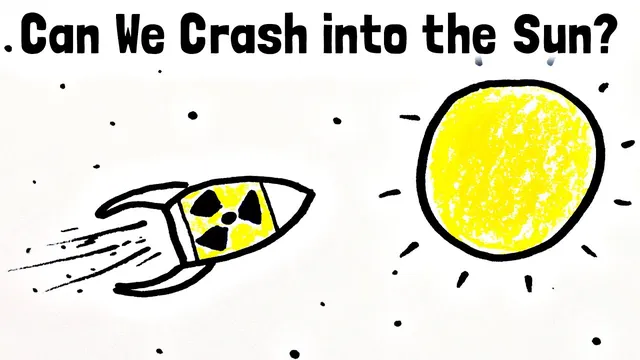
Hitting the Sun is HARD
Based on minutephysics's video on YouTube. If you like this content, support the original creators by watching, liking and subscribing to their content.
A Sun impact requires canceling sideways orbital motion, not merely moving inward under gravity.
Briefing
Sending nuclear waste into the Sun sounds like a clean solution—until physics turns it into a difficult, fuel-hungry mission. The biggest obstacle isn’t the Sun’s pull; it’s the need to cancel the sideways orbital motion that keeps everything in space from falling straight in. Earth (and anything on it) moves around the Sun at roughly 30 kilometers per second. To “sun-dive” instead of missing the target, a spacecraft must slow down enough that it stops moving around the Sun at that sideways speed—meaning it has to accelerate about 30 kilometers per second backward relative to Earth’s orbital motion. Even small leftover sideways velocity is enough to miss the Sun and whip into a new orbit.
That requirement is already extreme, but it becomes even more surprising when compared with escaping the solar system. From Earth’s orbit, escaping entirely requires only about 11 kilometers per second of additional speed. In other words, it takes less acceleration to leave the solar system than to aim precisely for a collision with the Sun. The reason is that “escape” can be achieved by reaching a threshold energy state, while a Sun impact demands a very specific trajectory: enough speed reduction to remove the sideways component without overshooting into a flyby.
The challenge also depends on where the spacecraft starts. Because orbital speed increases closer to the Sun, the “backward acceleration” needed to cancel sideways motion changes with starting orbit. Mercury orbits at about 1.5 times Earth’s speed, so crashing into the Sun from Mercury would require accelerating to roughly 48 kilometers per second backward—harder than from Earth despite being closer. Pluto, by contrast, orbits far more slowly (about one-sixth Earth’s speed), making a Sun crash much easier: only about 5 kilometers per second backward acceleration is needed.
Efficiency follows from that same logic. If the goal is to hit the Sun using rockets, it’s more efficient to first move to the outer solar system, where orbital speeds are lower, then perform a second burn to cancel the remaining sideways motion and let gravity pull the craft inward. That principle shaped early planning for NASA solar missions: initial trajectories proposed going out to Jupiter first to make the slowdown and Sun-targeting maneuver easier. Later designs shifted to using repeated Venus flybys to reduce fuel consumption while still achieving the necessary trajectory changes.
Overall, the Sun isn’t hard to reach because it’s far—it’s hard to hit because orbital motion must be precisely undone. The physics of energy and momentum makes “crash into the Sun” a much tighter target than “escape,” and mission planners have to exploit gravity assists and starting position to make the numbers workable.
Cornell Notes
Crashing into the Sun is far harder than escaping the solar system because a spacecraft must cancel its sideways orbital speed, not just move “toward” the Sun. Earth’s orbital speed is about 30 km/s, so a Sun impact requires roughly that much backward acceleration relative to Earth’s motion; even small sideways speed causes a miss. From Earth’s orbit, escaping needs only about 11 km/s, so leaving the solar system takes less acceleration than aiming for a collision. Starting farther out helps because orbital speeds are lower: Pluto needs only about 5 km/s backward acceleration, while Mercury needs about 48 km/s. Mission design therefore favors outer-solar-system approaches and gravity assists (early NASA concepts used Jupiter; later plans used repeated Venus flybys) to reduce fuel costs.
Why doesn’t gravity alone guarantee a direct fall into the Sun?
What speed change is needed for a Sun crash from Earth’s orbit?
How does the acceleration needed to crash into the Sun compare with escaping the solar system?
How do starting location and orbital speed change the difficulty of a Sun crash?
Why do gravity assists and outer-solar-system detours help mission planning?
Review Questions
- If a spacecraft reduces its speed but keeps a significant sideways velocity, what trajectory outcome is most likely?
- Why is escaping the solar system (about 11 km/s from Earth) easier than crashing into the Sun (about 30 km/s backward from Earth)?
- Compare the required backward acceleration for Mercury versus Pluto and explain how orbital speed drives that difference.
Key Points
- 1
A Sun impact requires canceling sideways orbital motion, not merely moving inward under gravity.
- 2
From Earth’s orbit, a Sun dive needs roughly 30 km/s of backward acceleration relative to Earth’s orbital speed.
- 3
Escaping the solar system from Earth’s orbit takes about 11 km/s—less than the acceleration needed to hit the Sun.
- 4
Closer starting points increase orbital speed: Mercury’s faster orbit makes a Sun crash harder (about 48 km/s backward) than from Earth.
- 5
Farther starting points reduce orbital speed: Pluto’s slow orbit makes a Sun crash easier (about 5 km/s backward).
- 6
Rocket efficiency improves by first traveling to the outer solar system, then performing a burn to remove remaining sideways motion.
- 7
Early solar-mission trajectory concepts used Jupiter to ease the slowdown; later designs relied on repeated Venus flybys to save fuel.