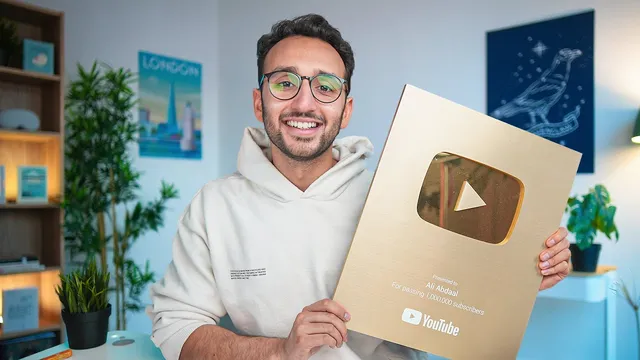
Honest YouTube Advice for 45 Minutes Straight (2026)
Based on Ali Abdaal's video on YouTube. If you like this content, support the original creators by watching, liking and subscribing to their content.
Most view-count differences come from packaging (concept, title, thumbnail, hook), not from polishing production details.
Briefing
YouTube growth, monetization, and creative consistency hinge less on “perfect production” and more on packaging—especially the title and the first seconds—paired with a sustainable way to keep making videos. Ali Abdaal’s core message is blunt: most view-count variation comes from concept-to-click packaging (title, thumbnail, hook), while the actual script, filming, and editing typically explain a smaller slice. That packaging work is also where systems and tools help most, because inspiration alone can’t reliably produce repeatable results.
Abdaal traces his own path from a stalled music-video dream to building an education channel around what he knew: getting into medical school. The turning point wasn’t better gear; it was acting while inspiration was still fresh. He describes an “inspiration half-life” effect—ideas decay quickly if execution is delayed—so the creative process must balance immediate filming with longer-term systems for idea generation.
When asked how to craft a hook, he breaks the workflow into a practical “TTH” framework: Title, Thumbnail, Hook. For his channel, the title matters most because it carries the promise of the outcome, while thumbnail design is secondary unless a creator is brand-new and lacks a recognizable format. He illustrates how hooks connect a title to the underlying concept by using a hypothetical book video: a niche topic like mimetic desire can be packaged through a more clickable framing (e.g., “watch this if you feel behind in life”), then the hook “switches” the viewer’s expectations to deliver real value.
He credits AI-assisted ideation tools—spotter studio in particular—for accelerating the title/thumbnail/hook search space. The tool helps generate ideas based on audience behavior, outliers, and what already works, plus it supports “workshopping” a chosen concept into multiple divergent variations for testing. Still, he stresses that fully engineered content doesn’t always beat “speaking from the heart.” One of his favorite recent examples came from inspiration alone: he borrowed a straightforward title (“how to get rich”) from another creator, then recorded quickly without AI ideation or A/B testing.
Beyond packaging, Abdaal argues that creators must align content with the overlap between what they want to make and what their audience wants to watch. He frames “the algorithm” as the audience’s click and watch behavior, not a mysterious force. When overlap is low—when a topic is personally meaningful but not obviously clickable—he recommends reframing it through the right niche positioning: target audience plus value proposition. He also offers tactics for creative blocks: talk to people in the target audience, use interviews/podcast-style conversations to bypass camera anxiety, and even use a voice-first workflow via his app voice pal to generate scripts from spoken ideas.
Finally, he pushes back on chasing trends and on fame as a goal. Trends can help at the macro level, but for new creators they often waste effort because the real job is delivering value to a specific person in the target audience. He also warns that work-life balance is usually impossible during the grind; the real tradeoff is strategic sacrifice. The healthiest long-term strategy is to optimize for sustainability and enjoyment—making videos when inspired—rather than treating YouTube as a constant output machine aimed at vanity metrics.
Cornell Notes
Ali Abdaal says YouTube performance is driven mostly by “packaging”: the concept, title, thumbnail, and hook. Actual production work—outline, filming, editing—matters, but it typically explains a smaller share of view-count differences than getting the click promise right. He recommends using a TTH workflow (Title, Thumbnail, Hook) where the hook connects a clickable title to the real value inside the video, sometimes by reframing the viewer’s expectations. Tools like spotter studio can speed up ideation and testing, but inspiration and fast execution can still outperform over-engineering. For long-term success, he argues creators should chase overlap between what they want to make and what their audience wants, and prioritize sustainability over fame or constant trend-chasing.
What does Abdaal mean by “packaging” being the biggest driver of view counts?
How does the “TTH” hook framework connect a clickable title to a niche concept?
When is thumbnail design more important than title?
How should creators use tools like spotter studio without losing the value of inspiration?
What’s Abdaal’s approach to creative blocks and camera anxiety?
Why does he discourage chasing trends and aiming for fame?
Review Questions
- Which parts of a YouTube video does Abdaal claim account for most view-count variation, and why?
- Use the TTH framework to propose a title and hook for a niche topic that isn’t naturally clickable—how would you reframe the viewer’s expectation?
- What practical methods does Abdaal suggest for overcoming creative blocks, and how do they change the way you prepare to film?
Key Points
- 1
Most view-count differences come from packaging (concept, title, thumbnail, hook), not from polishing production details.
- 2
A TTH workflow treats the hook as the bridge that connects a clickable title to the real concept and outcome inside the video.
- 3
Thumbnail importance rises sharply for brand-new channels that lack a recognizable format; established channels can rely more on title and structure.
- 4
AI ideation tools like spotter studio can accelerate divergent title/thumbnail/hook generation, but fast execution from genuine inspiration can still win.
- 5
Creative blocks often improve when creators switch from camera performance to conversation and question-driven dialogue with someone in the target audience.
- 6
Niche positioning is built from target audience plus value proposition; when overlap between creator interest and audience demand is low, reframing is the solution.
- 7
Sustainable output beats fame-chasing: strategic tradeoffs are unavoidable, so optimize for enjoyment and long-term consistency rather than vanity metrics.