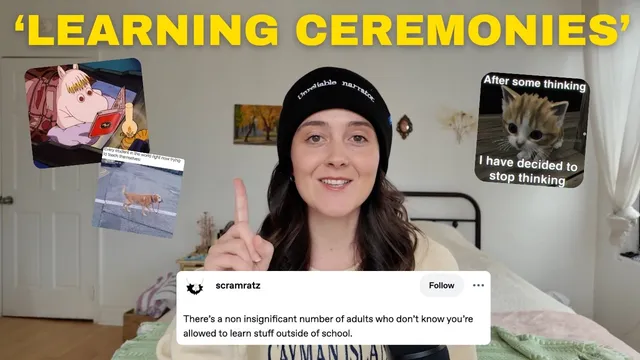
Honor Your Curiosity & Get Your Brain Back
Based on Anna Howard's video on YouTube. If you like this content, support the original creators by watching, liking and subscribing to their content.
Treat learning as “movement for your brain”: sustained effort at the intellectual edge tends to feel energizing and satiating, unlike endless easy content.
Briefing
Self-led learning is surging because it restores something modern feeds often strip away: sustained intellectual effort that feels like “movement for your brain.” The personal curriculum trend—building a tailored reading list, classes, and projects—works well for people who miss school’s structure, but it can also backfire when self-imposed rules turn learning into a chore. For adults, the deeper need isn’t a syllabus; it’s a way to re-enter curiosity, especially when scrolling habits and “too-easy” content create a loop of brief stimulation without lasting satisfaction.
A major thread ties that loop to broader cultural incentives. During the industrial revolution, people had to invent ways to keep their bodies active; today, the parallel is keeping minds engaged. Long-form, harder-to-digest material used to be the free option (books at libraries), while lighter entertainment required payment and attention. Now, the system often flips that bargain: endless short-form content is cheap or free, while serious, time-intensive learning tends to cost money and effort. That imbalance helps explain “brain rot” as a predictable outcome—demoralizing and exhausting because it forces people to think below their level while they chase occasional sparks of interest.
The episode argues that learning becomes energizing when it’s treated as active practice rather than passive consumption. Research and learning are reframed through “learning ceremonies,” a concept associated with decolonizing education and indigenous research methods. Instead of hierarchical, punitive schooling—built around grades, standards, and subject separation—ceremonies emphasize relationship, healing, and wholeness. The lighthouse learning method translates that into three “learning spirals”: interest, ancestor wisdom, and community care.
The interest spiral is the most immediately usable: pick one obsession and say yes to it for about a month. Week one is immersion; week two is creating something from what’s found; week three is connection, where new questions branch into the next spiral; week four is integration through sharing with a community. The example given is a plant-intelligence learning spiral built around reading Braiding Sweetgrass and then The Light Eaters, followed by discussions and deeper investigation.
Ancestor wisdom spiral adds lineage by asking what skills and interests were passed down—where ancestors gardened, what knowledge survived, and how family history shapes present learning. The community care spiral turns curiosity outward: ask what the community needs, how family gifts can serve others, and what local problems matter, then plan aligned action through mutual aid, events, or community circles. These spirals quickly become interdisciplinary—pulling in math for budgeting or data, social studies for civic engagement, language arts for communication, and arts for outreach.
To make the interest spiral stick, the episode offers retention tactics: read books in pairs (fiction and nonfiction in thematic conversation) to build relational memory, and annotate by writing responses in the margins as if the author is speaking directly to the reader. A personal example from reading The Light Eaters illustrates how margin notes can preserve a fleeting insight even when the reader doubts it—later confirmed by a scientist’s response. The overall message is pragmatic: self-led learning is a privilege and not one-size-fits-all, but treating learning as ceremony—curiosity plus relationship plus purposeful output—can reopen the locked door to awe.
Cornell Notes
The episode frames adult learning as a “ceremony” that restores the brain’s need for sustained, challenging engagement. Endless short-form content and frictionless “easy” material can make people feel mentally exhausted without gaining satisfaction, so learning should move back toward the intellectual edge. The lighthouse learning method offers three spirals: an interest spiral (immerse, create, connect, integrate), an ancestor wisdom spiral (root learning in lineage and decolonizing history), and a community care spiral (turn learning into aligned action for others). Retention tactics include reading in pairs (fiction + nonfiction) and annotating by writing marginal responses as if in direct conversation with the author. The approach matters because it makes learning feel alive, communal, and motivating rather than rule-bound or school-like.
Why does “brain rot” happen, and how does that connect to learning?
What makes a “personal curriculum” appealing—and why might it fail for some adults?
How does the lighthouse learning method work in practice?
What does “ancestor wisdom” add, and how is decolonization brought into it?
How can someone improve retention while doing an interest spiral?
Review Questions
- What conditions make learning feel energizing rather than draining, and how does the episode contrast that with short-form consumption?
- Describe the four-week interest spiral and give one example of how it could become interdisciplinary.
- How do ancestor wisdom and community care spirals change the purpose of learning compared with an individual reading list?
Key Points
- 1
Treat learning as “movement for your brain”: sustained effort at the intellectual edge tends to feel energizing and satiating, unlike endless easy content.
- 2
Personal curriculums can help, but rigid self-made rules may turn curiosity into resentment; adults may need a more flexible approach.
- 3
Endless short-form material can create a predictable loop of stimulation without depth, making “brain rot” less a personal failure and more a system outcome.
- 4
The lighthouse learning method reframes learning as ceremony through three spirals: interest (immerse-create-connect-integrate), ancestor wisdom (lineage and decolonizing history), and community care (aligned action for others).
- 5
Reading in pairs (fiction + nonfiction) can strengthen retention by building relational memory rather than storing facts in isolation.
- 6
Annotate by responding in the margins as if in direct conversation with the author; this preserves insights and increases active participation.
- 7
Self-led learning is a privilege and not one-size-fits-all; accommodations, time limits, and learning needs should shape the approach.