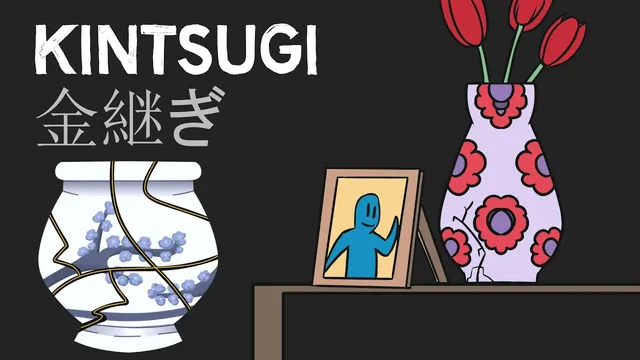
How a broken, screwed-up life can be beautiful (Kintsugi)
Based on Einzelgänger's video on YouTube. If you like this content, support the original creators by watching, liking and subscribing to their content.
Kintsugi treats visible cracks as part of an object’s identity, using gold lacquer to narrate breakage and repair rather than conceal it.
Briefing
Kintsugi—repairing broken pottery with gold lacquer—turns damage into visible beauty, offering a philosophy for how people might treat their own “cracks” instead of hiding or discarding them. Rather than erasing the history of breakage, gold seams make fractures part of the object’s identity, reframing imperfection as evidence of transformation, resilience, and time’s passage. The central claim is that a society obsessed with flawlessness often treats brokenness as worthless; Kintsugi proposes the opposite: scars can become a narrative of endurance.
The practice is traced to late-15th-century Japan, when artisans sought an alternative to metal-staple repairs. A commonly cited origin story links the shift to shogun Ashikaga Yoshimasa, whose displeasure with inelegant repairs is said to have prompted a better method. The move from staples to gold lacquer mattered beyond aesthetics: it changed what damage “means.” Where metal repairs could imply the object was merely patched up, gold joinery treats the break as another chapter—an event that adds character and makes the object’s past legible.
That mindset is then connected to broader Japanese ideas. Wabi-sabi—often summarized as “perfect imperfection”—encourages appreciation for things shaped by time and nature’s wear. The cracks in gold-accented pottery become a record of having been broken and repaired, and the same logic is applied to everyday artifacts: a suitcase that shows scuffs signals travel and lived experience; wrinkles and scars on faces can be read as accumulated stories. Mono no aware adds an emotional layer, emphasizing empathy for things precisely because they are transient. Beauty, in this view, intensifies when people recognize that everything—like pottery, like relationships, like life phases—eventually ends.
To ground the philosophy in place, the narrator points to Tilburg, a Dutch industrial city often labeled ugly for lacking a preserved historic center. Instead of demolishing decayed factories and abandoned train facilities, the city repurposed them—turning a train hall into a venue for festivities, a factory building into a food court, and a depot into a park. The result is a kind of urban kintsugi: scars of industrial decline remain visible, but they become the source of character and strength.
The argument reaches a public, historical example at the 9/11 Memorial in New York City. After debates about whether to rebuild the World Trade Center as exact replicas, the final approach combined remembrance with new construction, including One World Trade Center (the Freedom Tower). The memorial’s voids—represented by pools with water pouring into seemingly bottomless spaces—are surrounded by the names of those who died. The destruction is not covered up; it is embraced as a landmark of solidarity and renewal, echoing the gold-lacquer logic of making wounds meaningful.
The closing question is whether personal brokenness can be beautiful. The answer is conditional: beauty depends on how someone treats the shards—whether they discard the past, cover it with “as-it-should-be” perfection, or transform it into resilience, empathy, and growth. In the end, the message lands on a human scale: beauty may not be universal, but it can emerge when scars are allowed to tell the story they carry.
Cornell Notes
Kintsugi repairs broken objects with gold lacquer so cracks remain visible, turning damage into part of an item’s beauty and identity. The practice reframes breakage as transformation rather than failure, shifting the value of an object from “undamaged” to “enduring.” The philosophy connects to wabi-sabi (“perfect imperfection”), which appreciates wear shaped by time, and mono no aware, which heightens appreciation by acknowledging transience. Examples range from personal artifacts and faces to the repurposing of Tilburg’s abandoned industrial spaces. The 9/11 Memorial is presented as a public version of the same idea: scars are not erased but embraced and made meaningful through remembrance and renewal.
How does Kintsugi change the meaning of damage compared with conventional repair?
What historical origin is given for Kintsugi, and why does it matter to the philosophy?
How do wabi-sabi and mono no aware deepen the idea of beauty in brokenness?
What does Tilburg’s redevelopment illustrate about applying Kintsugi beyond pottery?
How does the 9/11 Memorial reflect Kintsugi’s logic on a national scale?
What is the transcript’s practical question for individuals dealing with personal “brokenness”?
Review Questions
- Which repair choice best matches Kintsugi’s philosophy: concealing cracks or highlighting them—and what does each choice imply about value and history?
- How do wabi-sabi and mono no aware each contribute a different reason to find beauty in imperfection?
- What parallels does the transcript draw between pottery repair, Tilburg’s redevelopment, and the 9/11 Memorial’s design choices?
Key Points
- 1
Kintsugi treats visible cracks as part of an object’s identity, using gold lacquer to narrate breakage and repair rather than conceal it.
- 2
The shift from metal-staple repairs to gold joinery is presented as a change in meaning—from patching to honoring a history of damage.
- 3
Wabi-sabi reframes imperfection as time-worn character, while mono no aware links beauty to the emotional recognition that things are temporary.
- 4
Tilburg’s redevelopment is offered as a real-world example of “urban kintsugi,” preserving industrial decay and repurposing it into community value.
- 5
The 9/11 Memorial is used to illustrate a public version of the same principle: scars become sites of remembrance and renewal instead of being erased.
- 6
The transcript ultimately argues that whether a “broken life” becomes beautiful depends on how someone interprets and integrates their scars—either hiding them or transforming them into resilience and empathy.