How a Student's Question Saved This NYC Skyscraper
Based on Veritasium's video on YouTube. If you like this content, support the original creators by watching, liking and subscribing to their content.
Citicorp Center’s safety risk came from a mismatch between wind-loading assumptions and the real behavior of bolted chevron connections under quartering winds.
Briefing
Citicorp Center’s structural engineer, Bill LeMessurier, uncovered a chain of design and construction shortcuts that could have let the tower fail in a major wind event—then quietly organized a high-stakes retrofit before hurricane season. The fix ended up saving thousands of lives, reshaping wind-engineering practice, and popularizing a technology that later spread across the world’s tallest, most slender buildings.
The crisis began in 1978, less than a year after the skyscraper opened. LeMessurier realized the building’s chevron bracing system—critical to handling both gravity and wind—had been connected using bolts rather than welds, a cost-saving change that was acceptable only under the assumptions used in the original calculations. The tower’s geometry and load paths made those assumptions fragile. Winds of about 110 kilometers per hour were enough, under the wrong stress conditions, to threaten collapse in the middle of Manhattan.
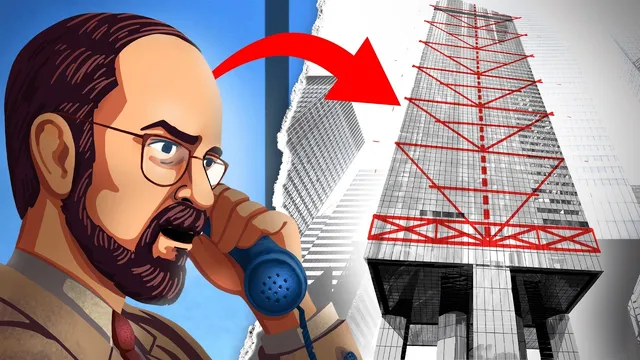
Citicorp’s deal with Saint Peter’s Church forced the tower to be built around the church and to keep two-thirds of the space above it open. That constraint led architect Hugh Stubbins and LeMessurier to place “stilts” (support columns) not at the corners but at the midpoints of each face, with the building’s forces routed through diagonal chevrons. The chevrons transferred gravity loads down to the stilts in discrete tiers and also “wrapped” wind forces around the structure by channeling horizontal loads from one chevron level to the next.
The chevrons solved the physics of wind and weight—but created a new vulnerability: the building became lighter and more flexible, so it could sway uncomfortably. LeMessurier countered that with a tuned mass damper (TMD), using a massive concrete block installed near the top (nicknamed “that great block of cheese”) to absorb motion and reduce oscillation amplitude by roughly 50%. With both the chevron bracing and the TMD in place, the design looked sound.
Trouble arrived after a student’s question triggered a deeper re-check. The key issue wasn’t just wind speed; it was wind direction. Standard analysis treated wind hitting a face head-on, but “quartering winds” strike a corner, splitting the load into perpendicular components. LeMessurier found that this diagonal loading could raise stresses by about 40%—and, because the bracing connections were bolted and treated as minor elements, the bolt counts and safety margins were wrong. Worse, wind-tunnel testing under dynamic conditions showed stresses could climb up to 60% beyond what static calculations predicted. The weakest joints clustered around the 30th floor; if they failed, the building could fall.
LeMessurier faced a brutal choice: stay silent and risk mass casualties, or act and invite professional ruin. He mobilized a confidential repair program—Project Serene—while keeping the public calm. Emergency generators were installed to keep the TMD operational, and welders retrofitted over 200 joints by adding steel plates to the bolted chevron connections, prioritizing the most critical floors. Citicorp coordinated evacuation planning with the Red Cross, installed strain gauges for remote monitoring, and even pushed AT&T to install new emergency lines quickly.
Repairs finished in October, just weeks after the decision. Hurricane Ella, with winds reaching roughly 200 kilometers per hour, threatened during the repair window but veered away. Later, reporting in The New Yorker brought the story to light, and New York updated building-code requirements to require quartering-wind calculations. The broader legacy was technical and ethical: the Citicorp case became a global teaching example of engineering responsibility, and TMDs went on to become common in tall buildings, including Taipei 101’s massive pendulum system.
Cornell Notes
Citicorp Center’s structural safety hinged on how wind forces were transferred through its chevron bracing and mid-face “stilts,” and on whether the bolted connections could handle the real stress levels. In 1978, Bill LeMessurier traced a potential failure to two gaps: the original calculations didn’t fully account for quartering winds (wind hitting a corner), and the bolted chevron joints were designed with inadequate safety margins under those conditions. Wind-tunnel dynamic analysis suggested stresses could rise up to 60% more than anticipated, with the most vulnerable joints around the 30th floor. LeMessurier organized a rapid, confidential retrofit—adding steel plates to strengthen more than 200 joints—while ensuring the tuned mass damper remained powered. The outcome prevented a likely collapse, influenced building codes, and helped popularize tuned mass dampers worldwide.
Why did Citicorp Center’s unusual geometry (the church and open space above it) force a different structural strategy?
How did the chevron bracing handle both gravity and wind in a way that standard corner columns couldn’t?
What went wrong after the design was built—specifically with the bolted connections?
Why did wind-tunnel testing matter more than static calculations in this case?
How did the tuned mass damper (TMD) fit into the safety plan once the retrofit became necessary?
What concrete actions did Project Serene take to reduce the collapse risk before hurricane season?
Review Questions
- What structural features of Citicorp Center made quartering winds more dangerous than face-on wind assumptions?
- How did dynamic wind-tunnel analysis change the predicted risk compared with static calculations?
- Why did the TMD become essential to collapse prevention rather than just comfort control?
Key Points
- 1
Citicorp Center’s safety risk came from a mismatch between wind-loading assumptions and the real behavior of bolted chevron connections under quartering winds.
- 2
Chevron bracing and mid-face “stilts” were engineered to route gravity and wind forces effectively, but they also created a connection-critical failure mode.
- 3
Static stress calculations underestimated the problem; dynamic wind-tunnel testing showed stresses could rise up to about 60% more than anticipated.
- 4
LeMessurier’s response combined structural retrofits (steel-plate weld additions to over 200 joints) with operational safeguards (emergency generators for the tuned mass damper).
- 5
The most vulnerable failure points were concentrated around the 30th floor; joint-by-joint reassessment drove repair prioritization.
- 6
Keeping the public calm required secrecy, but Citicorp still prepared for worst-case outcomes with evacuation planning and remote strain monitoring.
- 7
After the crisis became public, New York building-code practice shifted to require quartering-wind calculations, and tuned mass dampers spread globally.