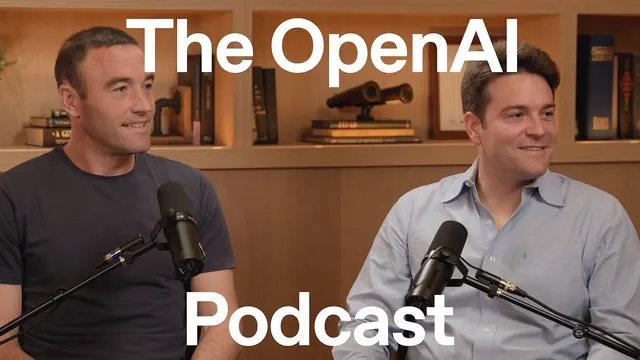
How AI is accelerating scientific discovery today and what's ahead — the OpenAI Podcast Ep. 10
Based on OpenAI's video on YouTube. If you like this content, support the original creators by watching, liking and subscribing to their content.
OpenAI for Science targets a specific acceleration goal: compressing roughly 25 years of scientific discovery into about five years by pairing frontier models with top researchers.
Briefing
AI is poised to accelerate scientific discovery by turning frontier-capable models into day-to-day collaborators for researchers—speeding up literature review, calculations, and even parts of mathematical reasoning—while also pushing into problems where models still need back-and-forth to get the right answer. OpenAI’s science push centers on a practical goal: compress decades of scientific progress into a much shorter timeline by putting advanced models in the hands of top scientists.
Kevin Weil, head of OpenAI for Science, frames the timing as a shift from “tools that help with known tasks” to models that can produce novel scientific outputs. Early “existence proofs” show GPT-5-level systems proving new results—sometimes not yet at the level of what humans can do independently, but far enough to demonstrate that the boundary of human knowledge is no longer a hard wall. Weil describes a rapid learning curve in which models go from failing, to barely succeeding, to becoming indispensable within months—an arc he says is already playing out for scientists using AI.
The acceleration isn’t limited to standalone breakthroughs. Researchers describe three recurring ways AI speeds work: exploring multiple solution paths in parallel, performing conceptual literature search that goes beyond keyword matching, and helping scientists connect new results to prior art in neighboring fields. Weil cites examples where GPT-5 identifies relevant work described with different terminology, even in other languages, such as locating a PhD thesis in German when a researcher couldn’t find anything using conventional search. Alex Lupsasca adds physics examples where AI recognizes mathematical structures—like the Schwarzen derivative or the conformal bridge equation—so a researcher can quickly see that an equation appearing in their work has already been studied.
Lupsasca’s most striking anecdote involves black hole physics. After initially using ChatGPT for proofreading and “warm-up” tasks, he tried a problem about symmetries in black hole equations. The model initially missed the hard version, but after a staged approach—first solving a simpler flat-space limit—it produced a correct symmetry result and then succeeded on the full problem after extended “thinking.” The episode underscores a key reality: at the frontier, models can be wrong often, and progress frequently comes from iterative prompting, verification, and patience rather than one-shot answers.
OpenAI’s initiative is formalized in a research paper that aggregates these patterns across disciplines—math, physics, astronomy, life sciences, and materials science—highlighting both pragmatic gains (search and computation) and more ambitious outputs, including several new non-trivial mathematical results. Weil emphasizes that the paper aims to document what works and what doesn’t, with shared conversation links to show the back-and-forth.
Looking ahead, the discussion treats the next few years as a “science 2.0” moment: models will keep improving, evaluations will need to move toward harder frontier questions, and AI’s biggest impact may come from expanding collaboration—effectively giving researchers a tireless assistant that can read broadly and help navigate jagged edges of knowledge. The long-term bet is that human-AI teamwork will be more powerful than either alone, enabling faster convergence on promising hypotheses, better experiment design, and ultimately more breakthroughs across fields ranging from fusion to drug discovery.
Cornell Notes
OpenAI for Science argues that advanced AI models are beginning to accelerate real scientific work—not just by drafting text, but by helping researchers navigate unknowns faster. Kevin Weil describes “existence proofs” where GPT-5 can prove new results and where AI speeds progress by exploring many candidate paths, performing conceptual literature search, and assisting with calculations. Alex Lupsasca’s black hole and pulsar examples show both the promise and the limits: models can identify the right mathematical identities and symmetries, but frontier problems often require staged warm-ups and iterative back-and-forth. The initiative’s paper consolidates these patterns across disciplines and includes new mathematical results, aiming to show what is working now and what still fails. The practical takeaway: researchers should treat AI as a collaborator that reduces cognitive load and shortens the time to useful directions, while still verifying outputs.
What does “accelerate science” mean in concrete terms, beyond writing or summarizing?
Why are “existence proofs” important for the timeline of AI’s impact on science?
What does Lupsasca’s black hole symmetry story reveal about how to use frontier models effectively?
How does AI help with the “niche problem” of modern science?
What is the role of back-and-forth when models have low pass rates at the frontier?
What does OpenAI’s science paper aim to demonstrate?
Review Questions
- When does AI provide acceleration through parallel exploration versus through conceptual literature search? Give one example from the discussion for each.
- Why does the black hole symmetry example require a warm-up step, and what does that imply about using models on frontier problems?
- What does “low but non-zero pass rate” mean for researchers trying to solve hard problems with AI, and how might tooling reduce the need for repeated attempts?
Key Points
- 1
OpenAI for Science targets a specific acceleration goal: compressing roughly 25 years of scientific discovery into about five years by pairing frontier models with top researchers.
- 2
GPT-5-level systems are starting to produce “existence proofs,” including novel mathematical results, signaling movement beyond routine assistance.
- 3
AI accelerates science through multiple mechanisms: parallel idea exploration, conceptual literature search that crosses terminology and languages, and recognition of known mathematical structures inside new equations.
- 4
Frontier tasks still demand iterative prompting and verification; models can be wrong often when operating at the edge of capability, so patience and scaffolding matter.
- 5
OpenAI’s research paper consolidates current GPT-5 scientific acceleration across math, physics, astronomy, biology, and materials science, including both pragmatic wins and new non-trivial math results.
- 6
The biggest long-term impact is framed as broad collaboration: giving scientists worldwide an always-available assistant to reduce cognitive load and shorten time-to-useful directions.
- 7
Evaluations and benchmarks must keep moving toward harder frontier questions because models quickly master earlier tests.