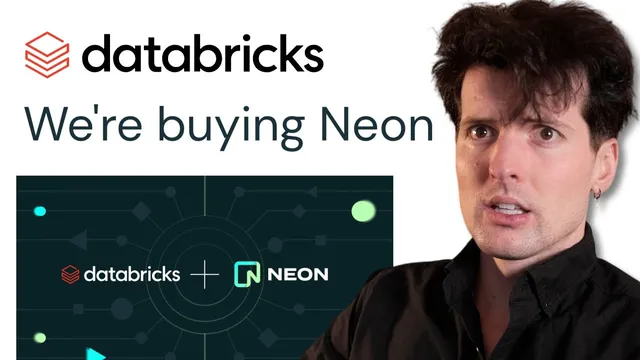
How AI Killed "Database Startups"
Based on Theo - t3․gg's video on YouTube. If you like this content, support the original creators by watching, liking and subscribing to their content.
Neon’s serverless Postgres rewrite is presented as a response to Postgres connection limits in ephemeral serverless environments where each request creates short-lived connections.
Briefing
Database startups are consolidating fast, and Neon’s acquisition by Databricks is presented as the clearest signal yet that the “endless options” era is fading. The core thread tying recent failures and buyouts together is economics: serverless Postgres platforms promised better developer experience and cheaper scaling, but many struggled to convert generous usage into sustainable revenue—especially as costs rose and fundraising became harder.
Neon is framed as a serverless Postgres rewrite built to solve Postgres’s weak fit for serverless workloads. Traditional Postgres connection handling doesn’t map cleanly to ephemeral environments like Lambda, Vercel, Netlify, and Cloudflare, where each request creates short-lived connections and can hit connection limits quickly. Neon also leaned into developer workflow features such as preview environments, branching, and forking—capabilities that let teams test schema changes without spinning up expensive, tightly coupled database instances.
Technically, Neon is described as an open-source serverless Postgres server that aims for Postgres compatibility while enabling cheap branching. It offers a free tier (10 projects, half a gig of storage, and compute hours) and paid plans that scale up with autoscaling. But the business side is where the pressure mounts. The transcript claims Neon scaled aggressively—deploying thousands of databases daily and managing hundreds of thousands overall—while maintaining a large headcount (with the narrator estimating 130 employees). That kind of growth in staffing is portrayed as difficult to sustain without strong margins.
The comparison section places Neon between two extremes. PlanetScale is characterized as enterprise-ready and highly reliable, but with expensive per-database pricing and no free tier; the model is said to be profitable because every user pays more than it costs to run. Terso is described as extremely cheap (storing SQLite in cold storage and recovering on demand), but reliability issues and data-loss incidents are cited as reasons it’s not a safe bet.
Neon’s pricing and usage dynamics are portrayed as the problem. The narrator suggests Neon’s average customer pays little or nothing—especially as AI app builders generate many databases automatically—so new database creation may be “at cost” rather than profit. With costs rising (engineering and payroll) and revenue not keeping pace, the transcript argues Neon’s options narrowed to either continued fundraising (unlikely without major dilution) or acquisition.
Databricks enters as the stabilizing buyer. Databricks is described as an enterprise analytics and AI platform that integrates with existing data infrastructure rather than replacing the database layer for end-user app traffic. The acquisition is framed as a strategic match: Neon gains enterprise-grade financial stability and distribution, while Databricks gains a developer-first serverless Postgres foundation that fits the AI era—particularly because AI agents and modern developer workflows benefit from fast database spin-up, branching, and preview-style testing.
The broader takeaway is that AI didn’t just create new demand; it also changed which database architectures feel “natural.” But the transcript warns that the database startup boom may be ending, with the remaining winners likely those that can survive the economics of serverless usage—or those absorbed into larger platforms that can.
Cornell Notes
Neon’s acquisition by Databricks is presented as a case study in how serverless Postgres startups are running into hard economics. Neon built a Postgres-compatible, serverless rewrite focused on branching, forking, and preview environments—features that fit modern developer workflows and AI agents. Yet the transcript argues Neon’s cost structure and pricing make it difficult to turn heavy automated database creation (especially from AI app builders) into meaningful profit. PlanetScale is portrayed as profitable by charging enough that every user covers costs, while Terso is portrayed as cheap but unreliable. Databricks is framed as the buyer that can provide stability and enterprise distribution, while also gaining a database layer that aligns with AI-era usage patterns.
Why does Postgres become difficult in serverless environments, according to the transcript?
What specific developer workflow problem Neon’s architecture targets?
How does the transcript position Neon relative to PlanetScale and Terso?
What economic mechanism is used to explain why PlanetScale can sustain free-tier-like behavior differently than Neon?
Why does fundraising matter in the transcript’s explanation of Neon’s acquisition?
What does Databricks gain, and what does Neon gain, in the acquisition framing?
Review Questions
- What connection-management behavior makes traditional Postgres a poor fit for serverless concurrency, and how does that motivate serverless Postgres rewrites?
- Which Neon features (branching, forking, preview environments) are described as especially valuable for AI agents and developer workflows?
- How do the transcript’s margin assumptions differ between PlanetScale, Neon, and Terso, and why does that lead to consolidation?
Key Points
- 1
Neon’s serverless Postgres rewrite is presented as a response to Postgres connection limits in ephemeral serverless environments where each request creates short-lived connections.
- 2
Preview environments and branching are framed as the workflow “unlock” that makes schema changes testable per pull request without expensive manual staging setups.
- 3
PlanetScale is portrayed as financially sustainable because pricing removes free-tier users and every database instance is assumed to generate margin above run cost.
- 4
Terso is portrayed as extremely cheap by using cold storage for idle SQLite databases, but reliability and data-loss incidents are cited as major drawbacks.
- 5
Neon’s economics are described as strained by low-paying customers (including AI app builders creating many databases) while engineering and payroll costs rise.
- 6
Databricks is framed as a strategic acquirer because it can provide enterprise stability and distribution while benefiting from Neon’s AI-friendly database capabilities.
- 7
The broader industry trend is consolidation: database startups increasingly need either profitability or absorption into larger platforms to survive.