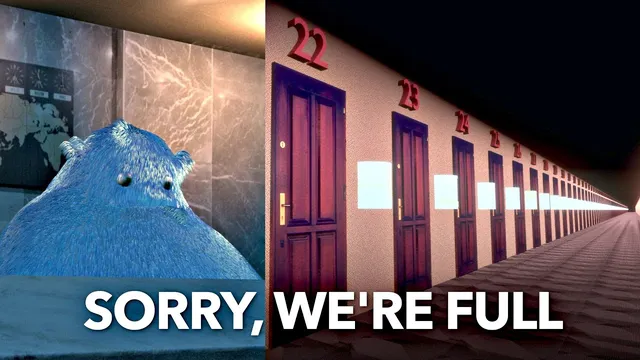
How An Infinite Hotel Ran Out Of Room
Based on Veritasium's video on YouTube. If you like this content, support the original creators by watching, liking and subscribing to their content.
Hilbert’s Hotel can always make room for a finite number of new guests by shifting every current occupant a fixed number of rooms.
Briefing
Hilbert’s “infinite hotel” can always make room for more guests—until the guests come from a larger kind of infinity. The core move is simple: when every room is occupied, the manager can still rearrange occupants to free up space. With one new person, shifting everyone from room n to room n+1 immediately creates room 1. With a finite bus of k people, shifting everyone k rooms down does the same. Even an infinitely long bus of infinitely many people can be handled by sending each existing guest from room n to room 2n, which frees all odd-numbered rooms for the newcomers.
The trouble starts when the arrivals are not merely infinite in quantity, but infinite in a stronger sense: infinitely many infinite buses. The manager models the situation as an infinite grid—rows for buses and columns for positions within each bus—so each person gets a unique identifier (bus number + seat/position). A zigzag “diagonalization” through this infinite spreadsheet pairs every identifier with a distinct hotel room, effectively turning a two-dimensional infinite structure into a single list. That rearrangement works because the set of all bus-position pairs is still countably infinite, meaning it can be matched to the positive integers.
Then comes the final twist: an infinite party bus with no seats where every passenger is identified by an infinite binary-style name made only of A and B, with every possible infinite A/B sequence present. Now the hotel’s earlier strategy breaks. Even though there are infinitely many rooms, the set of all infinite A/B sequences is uncountably infinite—too large to be put into one-to-one correspondence with the integers.
To demonstrate the mismatch, the manager attempts to list the passengers and assign rooms anyway. Suppose the passengers are arranged in a complete infinite list. The manager constructs a “missing” name by flipping letters along the diagonal: take the first letter of the first listed name and change A↔B, take the second letter of the second name and flip it, and continue forever. The resulting sequence differs from every listed passenger at least one position (the diagonal), so it cannot correspond to any room in the assignment. This diagonal argument proves that no matter how the hotel tries to pair rooms with passengers, at least one passenger remains unassigned.
The conclusion is that Hilbert’s Hotel has a limit: its rooms form a countably infinite set, while the passengers on the final bus form an uncountably infinite set. The story isn’t just a puzzle about rearranging furniture; it’s a concrete illustration of how infinities can have different sizes. That distinction—countable versus uncountable—helped spark deeper mathematical developments that ultimately influenced technologies far beyond the hotel, including the foundations behind modern computing devices.
Cornell Notes
Hilbert’s Hotel can always rearrange occupants to accommodate new guests as long as the newcomers come from a countably infinite set. Shifting guests by finite amounts works for finite buses, and mapping room n to 2n frees odd rooms for an infinitely long bus. With infinitely many infinite buses, a diagonal zigzag through an infinite grid pairs each bus-position identifier with a unique room, effectively listing them in one sequence.
The strategy fails when passengers are indexed by every possible infinite A/B sequence. Those names form an uncountably infinite set, larger than the countably infinite set of hotel rooms. A diagonal “flip” construction guarantees that any proposed room assignment misses at least one passenger, proving no one-to-one matching is possible.
Why does shifting everyone from room n to room n+1 solve the “one new person” problem?
How does the hotel fit an infinitely long bus of infinitely many people?
What does the “infinite spreadsheet” accomplish for infinitely many infinite buses?
Why can’t the hotel assign rooms to every infinite A/B name on the final party bus?
What is the key difference between countably infinite and uncountably infinite sets in this story?
Review Questions
- In the infinite-bus scenario, what specific room mapping frees the odd-numbered rooms, and why does it preserve uniqueness?
- How does the zigzag traversal through an infinite grid relate to the idea of turning a two-dimensional countable set into a one-dimensional list?
- What exactly does the diagonal letter-flipping construction guarantee about any proposed complete assignment of rooms to infinite A/B sequences?
Key Points
- 1
Hilbert’s Hotel can always make room for a finite number of new guests by shifting every current occupant a fixed number of rooms.
- 2
An infinite bus of infinitely many people can be accommodated by mapping each existing guest from room n to room 2n, freeing all odd rooms.
- 3
Infinitely many infinite buses can be handled by indexing passengers with (bus number, position) pairs and using a diagonal zigzag to assign each pair to a unique room.
- 4
The hotel’s room set is countably infinite, matching the positive integers, so it can only be paired one-to-one with other countable sets.
- 5
Passengers labeled by every infinite A/B sequence form an uncountably infinite set, which cannot be matched to the hotel’s countably infinite rooms.
- 6
The diagonal “flip” method proves any proposed room assignment for infinite A/B sequences must miss at least one passenger.