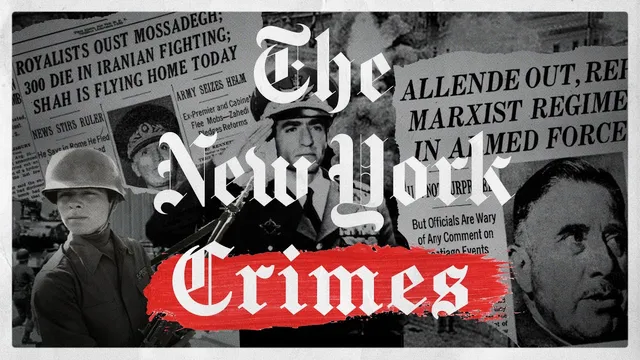
How (And Why) The New York Times Lies
Based on Second Thought's video on YouTube. If you like this content, support the original creators by watching, liking and subscribing to their content.
The transcript claims Western election coverage often uses a consistent framing pattern that portrays US-backed replacements as democratic while depicting targeted leaders as illegitimate autocrats.
Briefing
A pattern of Western media framing—especially at the New York Times—systematically casts left-leaning governments in the Global South as illegitimate “dictators,” while portraying US-backed opponents as democratic and downplaying US roles in coups, sanctions, and repression. The result is a narrative that makes American intervention feel like a distant, reluctant footnote rather than a recurring driver of political outcomes.
The argument centers on a recurring checklist used when covering regime change abroad: blame domestic economic and political failures on the targeted government; ignore or minimize the impact of US sanctions; describe the leader as a tyrannical autocrat; avoid the word “coup” in favor of terms like “uprising” or “transition”; mock the idea that the US could be involved; depict the replacement leadership as democratically minded; and ultimately blame the deposed leader for their own overthrow. Examples are drawn from multiple historical cases. In Brazil (1964), the New York Times framed the overthrow of President João Goulart as a “peaceful revolution,” while portraying the incoming military rule as a patriotic bridge to future elections. In Chile (1973), coverage of Salvador Allende’s election and subsequent removal is contrasted with later reporting: Allende is described as a threat to freedom, while US involvement and the role of sanctions are treated as peripheral. In Iran (1953), the narrative is said to emphasize the chaos caused by Mohammad Mossadegh while largely excusing the British and US actions—blockades, boycotts, and covert support for regime change—despite later declassified material indicating direct orchestration.
To move beyond isolated anecdotes, the transcript cites an analysis of roughly 300 New York Times op-eds and editorials about Iran from 1950 to 1960, reporting that the same asymmetry shows up repeatedly: blockades are rarely questioned, sanctions are treated as scapegoats rather than causal forces, and the Shah is often praised even amid harsh crackdowns. The coverage is also described as stylistically biased—Mossadegh and other left-leaning leaders are depicted with authoritarian or destabilizing imagery, while right-wing successors are romanticized as lovers of liberty or democratic figures.
The Venezuela section ties the framing to concrete political and economic context. Venezuela’s late-20th-century downturn is attributed to IMF-backed structural adjustment: privatization, reduced regulation, trade liberalization, and the resulting collapse in GDP, banking instability, high inflation, and rising foreign debt burdens. Against that backdrop, the transcript credits Hugo Chávez’s rise to policies that expanded social spending and nationalized key sectors, citing improvements in poverty rates, unemployment, literacy, and access to services.
When US-backed coups appear—such as the 2002 removal of Chávez—the New York Times is described as reverting to the same tropes: labeling Chávez as incompetent or dictatorial despite repeated electoral wins and referendums. The transcript emphasizes Venezuela’s election mechanics and claims that an audit of the 2013 presidential election found 99.98% accuracy, with discrepancies attributed to ballot handling rather than fraud. It then argues that the persistent “fraud” narrative persists because of structural media incentives: ownership by a billionaire family, advertiser interests, a sourcing culture that privileges official statements, and a pipeline of elite access that shapes how socialism and social movements are interpreted.
The broader takeaway is that alternative explanations—US sanctions, covert operations, and support for armed replacements—are often delayed, minimized, or only surfaced later through declassified records. That delay, the transcript argues, helps normalize the idea that the American empire is a background condition rather than an active participant in regime change, shaping what many Americans come to see as “reasonable” intervention.
Cornell Notes
The transcript argues that the New York Times and other Western outlets use a consistent framing pattern when covering foreign elections and regime change. Left-leaning leaders are portrayed as illegitimate “autocrats,” while US-backed opponents are described with democratic language and US roles (sanctions, coups, covert support) are minimized. Historical examples—Brazil (1964), Chile (1973), and Iran (1953)—are used to show how coverage can label events as “revolutions” or “transitions” rather than coups, and how sanctions and blockades are treated unevenly. Venezuela is used as a case study, with claims that structural adjustment worsened conditions before Chávez, and that later election audits found high accuracy. The transcript concludes that ownership, advertiser incentives, official sourcing, and elite access help sustain the narrative.
What “checklist” does the transcript claim Western outlets follow when covering coups or attempted coups abroad?
How does the transcript use Brazil (1964), Chile (1973), and Iran (1953) to support claims of biased coverage?
What evidence does the transcript cite to move beyond cherry-picked examples about Iran coverage?
How does the transcript argue Venezuela’s political and economic context was misrepresented in election coverage?
What does the transcript claim about Venezuela’s election integrity and audits?
According to the transcript, what structural factors help sustain the New York Times framing?
Review Questions
- Which specific language substitutions (e.g., “coup” vs “uprising”) does the transcript say change how audiences interpret foreign regime change?
- What causal chain does the transcript give for Venezuela’s crisis before Chávez, and how does that chain affect how election outcomes should be understood?
- How do ownership, advertisers, and sourcing practices interact in the transcript’s explanation for why certain narratives persist?
Key Points
- 1
The transcript claims Western election coverage often uses a consistent framing pattern that portrays US-backed replacements as democratic while depicting targeted leaders as illegitimate autocrats.
- 2
It argues that US sanctions and other external pressures are frequently minimized, even when they plausibly drive economic outcomes.
- 3
Historical examples (Brazil 1964, Chile 1973, Iran 1953) are used to illustrate how “revolution” and “transition” language can obscure coup dynamics.
- 4
A cited analysis of roughly 300 New York Times pieces about Iran is presented as evidence that the asymmetry appears repeatedly rather than only in isolated cases.
- 5
Venezuela is used as a case study linking election narratives to structural economic context, including IMF structural adjustment policies and their claimed effects on GDP, wages, and employment.
- 6
The transcript emphasizes Venezuela’s election procedures and claims a 2013 audit found 99.98% accuracy, with discrepancies attributed to ballot handling rather than systematic fraud.
- 7
It attributes persistent framing to structural media incentives: billionaire ownership, advertiser interests, official-source sourcing norms, and elite access for foreign correspondents.