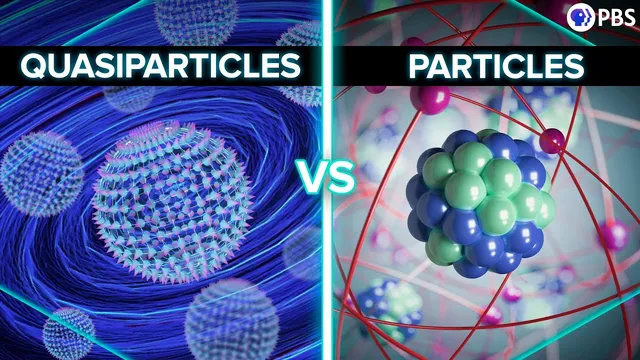
How Are Quasiparticles Different From Particles?
Based on PBS Space Time's video on YouTube. If you like this content, support the original creators by watching, liking and subscribing to their content.
An electron hole is an emergent quasiparticle: a moving vacancy in silicon’s valence shell behaves like a positively charged carrier with an effective positive mass.
Briefing
Quasiparticles are not just a convenient metaphor for semiconductor physics—they are the effective “particles” that emerge when electrons and atoms in a solid behave collectively in quantized ways. That shift in viewpoint matters because it turns messy many-body motion into simpler, particle-like rules that directly power modern electronics and explain phenomena like heat flow, sound in solids, and superconductivity.
In silicon, electrons are the only elementary particles that truly move through a circuit, but the material’s electronic structure creates an additional effective entity: the electron hole. When an electron is thermally excited or freed by a photon (as in a solar cell), it leaves behind an empty spot in the valence shell. Neighboring electrons can hop into that gap, making the vacancy appear to travel through the lattice. The missing electron behaves like a quasiparticle with an effective positive charge and even an effective positive mass. Modeling this “hole” as a real carrier is what makes semiconductor devices tractable.
That modeling becomes concrete in the p-n junction diode. Doping silicon with atoms that have extra valence electrons (commonly phosphorus) produces an n-type region where negative charge carriers dominate. Doping with atoms that have one fewer valence electron (commonly boron) creates a p-type region with mobile electron holes. When the two regions are fused, electrons diffuse into the p-type side and fill available valence gaps, forming a depletion zone where charge can’t flow. A forward voltage narrows that non-conducting region and allows carriers to cross the junction; a reverse voltage expands it and shuts current down—turning the junction into an electricity “valve.” The same hole-and-electron-carrier logic underlies solar cells, LEDs, and transistors.
A second major quasiparticle emerges from the lattice itself. Atoms in a crystal vibrate, and those vibrational modes are quantized: energy can be exchanged only in discrete chunks. The quantum of lattice vibration is the phonon. Phonons act like particles of sound and also like quanta of heat, because heat in solids is fundamentally tied to atomic vibrations. They can be thought of as a coherent stream in sound and a random buzz in thermal motion. Crucially, electrons can exchange energy with phonons; collisions and energy transfer into vibrational modes are a microscopic source of electrical resistance and the heat generated by current.
Superconductivity then comes from a more elaborate quasiparticle hierarchy. Cooling a metal near absolute zero reduces random phonons, allowing coherent vibrational behavior to dominate. In that regime, phonons can mediate an effective attraction between electrons that would otherwise repel each other via their electromagnetic interaction. The result is the Cooper pair: a bound state of two electrons whose collective quantum behavior is boson-like. Because many Cooper pairs can occupy the same lowest-energy state at very low temperatures—and because they can’t easily excite new phonons—electrical current can flow without resistance. The same Cooper-pair foundation also connects to superfluidity.
Beyond holes, phonons, and Cooper pairs, solids host many other quasiparticles—such as magnons in quantum spin lattices and topological excitations like skyrmions—showing how a single principle repeats across condensed matter: quantized fields in space produce particle-like excitations. The complexity of modern technology, from transistors to superconductors, is built on that emergent structure.
Cornell Notes
Quasiparticles are effective particle-like excitations that arise when a solid’s many-body behavior is quantized. In silicon, removing an electron from a valence bond creates an electron hole that behaves like a positively charged carrier, making p-n junction diodes work as controllable depletion regions. Lattice vibrations are also quantized, producing phonons—quanta of sound and heat—through which electrons exchange energy and generate resistance. At extremely low temperatures, coherent phonon behavior can bind electrons into Cooper pairs, which act like bosons and enable superconductivity by allowing zero-resistance flow. The broader takeaway: quantized fields in a crystal naturally generate a wide range of quasiparticles that power and explain real materials.
Why does an “electron hole” act like a real carrier in silicon even though electrons are the elementary particles?
How does doping create the conditions for a diode to conduct in one direction but not the other?
What makes phonons different from ordinary “sound waves,” and why do they matter for heat and resistance?
How can phonons—normally associated with thermal noise—help produce superconductivity?
Why do Cooper pairs enable zero resistance?
Review Questions
- In silicon, what physical process makes a vacancy in the valence shell behave like a positively charged quasiparticle?
- Describe how a p-n junction’s depletion region changes under forward versus reverse bias.
- Explain the chain from quantized lattice vibrations (phonons) to phonon-mediated electron pairing (Cooper pairs) and then to superconductivity.
Key Points
- 1
An electron hole is an emergent quasiparticle: a moving vacancy in silicon’s valence shell behaves like a positively charged carrier with an effective positive mass.
- 2
Doping with phosphorus creates n-type silicon with extra mobile electrons, while doping with boron creates p-type silicon dominated by electron holes.
- 3
A diode’s one-way conduction comes from a p-n junction depletion region: forward bias narrows it and enables carrier flow, while reverse bias widens it and blocks current.
- 4
Phonons are quantized lattice vibrations, acting as quanta of sound and heat; electron-phonon energy exchange is a microscopic source of electrical resistance.
- 5
Superconductivity near absolute zero relies on coherent phonon behavior that can mediate an effective attraction between electrons, forming Cooper pairs.
- 6
Cooper pairs behave boson-like, letting many pairs occupy the same lowest-energy state and suppressing resistance by preventing easy excitation of phonons.
- 7
Quasiparticles arise broadly because quantized fields in a crystal support discrete energy states, producing many particle-like excitations beyond electrons and photons.