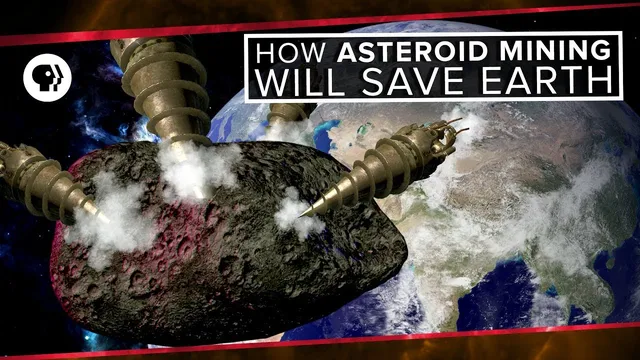
How Asteroid Mining Will Save Earth
Based on PBS Space Time's video on YouTube. If you like this content, support the original creators by watching, liking and subscribing to their content.
Asteroid mining is pitched as a way to extract high-value metals and industrial “critical” elements while also producing water for rocket fuel.
Briefing
Asteroid mining is being pitched as a practical next step for extracting high-value materials—especially platinum-group metals and industrial “critical” elements—while also producing water for in-space fuel. The core promise is economic: asteroids can concentrate resources that are scarce or hard to mine on Earth, and they can be accessed with relatively low fuel cost when they pass near Earth. If early missions prove profitable, the payoff could extend beyond profit margins to reshaping how humanity moves and builds in space.
The case starts with what asteroids are and why they differ. Leftover building blocks from the solar system, asteroids range from meters to hundreds of kilometers and mostly orbit in the belt between Mars and Jupiter, with some near-Earth asteroids crossing Earth’s path. Their compositions matter. Carbonaceous (C-type) asteroids make up about three-quarters of known asteroids and often contain abundant water, a key resource for life support and—more importantly—rocket fuel. Silicaceous (S-type) asteroids (about 17%) are rock-rich and tend to include more iron, nickel, and valuable elements. Metallic (M-type) asteroids are often iron-and-nickel cores exposed by collisions, formed through differentiation when heavier metals sank during molten stages.
Profitability hinges on the right mix of valuable contents, mission-essential resources, and accessibility. Precious metals like gold and platinum are attractive not because asteroids are richer than Earth overall, but because those metals are more accessible in space. Earth’s crust was “sucked dry” of many alloying metals during planetary formation, and much of Earth’s precious-metal inventory likely arrived via ancient asteroid impacts. Estimates cited for a single 30-meter asteroid put platinum value around $30 billion, with larger objects potentially holding platinum-group metal reserves comparable to or exceeding global totals. But there’s a catch: flooding markets could collapse prices, so miners would need to manage supply.
Industrial usefulness may be even more important than rarity. Platinum-group elements and rare-earth elements are central to electronics, batteries, fuel cells, magnets, and chemical processes. Rare-earth elements are not extremely rare in Earth’s crust, yet concentrated, commercially viable deposits are limited and accessible supply is tightening. Asteroids also offer raw materials—iron, nickel, aluminum, titanium—that may not be economical to return to Earth but could support construction and infrastructure in space.
Water is singled out as the enabling resource. Extracted water can be split into hydrogen and oxygen, providing rocket fuel. That reduces the need to launch return fuel from Earth, which in turn expands what kinds of asteroids can be reached and what equipment can be carried.
The early strategy targets near-Earth asteroids because they’re easier to reach from Earth orbit. Prospecting is already underway to identify “easily recoverable objects” with the right composition and size. Once a target is found, operations could mine in place or relocate the asteroid into a more accessible orbit—possibly even lunar orbit—using techniques like gravitational tractors or rockets fueled by the asteroid’s own water. NASA’s Asteroid Redirect Mission aimed at lunar-orbit relocation but was canceled in 2017.
Harvesting methods range from scooping surface material and scraping regolith to magnetic collection and chemical processing (including a Mond process using carbon monoxide to produce collectible nickel/iron-bearing gas). Water extraction is comparatively straightforward via evaporation and collection. Initial missions are expected in the 2020s, with timelines described as uncertain. The long-term vision is a robotic start, followed by human involvement as operations scale—potentially turning asteroid mining into a new industrial frontier rather than a one-off experiment.
Cornell Notes
Asteroid mining is framed as an economic and logistical solution: asteroids can supply high-value metals and industrial elements, while also providing water that can be converted into rocket fuel. Different asteroid types—carbonaceous (water-rich), silicaceous (rocky with iron/nickel), and metallic (iron/nickel cores)—offer different mixes of resources. Near-Earth asteroids are the first targets because they can be reached with relatively low fuel cost from Earth orbit, making early missions more feasible. After identifying an “easily recoverable object,” companies would either mine in place or move the asteroid to a more accessible orbit using methods such as gravitational tractors or water-fueled rockets. Water extraction is emphasized as the easiest step and the key to reducing return-fuel constraints.
Why are asteroids considered more economically accessible than Earth for certain metals?
What makes water on asteroids strategically valuable beyond being a commodity?
How do asteroid types (C-type, S-type, M-type) influence what miners can extract first?
What is the “easily recoverable object” idea, and why does it drive early mission targets?
What options exist after finding a target asteroid—mine it in place or move it?
What harvesting and processing methods are proposed for asteroid materials?
Review Questions
- Which asteroid type is most associated with water abundance, and why does that matter for propulsion?
- What tradeoffs determine whether a near-Earth asteroid is worth mining: composition, size, accessibility, or market price—and how do the transcript’s examples connect to those factors?
- How do gravitational tractors and water-fueled rockets differ in the proposed plan for relocating an asteroid to a more accessible orbit?
Key Points
- 1
Asteroid mining is pitched as a way to extract high-value metals and industrial “critical” elements while also producing water for rocket fuel.
- 2
C-type asteroids are water-rich and make up about three-quarters of known asteroids; S-type asteroids are rock/silicate-rich; M-type asteroids are often iron-and-nickel metallic cores.
- 3
Profitability depends on a combination of valuable materials, mission-essential resources (especially water), and accessibility—so near-Earth asteroids are prioritized for early missions.
- 4
Precious metals could be profitable but also risky for pricing if supply increases too quickly, potentially collapsing market value.
- 5
Rare-earth elements and platinum-group elements are emphasized as essential for electronics, magnets, batteries, fuel cells, and chemical processes, with constrained accessible supply on Earth.
- 6
Water extraction is comparatively straightforward and could reduce the need to launch return fuel from Earth, expanding what missions are feasible.
- 7
After prospecting, mining could happen in place or the asteroid could be relocated using tools like gravitational tractors or rockets fueled by the asteroid’s own water.