How Astrophysics Can (LITERALLY) Save the World
Based on PBS Space Time's video on YouTube. If you like this content, support the original creators by watching, liking and subscribing to their content.
Asteroid impact risk is quantified by converting early sky-position measurements into orbital parameters, then running many future trajectory simulations that include real perturbations.
Briefing
Astrophysics turns a blurry moving dot into a quantified Earth-impact probability by combining orbital mechanics, careful uncertainty modeling, and targeted follow-up observations—an approach that has already defused real near-miss scenarios like asteroid 2024 YR4. Early measurements for 2024 YR4 from the ATLAS survey initially produced a 3.1% chance of an Earth impact on December 22, 2032. As more observations refined its orbit, the threat collapsed toward zero, with NASA later revising the odds to about 1 in 5,500 by March and ESA estimating nearly 1 in a million. The key point is not that a collision is impossible, but that the risk can be narrowed dramatically once the object’s trajectory is better constrained.
The process starts with what astronomers can measure: a new asteroid appears as a fast-moving, tail-less blob against a starfield. Those early images give precise angular position on the sky but leave a major degeneracy—an object could be relatively close and slow or far and fast while still producing similar 2D motion. Using classic methods attributed to Laplace and Gauss, built on Kepler’s mathematically accurate description of elliptical orbits, astronomers can infer the six Keplerian orbital parameters from a small set of observations spaced over time. That yields a first estimate of whether the object is an Earth-crosser (like the “Apollo” class, with a semi-major axis larger than Earth’s) and how its orbit intersects Earth’s path.
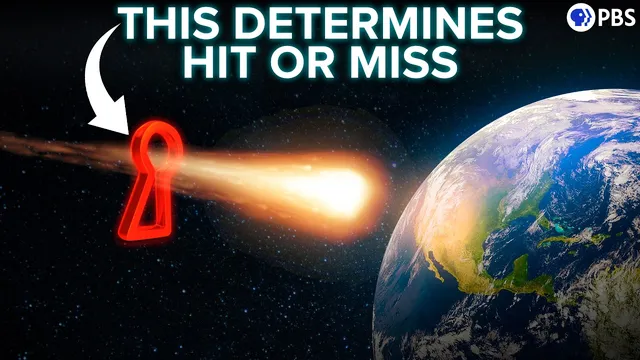
But Keplerian orbits aren’t the whole story. Planetary gravity, solar radiation pressure, and the Yarkovsky effect (a spin- and heat-driven force) all nudge the asteroid over time. The biggest uncertainty often comes from the initial conditions themselves—especially distance and velocity estimates—so the only practical way to forecast long-term outcomes is to run many simulations that sample the uncertain parameters. Those Monte Carlo runs reveal that impact trajectories are not evenly distributed: they cluster into tiny “gravitational keyholes,” sometimes only hundreds of meters wide, where a future close approach can redirect the asteroid onto a collision course at a later encounter.
Once a keyhole is identified, the probability of impact becomes the probability of threading that keyhole. Deflection planning also becomes more tractable: diverting an asteroid before it reaches a keyhole may require only kilometer-scale changes rather than the much larger offsets needed after a collision pathway is already established. NASA’s DART mission demonstrated that large asteroids can be deflected by slamming a spacecraft into them—provided the timing is early enough.
The same framework is used to manage longer-term risks. Apophis, nearly half a kilometer across, was once flagged for a 2029 impact chance as high as 2.9% based on early simulations. Radar observations (including by Arecibo) and continued tracking downgraded the risk, pointing instead to a possible pass through an 800-meter-wide keyhole for a 2036 impact—then further observations reduced the likelihood of any impact for the next century. OSIRIS-APEX, the renamed successor to OSIRIS-REX, is set to intercept Apophis to measure how Earth’s gravity changes its rotation and structure, improving future trajectory predictions.
Finally, the episode underscores a practical reality: new Earth-crossing asteroids keep turning up, so detection must keep pace. The Rubin Observatory’s LSST survey is expected to find many missing objects, while NASA’s Near Earth Object Surveyor (planned for launch around 2027) aims to detect at least two-thirds of objects larger than 140 meters. The astrophysics payoff is clear—when a new “moving smudge” is spotted, the same physics-based pipeline can convert it into actionable risk estimates rather than panic.
Cornell Notes
Astrophysics can convert a newly detected asteroid—initially just a fuzzy moving point—into a probability of Earth impact by solving its orbit and then simulating its future under real-world perturbations. Early observations provide accurate angles but uncertain distance, creating degenerate possibilities that are resolved using orbital-determination methods (Laplace/Gauss built on Kepler). The refined orbit feeds Monte Carlo simulations that include planetary gravity, solar radiation pressure, and the Yarkovsky effect; results cluster into tiny “gravitational keyholes,” where a later collision becomes extremely likely. For 2024 YR4, the impact probability fell from 3.1% to about 1 in 5,500 (NASA) and nearly 1 in a million (ESA) as uncertainty shrank. The same approach has been used to downgrade Apophis from earlier impact concerns, while OSIRIS-APEX will gather data to improve future predictions after close encounters.
Why do early asteroid observations produce misleadingly uncertain impact odds?
How do astronomers turn a few observations into an orbit accurate enough to assess risk?
What forces make long-term predictions diverge from simple Keplerian motion?
What are gravitational keyholes, and why do they matter for impact probability?
How did 2024 YR4’s risk change as more data arrived?
Why is OSIRIS-APEX relevant to planetary defense even after risks are downgraded?
Review Questions
- What observational degeneracy arises from measuring only angular motion, and how do Laplace/Gauss-style orbit solutions help resolve it?
- Explain how Monte Carlo simulations and gravitational keyholes transform a messy uncertainty problem into a computable impact probability.
- Why do small non-gravitational forces like the Yarkovsky effect become crucial over long timescales?
Key Points
- 1
Asteroid impact risk is quantified by converting early sky-position measurements into orbital parameters, then running many future trajectory simulations that include real perturbations.
- 2
Angular position can be measured precisely, but distance is initially uncertain, creating degenerate orbit possibilities that must be resolved with additional observations.
- 3
Classic orbit-determination methods (Laplace and Gauss, based on Keplerian ellipses) can infer six orbital parameters from a small set of time-separated observations.
- 4
Long-term predictions require accounting for planetary gravity, solar radiation pressure, and the Yarkovsky effect, because uncertainties compound over time.
- 5
Monte Carlo simulations reveal that impacts are concentrated into tiny “gravitational keyholes,” sometimes hundreds of meters wide, making impact probability effectively the chance of threading a keyhole.
- 6
Deflection planning is easier when intervention occurs before keyhole passage; DART demonstrated that large asteroids can be diverted with an early enough impact.
- 7
Improved detection surveys (Rubin Observatory/LSST and NASA’s Near Earth Object Surveyor) are essential because new Earth-crossing objects continue to be discovered.