How Big Can a Person Get?
Based on Vsauce's video on YouTube. If you like this content, support the original creators by watching, liking and subscribing to their content.
Average height has increased by about 10 cm (4 inches) since roughly 150 years ago, largely due to better early-life nutrition and healthcare.
Briefing
Human height is approaching a biological ceiling, but “how big a person can get” depends on what kind of size is being measured—body dimensions, environmental reach, or emitted light. Average height has risen by about 10 centimeters (roughly 4 inches) over the past 150 years, largely because better nutrition and medical care early in life help people take full advantage of genetic growth “blueprints.” Even with optimal conditions, those plans rarely push beyond about 7 feet 6 inches. When growth is driven longer and faster than normal—such as endocrine disorders involving tumors near the pituitary gland—individuals can exceed typical limits, including Igor Vovkovinskiy (7 foot 8 inches) and Sultan Kösen (8 foot 3 inches). The tallest officially recorded person, Robert Wadlow, reached 8 foot 11 inches.
To understand the true maximum, the transcript shifts from anecdotes to constraints of physics and physiology. Scaling a human up while keeping the same proportions runs into the square-cube law: as a shape grows taller, its volume (and thus weight) increases faster than the cross-sectional area that must support it. A tenfold increase in linear size would create a thousandfold increase in volume but only a hundredfold increase in supporting area—meaning bones and muscles would need to be dramatically stronger and thicker than human proportions allow. Even if skeletal and muscular strength were solved, the heart and circulatory system would still struggle to pump blood effectively through a much larger body.
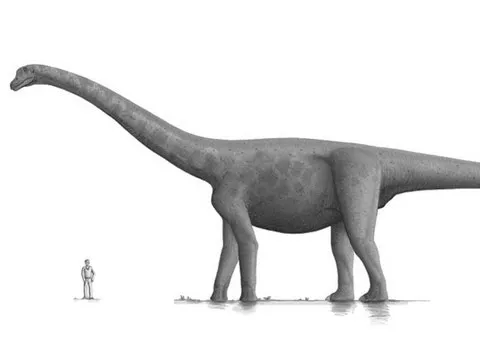
The limits become clearer by comparing to animals with different designs. Very large land animals like the giraffatitan—known from a mounted skeleton in Berlin’s Humboldt museum and estimated at 20,000–30,000 kilograms—could reach sizes humans can’t, because their proportions and organ layouts differ. Larger sauropods such as Bruhathkayosaurus are estimated around 140,000 kilograms, but beyond that, survival and reproduction would require more buoyancy than air can provide. That’s one reason blue whales, which can reach about 177,000 kilograms, rely on water for support.
For humans specifically, geometry and gravity imply a practical ceiling for body size. Higher estimates for average upper limits hover around 7 feet tall, while people over 9 feet would struggle to move, and the 12- to 15-foot range would likely make long-term survival difficult. Even if humans were born on Mars, where gravity is one-third of Earth’s, the transcript notes they could grow a few inches taller—but their bones and muscles wouldn’t develop strong enough for Earth.
The discussion then reframes size as influence. Sound, sight, and smell define different “bubbles” around a person. A loud shout around 88 decibels can travel roughly 5 kilometers (3 miles) before dropping below human hearing thresholds. Visual reach on Earth is capped by the horizon at about 5 kilometers, while in outer space visibility depends on angular size; with perfect conditions, a naked-eye distance of about 10–15 kilometers is suggested. Smell can extend farther: a bloodhound can track a scent trail days old, and a silvertip grizzly’s sense of smell is described as about seven times stronger, detecting scents from roughly 18 miles (nearly 30 kilometers).
Finally, light breaks the ceiling. Human-emitted radiation—mostly infrared—includes some visible light tied to circadian rhythms, with the body reportedly brightest around 4 p.m. But unlike sound or smell, electromagnetic radiation doesn’t require a medium. The transcript cites a calculation that at a distance of 168,000 kilometers, the human body would shrink to only a few photons; farther away, it becomes individual photons. Those photons can keep traveling outward indefinitely, making a person’s “personal glow” effectively unbounded by Earth’s atmosphere and, in a sense, “immortal” as light persists through space.
Cornell Notes
Average human height has increased by about 10 cm (4 inches) over the last 150 years due to better early-life nutrition and healthcare. Even under optimal conditions, genetic growth plans rarely exceed about 7 feet 6 inches, though endocrine disorders involving the pituitary can push individuals higher, such as Igor Vovkovinskiy (7'8") and Sultan Kösen (8'3"). Scaling a human up runs into the square-cube law: weight grows faster than the body’s supporting cross-sectional area, stressing bones, muscles, and the heart. Beyond body size, “how big” can mean environmental reach—sound travels ~5 km, sight is limited by the horizon on Earth (~5 km), and smell can extend tens of kilometers. Light is different: emitted photons travel through space without needing air, so a person’s visible “glow” is not bounded by Earth’s atmosphere.
Why does average human height seem to approach a ceiling even with better living conditions?
How does the square-cube law constrain making a human much larger while keeping the same proportions?
Why can some animals get far larger than humans?
What are the different “sizes” of a person when measured by sound, sight, and smell?
Why is emitted light treated as effectively unbounded compared with sound and smell?
Review Questions
- What biological and medical factors explain the rise in average human height over the last 150 years?
- Use the square-cube law to describe why increasing body size while keeping proportions becomes mechanically difficult.
- Compare how far sound, sight, smell, and light can extend from a person, and explain why each has a different limit.
Key Points
- 1
Average height has increased by about 10 cm (4 inches) since roughly 150 years ago, largely due to better early-life nutrition and healthcare.
- 2
Typical genetic growth limits for height are around 7 feet 6 inches, but endocrine disorders near the pituitary can extend growth and produce taller individuals.
- 3
Scaling a human up with the same proportions runs into the square-cube law: supporting area grows slower than volume/weight, stressing bones, muscles, and circulation.
- 4
Very large animals can exceed human limits because their body proportions and organ systems differ; water support helps the largest animals like blue whales.
- 5
A person’s environmental “size” varies by sense: loud shouts travel ~5 km, sight on Earth is horizon-limited to ~5 km, and smell can reach tens of kilometers.
- 6
Light behaves differently from sound and smell because photons propagate through space without needing air, making a person’s emitted glow effectively unbounded.