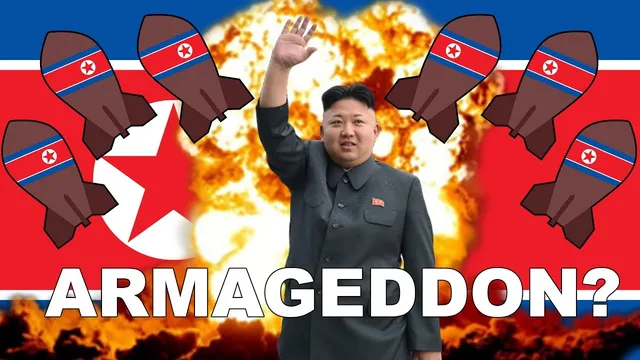
How Big of a Threat is North Korea?
Based on Second Thought's video on YouTube. If you like this content, support the original creators by watching, liking and subscribing to their content.
North Korea’s nuclear program is described as continuing despite sanctions aimed at limiting hard-currency reserves and military funding.
Briefing
North Korea’s nuclear drive is portrayed as a persistent, escalating threat that has survived years of international sanctions and repeated tests—while the region’s defenses may reduce risk, they cannot guarantee protection. The core concern is that Kim Jong-un’s leadership has treated nuclear weapons not as a bargaining chip but as the central mechanism for regime survival, even as it repeatedly violates UN Security Council resolutions through underground detonations and renewed warnings.
The timeline begins with 2003, when Kim Jong-il withdrew North Korea from the Treaty on the Non-Proliferation of Nuclear Weapons after U.S. allegations of an enriched-uranium weapons program. In 2006, North Korea announced it would conduct a nuclear test “in the future,” and a week later the U.S. Geological Survey detected a 4.3 magnitude seismic event consistent with an underground detonation. Confirmation followed: North Korea completed a successful underground nuclear test of a fission device. In response, the UN, the EU, and multiple countries—including the United States, Japan, South Korea, and China—imposed sanctions aimed at North Korea’s financial vulnerabilities, particularly by blocking offshore hard-currency reserves and restricting trade and income. Despite this pressure, North Korea continued testing; the transcript says it has conducted at least five additional nuclear tests, with increasing power, including a September 2016 detonation estimated at roughly 9–12 kilotons.
By 2017, North Korea signaled another nuclear test was imminent, claiming improvements in both the quality and quantity of its arsenal and warning the United States not to provoke it. The situation is framed as especially dangerous because multiple actors with different risk tolerances are now in direct confrontation—North Korea on one side, and the United States and regional allies on the other—amid rising tensions and military posture. The transcript highlights the immediacy of the threat to South Korea, citing around 11,000 pieces of artillery aimed at Seoul and emphasizing how quickly escalation could occur.
In response, the United States and South Korea are described as preparing for preemptive action through systems and plans such as South Korea’s “killchain” concept and joint “4D” operations—detect, disrupt, destroy, and defend. Yet preemption is portrayed as difficult to justify diplomatically and increasingly hard to execute as North Korea shifts toward mobile launchers and solid-fueled missiles that can be fired with little warning.
If missiles launch, the transcript points to layered missile defenses: South Korea’s KAMD supported by a U.S. THAAD battery, plus ballistic-missile tracking and interception capabilities from U.S. and allied Aegis destroyers. Still, missile defense is not treated as foolproof; many systems have not been tested in real combat, and the possibility of a few missiles slipping through remains catastrophic. The transcript also notes that North Korea could potentially deploy separating warheads, complicating defense.
In the event of full-scale war, South Korea’s “Korea Massive Punishment and Retaliation” plan is described as targeting leadership and infrastructure, including the destruction of Pyongyang with missiles and artillery. The broader strategic question—why North Korea would risk its own future—gets a blunt answer: North Korean officials are said to believe nuclear weapons are the best guarantee against eventual U.S. attack, given their view of the United States as the ultimate threat. The transcript closes by framing the decision facing leaders as a narrow line between deterrence and provocation, where miscalculation could trigger war even if neither side truly wants it.
Cornell Notes
North Korea’s nuclear program is presented as an enduring threat that has continued despite years of sanctions and international pressure. After withdrawing from the Non-Proliferation Treaty in 2003 and conducting its first confirmed nuclear test in 2006, North Korea carried out additional tests, including a large 2016 detonation. The transcript argues that sanctions and diplomacy have not changed the leadership’s incentives, because Kim Jong-un’s regime reportedly sees nuclear weapons as essential for survival against perceived U.S. hostility. Regional defenses—preemptive strike concepts, missile defense systems, and naval tracking—could reduce risk, but they are not guaranteed, especially as North Korea uses mobile launchers and solid-fueled missiles. The central danger is escalation: deterrence may fail if either side misreads signals or acts too aggressively.
What events mark the start of North Korea’s nuclear escalation in the transcript, and how did the world respond?
Why does the transcript claim sanctions failed to stop further nuclear development?
How do South Korea and the United States plan to respond if missiles are launched?
What makes preemptive strikes harder as North Korea’s capabilities evolve?
What role do missile defenses play, and what limitations remain?
What explanation does the transcript give for why North Korea pursues nuclear weapons despite the risks?
Review Questions
- How did the transcript connect North Korea’s withdrawal from the Non-Proliferation Treaty to later nuclear testing and sanctions?
- What operational and diplomatic challenges make preemptive strikes increasingly difficult as North Korea adopts mobile launchers and solid-fueled missiles?
- Why does the transcript portray missile defense as helpful but not decisive in preventing catastrophic outcomes?
Key Points
- 1
North Korea’s nuclear program is described as continuing despite sanctions aimed at limiting hard-currency reserves and military funding.
- 2
The transcript traces escalation from 2003 treaty withdrawal through a confirmed 2006 underground test and multiple subsequent tests, including a large 2016 detonation.
- 3
Preemptive planning relies on systems like South Korea’s killchain and joint 4D operations (detect, disrupt, destroy, defend), but execution becomes harder as launchers become mobile and missiles become solid-fueled.
- 4
Layered missile defense includes KAMD with U.S. THAAD support and Aegis destroyers, yet combat effectiveness remains uncertain and warhead-separation concepts could overwhelm defenses.
- 5
Full-scale conflict planning emphasizes rapid retaliation and targeting leadership and infrastructure, including plans to destroy Pyongyang.
- 6
The transcript’s central motivation claim is that North Korean leadership views nuclear weapons as the best guarantee of regime survival against perceived U.S. threat.
- 7
The overall risk is escalation: deterrence can fail if either side misreads signals or crosses the line into provocation.