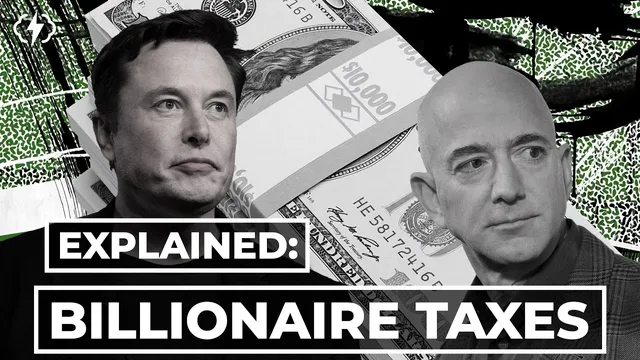
How Billionaires Pay Less In Taxes Than You
Based on Second Thought's video on YouTube. If you like this content, support the original creators by watching, liking and subscribing to their content.
ProPublica’s “Secret IRS Files” reports that effective tax rates for the ultra-wealthy can be dramatically lower than those paid by average workers.
Briefing
The central finding is stark: the richest Americans can pay effective federal tax rates far below ordinary workers—largely because they earn and hold wealth in ways that avoid taxation until (and unless) assets are sold. A ProPublica investigation, “The Secret IRS Files,” put numbers on the gap, including Jeff Bezos’s effective tax rate of 0.98% from 2014 to 2018 despite roughly $100 billion in wealth growth during the same period. By comparison, the average American’s effective tax rate is cited as 14.6%. The implication is not just that billionaires are “lucky,” but that the tax system is structured so that wealth accumulation is treated differently than wages.
Much of the explanation centers on a strategy ProPublica describes as “buy, borrow, die.” First, the ultra-wealthy buy assets, build companies, or inherit fortunes; as long as they don’t sell, they owe little or no tax on gains that exist mainly on paper. Second, they borrow against those holdings to fund day-to-day spending and luxury purchases—so they can live on borrowed cash rather than taxable income. The transcript contrasts the tax burden of taking a large salary (with a much higher tax rate) against the relatively favorable terms of loans secured by appreciating assets. Third, when they die, complicated trusts and philanthropic structures can reduce or eliminate estate taxes, allowing heirs to inherit assets with favorable tax treatment.
The transcript argues that this isn’t merely a loophole exploited by a few individuals; it reflects a broader political economy. Wealthy interests are portrayed as having enough influence to steer policy toward lower taxes on corporations and the wealthy, a shift traced to the post–1980s acceleration of declining tax burdens. The result is worsening inequality and a system where the ultra-rich can effectively shape government without being elected. The discussion also claims that public-facing support for higher taxes on the rich often functions as branding, while lobbying efforts work to keep actual tax rates low.
To counter the common defense that billionaires are “not really that rich” because their wealth is unrealized, the transcript points to conspicuous consumption funded through borrowing: Bezos’s ability to buy a custom $500 million superyacht and multiple high-end properties is used as evidence that the wealth is real even if it isn’t taxed as income. It also highlights how political reactions to the ProPublica report—such as investigations into how the information was obtained—are framed as evidence that officials prioritize protecting the system over addressing the underlying tax imbalance.
Finally, the transcript links the tax issue to a larger democratic problem: a “corporate duopoly” in which Democrats and Republicans are described as converging on corporate interests, leaving ordinary voters with little leverage. It ends by arguing that electoral participation alone has not produced meaningful change, and that renewed class consciousness and mass organization are the missing ingredients for radical reform. In that framing, the ProPublica findings are less a one-off scandal than fuel for a broader shift in public anger toward those controlling the levers of power.
Cornell Notes
ProPublica’s “Secret IRS Files” documents how the ultra-wealthy can pay extremely low effective tax rates while their fortunes grow rapidly. Jeff Bezos’s effective rate is given as 0.98% from 2014–2018 despite about $100 billion in wealth growth, compared with an average American rate of 14.6%. The transcript attributes the gap to “buy, borrow, die”: holding appreciating assets to avoid tax, borrowing against them to fund spending, and using trusts or foundations to reduce estate taxes. The broader claim is that declining taxes on the wealthy and corporate influence over policy have accelerated inequality. The stakes are framed as both fairness and democratic accountability—ordinary workers pay taxes on wages, while billionaires can access a different system tied to asset ownership.
How does “buy, borrow, die” reduce taxes for billionaires compared with wage earners?
What specific numbers are used to illustrate the tax gap between the ultra-wealthy and average workers?
Why does the transcript treat “unrealized gains aren’t taxed” as a partial defense rather than a full rebuttal?
What evidence is offered to show that billionaires’ wealth is usable even if it’s not taxed as income?
How does the transcript connect tax policy to political influence and party differences?
What change does the transcript say is needed beyond voting?
Review Questions
- What mechanisms in “buy, borrow, die” delay or avoid taxes at each stage (living, holding, and dying)?
- How do the transcript’s comparisons between Bezos’s effective rate and the average American’s rate support its fairness argument?
- What political dynamics does the transcript claim explain why tax policy remains favorable to the ultra-wealthy?
Key Points
- 1
ProPublica’s “Secret IRS Files” reports that effective tax rates for the ultra-wealthy can be dramatically lower than those paid by average workers.
- 2
Jeff Bezos is cited as having a 0.98% effective tax rate from 2014 to 2018 despite about $100 billion in wealth growth during that period.
- 3
The transcript attributes the tax gap to “buy, borrow, die”: holding appreciating assets to avoid tax, borrowing against them to fund spending, and using trusts or foundations to reduce estate taxes.
- 4
The “unrealized gains” defense is treated as technically correct but practically incomplete because borrowing can finance lifestyles without triggering taxable income.
- 5
Declining tax burdens on corporations and the wealthy are linked to worsening inequality, with policy influence attributed to wealthy donors and corporate lobbying.
- 6
Political reactions to the tax-reporting scandal are framed as evidence that officials prioritize protecting the system over addressing the underlying imbalance.
- 7
The transcript argues that meaningful reform requires renewed class consciousness and mass organization, not just voting.