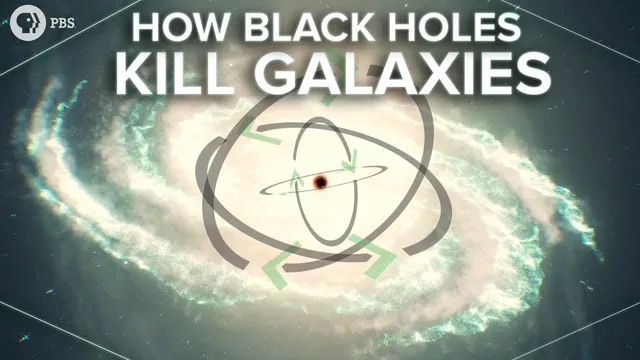
How Black Holes Kill Galaxies
Based on PBS Space Time's video on YouTube. If you like this content, support the original creators by watching, liking and subscribing to their content.
Supermassive black holes correlate tightly with galactic bulges in ways that are hard to attribute to direct gravity alone.
Briefing
Supermassive black holes appear to be the main mechanism that shuts down star formation in the biggest galaxies—turning them “red and dead”—and the timing of black hole growth lines up with the universe-wide decline in star birth. Astronomers have long noticed a tight mass connection between a galaxy’s central black hole and the mass of its stellar bulge, plus an even tighter link between black hole mass and how fast stars move in random orbits inside that bulge. Those correlations are puzzling because a black hole’s gravity should matter most only very near the galactic center, not across the entire galaxy.
The leading solution starts with how galaxies build up in the early universe. In the prevailing “bottom-up” picture, small galaxies form first and merge into larger systems, with gas funneled into dense regions by dark matter. As galaxies assemble, their central black holes also grow: early “seed” black holes form from the first generations of stars, sink to galactic centers, and merge as their host galaxies merge—while also feeding on abundant gas. In principle, that shared growth could naturally produce correlations. In practice, the relationship is too tight, and it evolves with cosmic time: observations suggest many black holes were already massive early, while surrounding galaxies later “caught up,” implying the two weren’t simply growing in lockstep from the same inflow.
That mismatch is where “quenching” enters. In the largest galaxies—especially giant elliptical galaxies—star formation has largely stopped for billions of years. The usual explanation is that black holes switch on as quasars and inject energy into the surrounding gas. When gas spirals into a black hole, it forms an accretion disk heated by gravitational energy; a fraction of the infalling mass is converted into radiation, which then drives powerful winds and can also launch jets via magnetic fields. The result is feedback: energy either blows gas out of the galaxy or heats it so it can’t cool and collapse into new stars. Quasar activity can also self-limit black hole growth by cutting off the very gas supply that fuels the black hole, creating a balancing cycle between feeding and shutdown.
Even if other processes contribute—like supernova-driven heating during intense starbursts or shock heating from gas accreting into clusters—the black hole hypothesis remains the prime suspect because the cosmic histories match. Black hole growth peaks around 10 billion years ago, near the same era when the universe’s star formation rate begins to fall sharply. In today’s universe, massive “red and dead” ellipticals host fossil quasars and supermassive black holes, suggesting a long, violent struggle: galaxies grow, black holes feed, quasars ignite, star formation is choked off, and the system settles into a quiescent state. The core takeaway is that the black hole–galaxy connection likely reflects feedback that sets the maximum size and star-forming lifetime of the biggest galaxies, even if the exact balance of culprits is still under debate.
Cornell Notes
The strongest evidence links supermassive black holes to the shutdown of star formation in the largest galaxies. Observations show tight correlations between black hole mass and properties of the galactic bulge—despite the fact that a black hole’s direct gravity should only dominate near the center. The leading mechanism is quenching: when gas feeds a black hole, it powers a quasar whose radiation, winds, and jets heat or expel galactic gas, preventing it from cooling and collapsing into new stars. This feedback also limits further black hole growth, creating a self-regulating cycle. The timing matters: black hole growth peaks around the same epoch (~10 billion years ago) when the universe’s star formation rate begins to decline, supporting a causal role for black holes in “red and dead” ellipticals.
Why are the observed black hole–galaxy correlations surprising given basic gravity?
How does the “bottom-up” galaxy formation picture help explain co-growth of black holes and galaxies?
What does “quenching” mean, and how can a quasar stop star formation?
Why does the cosmic timing of black hole growth matter for the quenching hypothesis?
What other mechanisms could also reduce star formation, and why do they not fully replace the black hole explanation?
What does it mean that giant ellipticals are “red and dead”?
Review Questions
- What observational relationships between black hole mass and bulge properties create the central puzzle about how black holes affect galaxies beyond their immediate region?
- Describe the quenching feedback loop: how does quasar energy change the state of galactic gas, and how does that also limit black hole feeding?
- How does the alignment between the quasar/black hole growth peak and the decline in cosmic star formation rate strengthen the case for black holes as a primary driver?
Key Points
- 1
Supermassive black holes correlate tightly with galactic bulges in ways that are hard to attribute to direct gravity alone.
- 2
Early galaxy assembly in a bottom-up, merger-driven universe naturally produces co-growth, but the tightness and timing still demand feedback physics.
- 3
Quenching is the leading explanation for why giant elliptical galaxies stop forming stars: quasar winds and jets heat or expel gas and prevent cooling.
- 4
Quasar activity can self-regulate black hole growth by cutting off the gas supply, creating a feedback balance.
- 5
The universe’s star formation rate declines after peaking around the same era (~10 billion years ago) when black hole/quasar growth peaks.
- 6
Other processes—supernova heating and accretion shocks—likely contribute, but black holes remain the strongest suspect given correlations and cosmic timing.