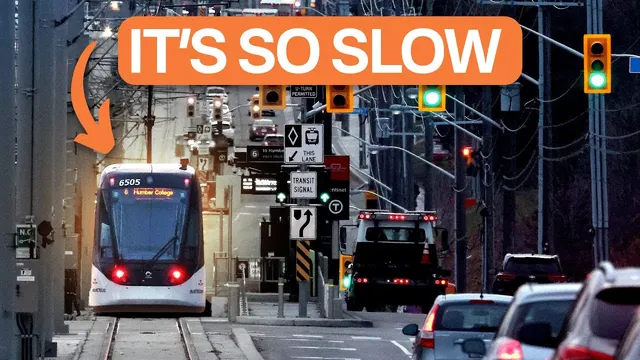
How can a NEW Transit Line be THIS BAD!? (Finch West LRT)
Based on Not Just Bikes's video on YouTube. If you like this content, support the original creators by watching, liking and subscribing to their content.
Finch West LRT’s opening-day performance—55 minutes for 10.3 km—translated into an average speed under 12 km/h and drew immediate public scrutiny.
Briefing
Toronto’s new Finch West LRT has drawn immediate backlash because it’s painfully slow—so slow that riders have been filmed racing the train on foot and beating it. On opening day, the 10.3-kilometre westbound trip took 55 minutes, averaging under 12 km/h, and it has continued to underperform compared with the bus route it replaced. The central issue isn’t just that the line is delayed or expensive; it’s that the operating design makes speed gains unlikely, even if some fixes are made.
The slowdown starts at intersections. Although the LRT runs in a dedicated lane, it lacks traffic-signal priority, meaning trains frequently stop for red lights. The promised “priority” is described as conditional and limited—extending green time only when a train is approaching and only if it’s behind schedule—rather than actively adjusting signals to keep service on a fast, predictable timetable. Even when lights do turn green, the timing reportedly favors left-turning cars first, forcing the LRT to wait while motorists clear turns. City council has signaled it will change signal timing and add priority, but the critique is that the changes may remain “watered-down,” leaving the line stuck with a stop-and-go rhythm.
Speed restrictions compound the problem. The TTC’s framework includes a 60 km/h limit in suburban areas, yet observed speeds between stops are often under 40 km/h, with brief peaks around 56 km/h. More damaging are the low limits through intersections (25 km/h) and at platforms (15 km/h). The TTC justifies these limits as safety measures tied to Vision Zero, but the argument is that tram lines in other countries—where road speeds are managed more consistently—don’t cripple transit with such extreme throttling. The line also appears to accelerate sluggishly from stops, reducing one of modern LRTs’ key advantages: quick electric acceleration.
Beyond operations, the line’s physical layout is criticized as “car-centric transit.” Stations sit in the middle of a suburban arterial road (“stroad”), forcing passengers to cross multiple lanes of traffic to reach destinations. The stops are also spaced extremely closely—often under 450 metres apart—so trains rarely build momentum. The design reportedly avoids placing stations next to buildings, parks, or car-free areas, instead landing riders at the edges of strip malls and large parking lots. Even the Humber College end of the line is framed as an awkward concession to drivers, with the stop positioned at the far side of a parking lot beside Highway 27.
The transcript places Finch West within a longer Toronto planning saga: the line traces back to the Transit City plan proposed in 2007, was scheduled to open in 2013, and was delayed after political cancellations under Rob Ford and Doug Ford. Yet the strongest takeaway is that the performance failures shouldn’t have been surprising. The line is portrayed as being built to operate like Toronto’s existing streetcars—without signal priority, with close stop spacing, and with restrictive intersection speeds—meaning it inherited the same structural constraints. The proposed remedy is not only technical: sustained public pressure is framed as necessary so promised changes extend beyond incremental signal tweaks and also carry over to the Eglinton Crosstown and the streetcar network.
Cornell Notes
Finch West LRT’s early performance has triggered sharp criticism because the line is designed to move slowly through a suburban road network. Opening day travel time—55 minutes for 10.3 km—translated into an average speed under 12 km/h, and riders have even been filmed beating the train on foot. The transcript points to two main causes: intersection behavior (no meaningful traffic-signal priority, plus left-turn timing that keeps the LRT waiting) and restrictive speed policies (low limits through intersections and at platforms, plus observed between-stop speeds well below posted caps). A third, structural problem is “car-centric” station placement and spacing, which forces frequent stops and unsafe, inconvenient crossings. The takeaway: without deeper design and operating changes, fixes may not deliver the speed and rider experience Toronto expected.
Why does the Finch West LRT lose so much time at intersections even though it has a dedicated lane?
How do speed limits and observed speeds combine to keep the LRT slow between stops?
What does “car-centric transit” mean in the Finch West LRT context, and how does it affect riders?
Why does station spacing matter for LRT speed, and what’s wrong with Finch West’s spacing?
How does the line’s political and planning history relate to the performance problems?
What changes are being discussed, and why might they fall short?
Review Questions
- Which specific intersection-control shortcomings are blamed for the LRT’s low average speed?
- How do the intersection and platform speed limits affect the train’s ability to maintain momentum?
- What role does station spacing play in preventing the LRT from reaching efficient cruising speeds?
Key Points
- 1
Finch West LRT’s opening-day performance—55 minutes for 10.3 km—translated into an average speed under 12 km/h and drew immediate public scrutiny.
- 2
The line’s lack of meaningful traffic-signal priority causes frequent red-light stops, with left-turn timing reportedly taking precedence over LRT movement.
- 3
Speed restrictions are a major contributor: low limits through intersections (25 km/h) and at platforms (15 km/h) keep average speeds depressed even when signals turn green.
- 4
Observed between-stop speeds are often far below posted suburban caps, suggesting operational constraints beyond signage alone.
- 5
Extremely close station spacing (often under 450 metres) prevents trains from building momentum, making speed improvements difficult without redesign.
- 6
Station placement and alignment are criticized as “car-centric,” forcing riders to cross multiple lanes and making stops feel unsafe and inconvenient.
- 7
The transcript argues that promised signal tweaks may not be enough unless they deliver proactive priority and are paired with broader fixes that also apply to other Toronto transit projects.