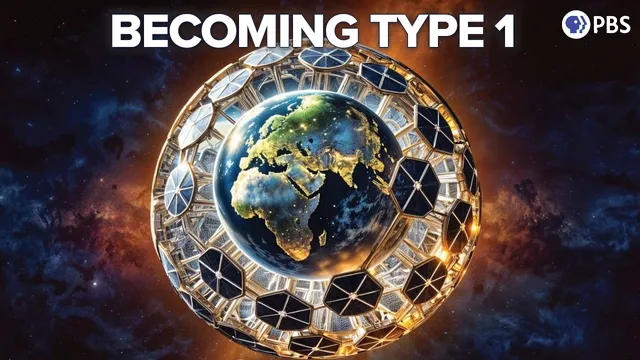
How Can Humanity Become a Kardashev Type 1 Civilization?
Based on PBS Space Time's video on YouTube. If you like this content, support the original creators by watching, liking and subscribing to their content.
Kardashev Type 1 is framed as commanding roughly 10^17 watts of power at a planetary scale, estimated from the total solar energy Earth intercepts each day.
Briefing
Humanity’s best shot at becoming a Kardashev Type 1 civilization hinges on one measurable capability: commanding roughly planet-scale energy—about 10^17 watts—using stable, renewable sources. On the Kardashev scale, Type I means accessing all available energy on a planetary level; Type II and Type III step up to star and galaxy scales. The transcript frames the practical question as a solar problem: how much energy does Earth receive from the Sun each day, and what would it take to collect anything close to that amount?
Earth intercepts sunlight over a disk the size of its radius, yielding an upper limit near 1.7×10^17 watts, with 10^17 watts treated as the target order of magnitude. Today’s global power use is around 10^13 watts—about 10,000 times smaller—so reaching Type I requires far more than incremental improvements to existing solar farms. The path starts with solar technology itself. Silicon p-n junction cells convert light via photoexcitation, but they face efficiency ceilings such as the Shockley–Queisser limit, where spectrum losses cap how much of the incoming photon energy becomes usable electrical power. Traditional single-junction designs land around ~30% theoretical limits and only about 25% in practice, while newer approaches—multi-junction stacks tuned to different photon energies, perovskites, and quantum dots—aim to push beyond 50% efficiency through better spectral capture.
Where the cells sit matters as much as how well they convert. Space-based solar power gains energy because Earth’s atmosphere blocks much UV light; in space, those UV photons raise the available energy by about a factor of 10. Continuous operation without night adds another factor of two. The major engineering bottleneck becomes transmitting that power back to Earth. Microwave power transmission at 2.45 GHz is presented as a leading option: orbiting solar arrays beam energy through the atmosphere, and ground receivers (“rectennas”) convert it back into electricity. The transcript also notes that a space elevator could someday help with logistics, but the core idea remains the same—massive swarms of collectors in orbit, co-orbit, or near Lagrange points.
Scaling to 10^17 watts implies collector areas vastly larger than Earth’s surface to compensate for transmission and other losses—on the order of more than 100 trillion square kilometers. Even with thinner silicon (scaled down by a factor of 10), the mass could still be only a few trillion kilograms, which the transcript argues is not absurd given silicon’s abundance and the likely role of asteroid mining for supporting infrastructure. Achieving Type I via solar also sets up a natural progression toward Type II: keep expanding until the Sun is effectively wrapped by arrays, approaching a Dyson-sphere-like configuration.
Solar isn’t the only route. The transcript lays out an alternative: building “mini-Suns” through artificial fusion. Deuterium–tritium fusion releases about four times as much energy per gram as uranium fission, and the fuel supply for deuterium is abundant in Earth’s oceans. The challenge shifts from fuel to reactors and power conversion. Magnetic confinement fusion—especially tokamaks such as ITER—relies on strong magnetic fields to hold hot plasma and aims for net energy gain at scale. The transcript estimates that if electricity extraction from fusion is limited (for example, 20% efficiency), powering a Type I civilization could require on the order of 100,000 ITER-like reactors; higher efficiency and larger reactor designs could reduce that number to thousands.
Finally, the transcript turns from energy to purpose. With energy on the scale of oceans and atmosphere, humanity could tackle climate reversal, mass desalination and farming, asteroid mining, advanced manufacturing, and eventually terraforming—while also enabling the computation and AI needed to solve remaining technical hurdles. The endgame remains Kardashev’s ladder: Type I as the first step toward mastering a star’s output and beyond, potentially making Earth a detectable beacon to other emerging civilizations.
Cornell Notes
Kardashev Type 1 is defined by commanding planet-scale energy—about 10^17 watts. The transcript estimates this target using the total solar power Earth intercepts each day, then compares it to today’s global use (~10^13 watts), showing the gap is roughly 10,000×. Reaching the goal requires both better energy conversion (beyond silicon’s ~25% practical efficiency and the Shockley–Queisser limit) and large-scale collection, with space-based solar offering major gains from UV access and continuous sunlight. Power delivery is treated as the key systems problem, with 2.45 GHz microwave transmission and rectennas as a leading approach. Fusion is presented as a possible alternative route, but it depends on solving reactor-scale net energy and building many reactors to supply Type I power.
Why does the transcript treat “planet-scale energy” as the defining requirement for a Type 1 civilization?
How is the Type 1 energy target estimated from Earth’s sunlight?
What limits conventional solar cells, and how do newer designs aim to beat those limits?
Why does space-based solar power offer big advantages over ground-based solar?
How does the transcript propose sending space-collected solar energy to Earth?
What would fusion need to deliver for Type 1 power, and why are many reactors likely required?
Review Questions
- What numerical gap does the transcript highlight between today’s global power use and the Type 1 target, and how is the target derived from solar irradiance?
- Which efficiency limits constrain single-junction solar cells, and what specific material or architecture changes are proposed to surpass them?
- Between space-based solar and fusion, which bottleneck does the transcript emphasize most strongly for each path (transmission vs. reactor scale and net energy)?
Key Points
- 1
Kardashev Type 1 is framed as commanding roughly 10^17 watts of power at a planetary scale, estimated from the total solar energy Earth intercepts each day.
- 2
Current global energy use (~10^13 watts) sits about 10,000× below the Type 1 benchmark, making incremental solar growth insufficient on its own.
- 3
Solar cell efficiency is constrained by spectrum losses and the Shockley–Queisser limit; multi-junction designs, perovskites, and quantum dots are proposed routes beyond ~50% efficiency.
- 4
Space-based solar gains major headroom because UV photons are not blocked by the atmosphere and there is no night-time, but it demands large-scale power transmission infrastructure.
- 5
Microwave power transmission at 2.45 GHz with rectennas is presented as a leading method to deliver space-collected energy to Earth.
- 6
Fusion offers an alternative energy source using deuterium–tritium reactions, but achieving Type 1 power likely requires many large magnetic-confinement reactors (e.g., ITER-scale) due to conversion efficiency limits.
- 7
With planet-scale clean energy, the transcript argues the next bottleneck becomes distribution, storage, computation, and large-scale engineering for climate repair and expansion.