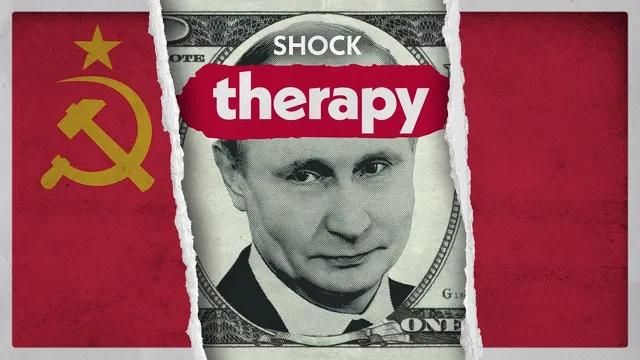
How Capitalism Destroyed Russia
Based on Second Thought's video on YouTube. If you like this content, support the original creators by watching, liking and subscribing to their content.
Shock therapy is described as a rapid, top-down shift from planned to neoliberal capitalism, combining price liberalization, austerity, international capital access, and fast privatization.
Briefing
Russia’s post-Soviet transition wasn’t a peaceful march toward democracy; it was a rapid, top-down conversion to neoliberal capitalism carried out through “shock therapy,” producing mass economic collapse and political repression. The core claim is that liberal reforms were designed to break labor power and concentrate ownership, and that “democracy” functioned mainly as a rhetorical cover rather than an outcome.
The narrative begins by rejecting the familiar Western storyline: the USSR’s end is often framed as an inevitable triumph of capitalism and a democratic awakening. Instead, the dissolution is described as fast, internal, and undemocratic—Gorbachev resigns after the USSR is formally dissolved, while Boris Yeltsin and leaders of Ukraine and Belarus recognize each other’s independence. A key detail is that a referendum held shortly before the collapse showed roughly 80% support for preserving the union with reforms, suggesting the breakup was not the product of popular democratic choice.
Once the Russian Federation is established, shock therapy is portrayed as the mechanism that turns sudden political change into economic transformation. Beginning in January 1992, price controls on consumer goods are largely removed, triggering an immediate surge in prices (described as about 250% for necessities). The reforms then bring layoffs, hyperinflation, and steep declines in output: unemployment rises, GDP falls, industrial production drops, inflation reaches extremely high levels, and real incomes are cut roughly in half. The human toll is emphasized with statistics on rising deaths, falling male life expectancy, and a sharp increase in poverty—along with cuts to education and health spending.
The account links these outcomes to specific policy choices: austerity, opening the economy to international capital, and privatization at breakneck speed. A decree allowing people to sell anything anywhere is described as a desperate survival response, not evidence of healthy spontaneous markets. Organized crime is said to flourish in the deregulated chaos. Privatization is quantified as well: tens of thousands of state companies are privatized within a short period, often through vouchers worth about $20, which are portrayed as effectively worthless during starvation and hyperinflation.
The most consequential argument targets how ownership was distributed. Even if privatization had been “fair” in procedure, capitalism would still concentrate wealth; but the process is described as both sloppy and politically motivated. Jeffrey Sachs is cited for advocating “speed above perfection,” including acceptance of heavy insider representation, because delays would risk democratic resistance. The IMF is described as withholding funds until reforms were implemented, while Yeltsin is described as consolidating executive power—ruling through constitutional changes and periods of exceptional authority, including violent suppression of parliamentary opposition in 1993.
Across both economic and political dimensions, democracy is presented as something that had to be sidelined for capitalism to proceed. The result is characterized as “sham elections” and capitalist dominance rather than genuine self-government. The closing warning connects the transition to later consequences: extreme wealth concentration, dependence on oil and gas, and geopolitical conflict—framing today’s wars and crises as downstream effects of a system built on repression and market-based domination rather than democratic legitimacy.
Cornell Notes
The transition from the USSR to modern Russia is framed as a rapid neoliberal conversion carried out through “shock therapy,” not as a democratic awakening. After the USSR’s dissolution—portrayed as swift and not driven by popular democratic choice—Russia’s government removed price controls, imposed austerity, and pursued privatization at high speed. The economic shock is linked to hyperinflation, unemployment, falling GDP and industrial output, and major declines in health and living standards. Politically, the same period is described as anti-democratic: executive power was consolidated, parliamentary opposition was suppressed, and “democracy” is treated as a rhetorical cover. The long-run claim is that this structure helped produce oligarchic wealth, repression, and later instability, including conflict tied to fossil-fuel dependence.
Why does the account reject the idea that the USSR’s end was an inevitable, democracy-driven triumph of capitalism?
What policies are described as “shock therapy” in Russia, and what immediate economic effects followed?
How does the transcript connect economic collapse to privatization and ownership distribution?
What role do international institutions and economic advisors play in the “speed over perfection” logic?
How does the account argue that political repression was necessary for the economic transition?
What long-term consequences does the transcript link to this transition?
Review Questions
- What specific economic indicators (prices, GDP, inflation, employment, life expectancy) are used to characterize the early shock therapy period in Russia?
- How does the transcript connect the mechanics of privatization (vouchers, insider access, speed) to the emergence of oligarchic wealth?
- Which political actions (executive consolidation, parliament sidelining, suppression) are presented as prerequisites for the economic reforms?
Key Points
- 1
Shock therapy is described as a rapid, top-down shift from planned to neoliberal capitalism, combining price liberalization, austerity, international capital access, and fast privatization.
- 2
The USSR’s dissolution is portrayed as sudden and not driven by democratic consent, despite a recent referendum showing strong support for preserving the union with reforms.
- 3
Early 1992 reforms are linked to immediate price spikes, hyperinflation, rising unemployment, falling GDP and industrial output, and sharp declines in real incomes.
- 4
The transcript argues that privatization produced oligarchic wealth by distributing assets largely to insiders and managers, while vouchers lost value amid crisis.
- 5
International leverage is emphasized: the IMF is described as withholding funds until reforms were implemented, while advisors pushed “speed above perfection.”
- 6
Political repression is presented as structurally tied to economic change, with executive consolidation and suppression of parliamentary opposition during the Yeltsin era.
- 7
The long-run legacy is framed as wealth concentration, fossil-fuel dependence, and geopolitical conflict fueled by competition over energy profits.