How Capitalism Destroys Radical Movements
Based on Second Thought's video on YouTube. If you like this content, support the original creators by watching, liking and subscribing to their content.
The mural is treated as a case of political co-optation: public recognition substitutes for meeting the movement’s policy demands.
Briefing
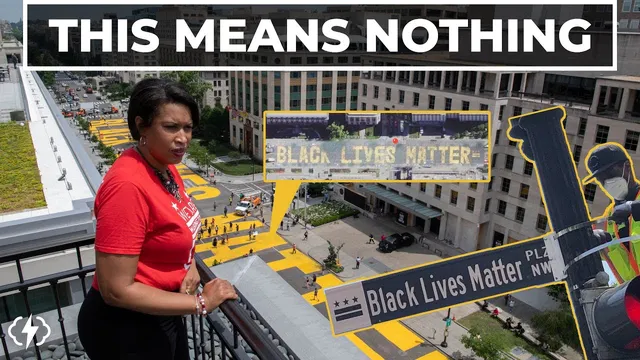
A Black Lives Matter mural commissioned by Washington, D.C. mayor Muriel Bowser in June 2020 is used as a case study in how power neutralizes radical movements without directly confronting their demands. The mural is framed as more than a symbolic gesture: it helps Bowser “co-opt and neutralize” BLM by substituting a spectacle of solidarity for concrete policy change. That matters because it shows how governing can proceed through consent—winning public legitimacy while shifting away from the movement’s actual aims.
The argument links the mural to Bowser’s contemporaneous policy direction, including proposals that would increase police budgets and expand the cadet program, alongside public messaging that reframed “defund the police” as something closer to reform rather than abolition. Even when the movement’s local wing called out the hypocrisy, the mural still functioned effectively in a broader political sense: it sterilized radical slogans into safer, more acceptable language. “Defund the Police” becomes training and funding; “Black Lives Matter” becomes a recognition statement rather than a push to redistribute wealth, dismantle the carceral state, or re-fund institutions that support a decent life.
To explain how this happens, the discussion draws on Guy Debord’s concept of the “society of the spectacle” from *The Society of the Spectacle* and related Situationist International ideas. In this view, consumerist capitalism trains people to treat appearances as essential—so political life increasingly runs on images, branding, and performative legitimacy rather than substantive conflict over material conditions. The analysis extends beyond any single politician: Trump’s outsider image is contrasted with policy outcomes that benefited elite interests, while Hillary Clinton and Joe Biden are described as challenging Trump largely through cultivated credibility and temperament rather than reversing key policies. The common thread is politics dominated by how things look, not what they do.
That spectacle becomes a tool for “recuperation,” the process by which dominant classes absorb revolutionary symbols and defang their content. Debord’s formulation—subversive discoveries get trivialized, sterilized, and safely spectacularized—serves as the mechanism behind the mural’s effect. Recuperation doesn’t just dilute demands; it also protects the existing order. With radical language neutralized, officials can claim alignment with revolution while maintaining the oppressive structures the movement targets.
The framework then shifts to Antonio Gramsci’s theory of hegemony. Coercion through police and prisons is only one pillar of rule; the other is manufacturing consent through “civil society” institutions like media and political organizations. Bias may not appear as overt lies, but as unchallenged assumptions, selective framing, and language changes that make the dominant narrative feel like common sense. This cultural domination is described as “cultural hegemony,” where debates are permitted only within boundaries that preserve power.
Finally, Mark Fisher’s “capitalist realism” is introduced to show the long-term consequence: capitalism becomes not just the prevailing system but the only imaginable option. Recuperated movements and co-opted slogans help hollow out alternatives, narrowing public debate to market-compatible “externalities” rather than systemic change. The result is a world where even abolitionist language can coexist with the persistence of capitalist structures—turning radical politics into prefixes, entertainment, and weekly talking points rather than threats to the social order.
Cornell Notes
A Black Lives Matter mural in Washington, D.C., commissioned by Mayor Muriel Bowser, is treated as a concrete example of “recuperation”: radical slogans are absorbed into official culture while their demands are neutralized. The analysis connects this to Debord’s “society of the spectacle,” where politics increasingly runs on appearances and legitimacy performances rather than material policy conflict. It then uses Gramsci’s hegemony to explain how consent is manufactured through cultural institutions—media, political debate, and framing—so dissent becomes safe or irrelevant. Over time, Mark Fisher’s “capitalist realism” describes how capitalism becomes the only thinkable system, making alternatives seem impossible even when suffering is obvious. The takeaway is that symbolic recognition can function as political control when it replaces substantive change.
How does the mural illustrate “recuperation” rather than genuine support for BLM’s goals?
What does Debord’s “society of the spectacle” add to the explanation of political co-optation?
Why does the discussion say coercion alone can’t explain stable rule?
How can media bias manufacture consent without relying on outright lies?
What is “capitalist realism,” and how does recuperation connect to it?
Review Questions
- What specific mechanisms turn radical slogans into safer policy language, according to the analysis of “defund the police” and “Black Lives Matter”?
- How do Debord’s spectacle and Gramsci’s hegemony each explain why appearances can matter politically more than substance?
- In what ways does capitalist realism limit the range of solutions considered legitimate, and how does that affect the prospects for systemic change?
Key Points
- 1
The mural is treated as a case of political co-optation: public recognition substitutes for meeting the movement’s policy demands.
- 2
Bowser’s contemporaneous proposals—like increasing police budgets and expanding the cadet program—are used to argue that the mural helped justify a shift away from BLM’s aims.
- 3
Debord’s “society of the spectacle” frames modern politics as image-driven, where legitimacy performances can replace material conflict over policy.
- 4
“Recuperation” describes how dominant classes absorb revolutionary symbols, sterilize their radical content, and neutralize their threat to power.
- 5
Gramsci’s hegemony explains stability through consent-making in “civil society,” not just through coercion via police and prisons.
- 6
Manufactured consent often relies on subtle framing and unchallenged assumptions that make dominant narratives feel like common sense.
- 7
Fisher’s “capitalist realism” explains how co-opted movements and market-compatible debate narrow imagination, keeping capitalism presented as the only viable option.