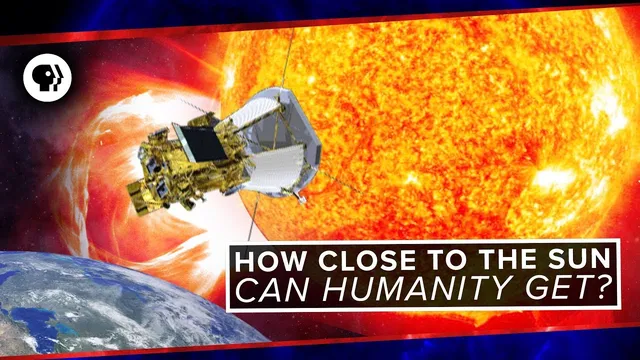
How Close To The Sun Can Humanity Get?
Based on PBS Space Time's video on YouTube. If you like this content, support the original creators by watching, liking and subscribing to their content.
Parker Solar Probe will reach about 6.2 million kilometers from the Sun, enabling direct sampling of the solar wind’s source region.
Briefing
Humanity’s closest-ever approach to the Sun is coming with NASA’s Parker Solar Probe, a mission designed to solve a practical problem with civilization-scale consequences: the Sun’s corona and solar wind can disrupt—and sometimes cripple—modern technology. The probe will fly within about 6.2 million kilometers of the solar surface, roughly seven times closer than any human-made object has gone, and it will repeatedly skim the region where the Sun’s most energetic outbursts send streams of charged particles toward Earth.
The urgency comes from how the Sun delivers both life and danger. Solar energy powers Earth’s biosphere, but solar activity also drives magnetic storms and the solar wind—plasma that can damage satellites, power grids, and communications. A landmark example is the 1859 Carrington Event, when a massive coronal mass ejection disrupted Earth’s magnetosphere. Charged particles arrived at nearly 1% the speed of light, producing auroras worldwide and knocking out newly built telegraph networks across North America and Europe. A similar event in 2012 missed Earth; had it struck a week earlier, the transcript notes, the “end of world” prediction tied to the Mayan calendar might have been closer to reality. The financial fallout from an event of that magnitude has been estimated at up to $2 trillion, and recovery today would likely take years or decades.
Parker’s mission is built around a core scientific goal: trace how energy moves through the corona and identify what accelerates the solar wind. Existing monitoring—ground telescopes and spacecraft observing from safer distances—can’t directly sample the source region closely enough. Parker will instead “bathe” in the solar wind and measure the electromagnetic environment and particle properties at the origin.
Four instruments work together to build a complete picture. The field experiment measures the Sun’s electromagnetic field using a magnetometer and voltage detector, linking magnetic activity to the solar wind’s source while also measuring plasma density and electron temperature. SWEAP (Solar Wind Electrons, Alphas, and Protons) directly samples the dominant solar-wind particles—electrons, helium ions (alpha particles), and protons—tracking their velocity, temperature, and density. ISIS (Integrated Science Investigation of the Sun) captures the most energetic particles and maps their energies back to coronal origins. WISPR (Wide-field Imager for Solar Probe) uses two telescopes to image the corona and nearby structures, including shocks, providing the visual context needed for three-dimensional models.
Getting that close is a major engineering challenge. The spacecraft needs a heat shield that can endure continuous exposure to intense solar radiation and temperatures above 1,650 Kelvin while keeping instruments near room temperature. A 4.5-inch carbon composite heat shield was developed for the job.
Even reaching the Sun is nontrivial. Parker can’t simply “fall” inward; it must escape Earth’s gravity and then shed speed to enter a tighter orbit. The plan uses multiple Venus gravitational assists—seven flybys in total—to reduce velocity and progressively stretch Parker into an orbit that reaches closer to the Sun. By the end of 2024, the closest approach is targeted at 6.2 million kilometers. Over nearly seven years, Parker will complete 26 close approaches, including five passes at a near-touch distance where it will sample the full force of solar outbursts, delivering data aimed at understanding both the corona and the perilous solar wind.
Cornell Notes
NASA’s Parker Solar Probe is designed to answer how the Sun’s corona heats up and what accelerates the solar wind—questions tied to real-world risks to satellites, power systems, and communications. The probe will repeatedly fly to within about 6.2 million kilometers of the Sun, far closer than any previous spacecraft, sampling the electromagnetic fields and particles directly in the region where solar wind is launched. Four coordinated instruments measure fields (field experiment), particle properties (SWEAP), energetic particle origins (ISIS), and coronal structures and shocks (WISPR). A specialized 4.5-inch carbon composite heat shield must withstand radiation and temperatures above 1,650 Kelvin while keeping instruments near room temperature. Reaching the Sun requires seven Venus flybys to reduce speed and reshape the orbit into a Mercury-like 88-day period.
Why does studying the corona and solar wind matter for modern society?
What is Parker Solar Probe’s primary science objective?
How do Parker’s instruments work together to connect coronal processes to the solar wind?
What engineering solution lets Parker survive near the Sun?
Why can’t Parker just “fall” toward the Sun, and what role do Venus flybys play?
Review Questions
- What specific measurements must Parker make to connect coronal heating to solar wind acceleration?
- How does the carbon composite heat shield address the thermal problem of operating near 1,650+ Kelvin solar radiation?
- Why does Parker’s mission architecture rely on multiple Venus flybys rather than a direct inward trajectory?
Key Points
- 1
Parker Solar Probe will reach about 6.2 million kilometers from the Sun, enabling direct sampling of the solar wind’s source region.
- 2
Solar activity can disrupt technology; the 1859 Carrington Event knocked out telegraph systems and caused widespread auroras.
- 3
Parker’s core science objective is to trace energy flow in the corona and identify what accelerates the solar wind.
- 4
Four instruments—field experiment, SWEAP, ISIS, and WISPR—combine electromagnetic, particle, and imaging measurements to build a unified picture.
- 5
A 4.5-inch carbon composite heat shield is required to keep instruments near room temperature despite temperatures above 1,650 Kelvin.
- 6
Reaching the Sun depends on seven Venus gravitational assists to reduce orbital speed and reshape Parker’s trajectory into a tight, eccentric orbit.
- 7
Over nearly seven years, Parker targets 26 close approaches, including five passes at a near-touch distance for sampling the Sun’s most intense outbursts.