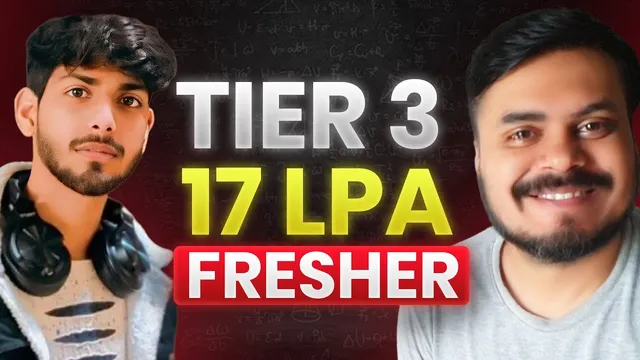
How Did He Crack Data Scientist Job in Such Tough Job Market ? | Success Story 2024 | CampusX DSMP
Based on CampusX's video on YouTube. If you like this content, support the original creators by watching, liking and subscribing to their content.
Tarun Chauhan treated job hunting as a parallel discipline to learning, not a last step after skills were built.
Briefing
A data science fresher from a tier-3 college, Tarun Chauhan, landed a Data Scientist role paying 17 LPA despite a weak hiring market—largely by treating preparation and job hunting as two parallel, disciplined projects. The core takeaway is blunt: confidence comes less from luck and more from a structured learning plan, consistent execution, and relentless outreach when replies don’t arrive.
Tarun’s path starts with a mindset shift. When doubts about “no jobs for freshers” surfaced, he didn’t overthink the market. He chose a specialization—AI/ML—after researching branches in college and then committed to the work behind the choice. His approach mirrored a “pick the ball and hit” philosophy: focus on what has potential, then put in the effort. He also emphasized that social media noise creates confusion, so he avoided chasing too many resources at once.
For technical preparation, he built a roadmap and followed it tightly for roughly two years (from late second year through third year). He began with Python (which took him about four to five months due to limited good resources), then moved to SQL, data analysis, and finally machine learning. Instead of jumping between multiple guides, he extracted common elements from several roadmaps, created a single learning plan, and stayed on it. A key detail: he used a long-form SQL learning resource (a four-hour SQL video) to gain clarity quickly, then moved into a structured “100 Days of Machine Learning” playlist with notes and a course completion strategy.
When his knowledge reached a “decent level,” he shifted to proof—portfolio and resume building. He created a forecasting project and a movie recommendation system, expanding features and data, and improving the front end using HTML, CSS, and JavaScript. He also pursued internships: one machine learning internship for three months and another research-lab experience in his third year, which added practical tools and deeper exposure.
Job hunting became the second major discipline. After applying through platforms like Internshala, LinkedIn, and Unstop with little response for about two months, he changed tactics: he started cold emailing and targeted companies aligned with data science roles. He joined groups, set job alerts, and used LinkedIn networking strategically—sending connection requests to many employees, then messaging them with relevant skills and internship experience without asking directly for referrals. Over roughly six months, he gave interviews for about 15 data science roles across around 50 total interviews, facing rejections but continuing weekly.
His final hiring process at Monotype was multi-round and technical. It included DSA problems (subarray sum equals K, median of two sorted arrays, duplicate detection, and a sorting-based character function), SQL questions (window functions like top-N per department, dense_rank vs rank concepts), pandas/data analysis tasks on a dataset of about 1000 rows, and then deeper statistics, ML, and deep learning rounds. He credited success to preparation depth—especially DSA practice, math/stats grounding, and handwritten notes that made recall fast during interviews. He ultimately joined Monotype as an AI/ML-related trainee/role, translating a structured learning-to-execution pipeline into an offer of 17 LPA.
Cornell Notes
Tarun Chauhan secured a 17 LPA Data Scientist offer from Monotype by combining a tight technical roadmap with a high-effort job search. He chose AI/ML after researching branches, then spent roughly two years building skills—starting with Python (4–5 months), then SQL, data analysis, and machine learning—while avoiding resource sprawl. He backed learning with portfolio work (forecasting and an enhanced movie recommendation system) and two internships, including a machine learning internship and an innovative research lab experience. When applications stalled, he shifted to cold outreach and targeted LinkedIn networking, sending many connection requests and messages and continuing through weekly interview cycles. His interview success came from strong DSA, SQL/window functions, pandas/data manipulation, and math/stats fluency supported by handwritten notes for rapid recall.
How did Tarun Chauhan handle the fear that freshers can’t find data science jobs in a weak market?
What learning strategy helped him progress from beginner to interview-ready without getting lost in too many resources?
What role did portfolio projects and internships play in his transition from learning to getting interviews?
Why did his job search change after initial applications produced little response?
What kinds of technical questions appeared in his Monotype interview rounds?
What did he credit as the biggest differentiator during interviews—knowledge, practice, or recall?
Review Questions
- What specific sequence did Tarun Chauhan follow in his technical roadmap, and how did he handle the early difficulty with Python?
- How did Tarun Chauhan’s job search strategy evolve from platform applications to cold outreach and LinkedIn employee networking?
- Which technical areas (DSA, SQL/window functions, pandas, stats, ML, deep learning) appeared across his interview rounds, and what evidence did he use to answer them effectively?
Key Points
- 1
Tarun Chauhan treated job hunting as a parallel discipline to learning, not a last step after skills were built.
- 2
He avoided resource sprawl by extracting common elements from multiple roadmaps and then following one consistent learning plan.
- 3
Python was the biggest early bottleneck (about 4–5 months), but once mastered, the rest of the roadmap progressed faster.
- 4
Portfolio proof mattered: he built forecasting and recommendation projects, then improved the recommendation system with extra attributes, data, and a front end.
- 5
Internships provided credibility and practical exposure, including a three-month machine learning internship and later research-lab work.
- 6
When applications stalled, he shifted tactics—cold emailing, targeted company research, and LinkedIn networking with many connection requests and tailored messages.
- 7
Handwritten notes in his own language improved recall during interviews, helping him deliver examples repeatedly across rounds.