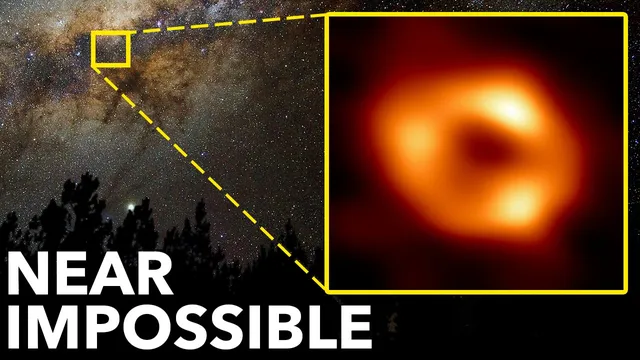
How did they actually take this picture? (Very Long Baseline Interferometry)
Based on Veritasium's video on YouTube. If you like this content, support the original creators by watching, liking and subscribing to their content.
Sagittarius A* appears only slightly larger than M87* from Earth because it is about 2,000 times closer but over 1,000 times smaller, and its environment blocks visible light.
Briefing
The Event Horizon Telescope’s black-hole images are possible only because Earth-based radio observatories act together like an Earth-sized telescope, using very long baseline interferometry to sharpen radio-wave measurements to the scale of a black hole’s “shadow.” Sagittarius A*—the supermassive black hole at the Milky Way’s center—was especially hard: it sits behind thick dust and gas that blocks visible light, it is over 1,000 times smaller than M87* (so it appears only slightly larger from Earth), and its accretion flow changes on minute timescales. Yet the collaboration still produced a ring-like silhouette by observing at radio wavelengths of 1.3 millimeters, where the surrounding plasma is detectable even though the black hole itself emits no light.
The core technical trick starts with angular resolution, the ability to distinguish tiny structure on the sky. A single radio dish can’t resolve the ring structure of a black hole because its resolution is too coarse; as a telescope scans across the target, it would blur together signals from different parts of the black hole. Shorter wavelengths could, in principle, improve resolution, but Earth’s atmosphere and the black hole’s environment block those options. Instead, resolution is boosted by effectively increasing the telescope’s diameter. The Event Horizon Telescope accomplishes this not with one giant dish, but by linking widely separated dishes across the planet—up to distances comparable to Earth’s diameter—so their combined signals reproduce the interference pattern an Earth-sized instrument would generate.
Each observatory records the incoming radio signal locally along with extremely precise timing (to the femtosecond). The data can’t be combined in real time because the signals arrive at different places, so petabytes of recordings are shipped to central processing sites. The imaging step then relies on interference fringes: pairs of telescopes separated by different distances and orientations produce different bright-and-dark patterns depending on the wavefront’s phase and the source’s position. By collecting many such patterns across a global network, the system reconstructs a high-resolution image that no single telescope could produce.
What the “black shadow” corresponds to is subtler than the event horizon itself. Space-time curvature bends light rays, so photons that skim near the black hole can either fall in or escape depending on their approach angle. The resulting dark region is set by the photon sphere: light can orbit at about 1.5 Schwarzschild radii, but that orbit is unstable. Rays that just graze the photon sphere form a shadow whose diameter is about 2.6 times the event horizon’s radius. In that sense, the center of the shadow maps to the event horizon, while the surrounding darkness reflects how many light paths are swallowed.
The bright ring and asymmetries come from the accretion disk’s hot, fast-moving plasma. Matter orbits at significant fractions of the speed of light, so relativistic (Doppler) beaming makes the side moving toward Earth brighter than the side moving away. Depending on viewing angle, gravitational lensing can also reveal the “backside” of the accretion disk and even multiple, nested images of the event horizon—light that loops around the black hole before reaching the telescopes. The final picture is therefore not a direct photograph of a black hole, but a map of how curved space-time and relativistic plasma dynamics shape the paths and brightness of incoming radio-emitting light.
Cornell Notes
The Event Horizon Telescope created black-hole images by observing Sagittarius A* at radio wavelengths of 1.3 millimeters and combining signals from a global network of dishes using very long baseline interferometry. No single telescope can resolve the ring-scale structure, so widely separated observatories provide the angular resolution an Earth-sized dish would have. Each site records the signal with femtosecond-accurate timing; later, interference fringes from many telescope pairs are combined to reconstruct the image. The dark “shadow” is not just the event horizon: gravitational lensing and unstable photon orbits produce a shadow about 2.6 times larger than the event horizon radius, while relativistic beaming from the fast accretion disk makes one side brighter.
Why can’t a single radio telescope on Earth directly resolve the ring around Sagittarius A*?
How does very long baseline interferometry mimic an Earth-sized telescope?
What role do “fringes” play in turning raw telescope recordings into an image?
What sets the size of the black hole’s shadow—event horizon or something else?
Why does the ring look brighter on one side?
How can an image reveal the “backside” of the event horizon or multiple rings?
Review Questions
- What physical limitation prevents a single radio dish from resolving the black hole ring, and why can’t shorter wavelengths solve it?
- Explain how baseline length and orientation affect the interference fringes used to reconstruct an image.
- Why is the observed shadow diameter about 2.6 times the event horizon radius, and how does the photon sphere determine that scale?
Key Points
- 1
Sagittarius A* appears only slightly larger than M87* from Earth because it is about 2,000 times closer but over 1,000 times smaller, and its environment blocks visible light.
- 2
The Event Horizon Telescope images at radio wavelengths of 1.3 millimeters because that radiation can penetrate dust and gas and because shorter wavelengths are not practical from Earth.
- 3
Angular resolution scales with wavelength and telescope diameter, so the array’s effective diameter must be increased to resolve the ring-scale structure.
- 4
Very long baseline interferometry links widely separated telescopes so their combined interference pattern matches what an Earth-sized dish would achieve.
- 5
Each observatory records signals locally with femtosecond-accurate timing; petabytes of data are later combined to reconstruct the image from many baseline-dependent fringes.
- 6
The dark shadow size is set by photon trajectories near the unstable photon sphere, producing a shadow about 2.6 times larger than the event horizon radius.
- 7
Relativistic beaming from the fast accretion disk and gravitational lensing determine the ring’s brightness asymmetry and the appearance of additional lensed features.