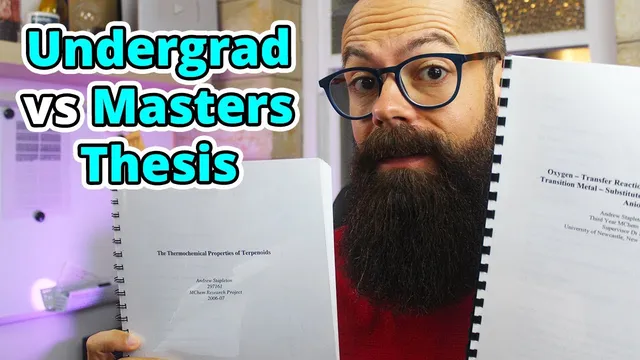
How Different Are They Really? Critical Differences between undergrad & masters thesis
Based on Andy Stapleton's video on YouTube. If you like this content, support the original creators by watching, liking and subscribing to their content.
An undergraduate thesis primarily demonstrates competence: gathering information, explaining it, and applying it in a limited, degree-focused way.
Briefing
Undergraduate and master’s theses can look similar on paper, but the biggest difference is what each one is meant to prove—and how much room it leaves for original research. An undergraduate thesis is primarily a credentialing exercise: it demonstrates that a student can gather information, explain it clearly, and apply it in a limited way. A master’s thesis, by contrast, pushes harder on knowledge transfer—taking established material from the literature and moving it into a new or broader research area, with enough momentum that it can plausibly feed into a PhD-level question.
That shift toward transfer and research readiness shows up in several practical ways. The master’s thesis typically demands a deeper literature review and more careful explanation of how prior work applies to the student’s chosen direction. It also functions as a “taster” of research life: more interaction with a supervisor, more exposure to the frustrations and politics of academia when plans don’t go smoothly, and a clearer sense of what a supervisor is like as a researcher rather than just a teacher. The undergraduate experience can feel more procedural and more isolated, with less day-to-day guidance and fewer chances to test ideas in real time.
Time and scope reinforce the distinction. With more time available, the master’s thesis tends to go into greater detail and depth, even if the overall subject area remains similar. In the account here, the undergraduate work leaned toward repeating established approaches and “going through the motions,” while the master’s thesis involved more active engagement—delving deeper into the latest developments and relying on feedback from other PhD students in the lab to check what was right, what was wrong, and whether the work was being done correctly.
Length and density also tend to separate the two. In the same field, a master’s thesis is expected to be thicker, with more data and references; the example given contrasts 45 pages versus 63 pages, and 27 versus 46 references. The master’s thesis also included more substantial content such as additional data and a more detailed literature engagement, whereas the undergraduate thesis is described as lighter on acknowledgments and more focused on completing the required process.
Even the personal experience differs. The master’s thesis is portrayed as more demanding emotionally and politically, but also more formative—especially because supervisor fit can shape motivation and satisfaction. The undergraduate supervisor was described as quirky and pleasant, yet the student felt less connection; later, that lesson carried into the PhD decision, where supervisor choice became central to research happiness.
Overall, the core takeaway is that the undergraduate thesis is about proving competence with established knowledge, while the master’s thesis is about demonstrating the ability to reposition that knowledge into a research project with original direction. The result is a subtle but important graduation from “showing you can do the work” to “showing you can extend it.”
Cornell Notes
An undergraduate thesis mainly proves that a student can gather and explain knowledge and apply it in a limited way to meet degree requirements. A master’s thesis raises the bar by requiring knowledge transfer into new areas, deeper literature engagement, and the ability to shape that material into a research project with hints of new questions. The master’s experience also tends to feel more like early research training: more supervisor interaction, more lab feedback, and exposure to the frustrations and politics of academia. Differences in time, scope, and document density (pages, references, and data) often make master’s theses look heavier even when the field is the same.
What is the central purpose difference between an undergraduate and a master’s thesis?
How does supervisor interaction change from undergraduate to master’s work?
Why does time matter for thesis depth?
What role do lab and peer interactions play in the master’s thesis process?
How do document metrics like pages and references signal the difference?
How does personal interest and supervisor fit affect thesis experience?
Review Questions
- In what ways does “knowledge transfer” change what a master’s thesis must accomplish compared with an undergraduate thesis?
- Which thesis differences described here are most likely to affect document structure (pages, references, data), and which are more about process (supervision, lab feedback, politics)?
- How might supervisor choice influence research motivation differently for undergraduate, master’s, and PhD stages?
Key Points
- 1
An undergraduate thesis primarily demonstrates competence: gathering information, explaining it, and applying it in a limited, degree-focused way.
- 2
A master’s thesis emphasizes knowledge transfer—moving literature into a new or expanded research area and shaping it into a research project.
- 3
Master’s work typically involves deeper literature review and more explicit connection between prior research and the student’s chosen direction.
- 4
More time and broader scope in a master’s thesis often produce greater depth, denser documentation, and more data.
- 5
Supervisor interaction tends to increase at the master’s level, bringing both practical guidance and exposure to research frustrations and academic politics.
- 6
Peer and lab feedback can materially improve the quality of a master’s thesis by helping validate what is correct and correct what is not.
- 7
Supervisor fit and personal interest strongly affect how meaningful the thesis experience feels, influencing later research choices.