How Do Airplanes Fly?
Based on minutephysics's video on YouTube. If you like this content, support the original creators by watching, liking and subscribing to their content.
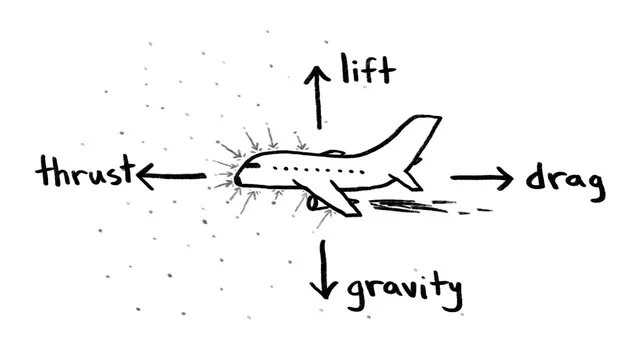
Airplanes stay airborne when the upward lift force balances gravity, making the net force zero.
Briefing
Airplanes fly because lift emerges from a pressure imbalance: the air pressure on the underside of the wings is higher than the pressure on top, and that difference can counter gravity. The key condition is not that forces disappear, but that they balance. Gravity pulls the aircraft, passengers, and cargo downward, while air molecules push on the fuselage and wings in many directions. When the upward push from the wing-generated airflow matches the downward pull from gravity, the net force becomes zero, letting the plane stay aloft.
The lift mechanism starts with how air behaves around a wing at rest versus in motion. When a plane is parked, air molecules bounce off the top and bottom of the wing in roughly equal amounts, producing “equal pressure” and no net lift. Once the wing moves forward, its curved shape and slight angle of attack change the interaction: the underside “crashes” into more air molecules and with more force than the top. That raises pressure beneath the wing. At the same time, fewer molecules strike the top and those that do arrive with less impact, partly because the wing’s forward motion “shields” the top (similar to how running into rain keeps your back drier) and partly because curved flow patterns create lower pressure on the inside of the curve as air is deflected outward by centripetal effects.
With low pressure above and high pressure below, the wing generates an upward force large enough to lift the aircraft against gravity. But lift alone doesn’t keep a plane moving. The same momentum exchange that produces lift also tends to slow the aircraft down, because pushing air downward and backward implies a drag-like reaction. Engines prevent that loss of speed by adding thrust—pushing air backward.
Propellers and jets both create thrust by accelerating air rearward. Even when engines are inefficient, the spinning fan blades still generate thrust through the same basic physics as wings: their curved, angled surfaces act like mini-wings moving quickly through air. Put together, an airplane becomes a “meta-wing” system. The aircraft advances because its engine-driven mini-wings push air backward, and that forward motion then lets the large wings push air down hard enough to generate lift. In short: thrust keeps the plane moving; wing pressure differences keep it flying.
Cornell Notes
Lift comes from a pressure difference across the wings: higher pressure under the wing and lower pressure above it. When that upward lift balances gravity, the net force on the airplane is zero, so the aircraft can remain in the air. At rest, a wing produces roughly equal pressure on top and bottom, so there’s no lift. In motion, the wing’s curvature and slight angle of attack cause the underside to hit more air molecules more forcefully, while the top experiences fewer, less forceful impacts due to shielding and curved-flow effects. Engines then supply thrust by pushing air backward, and rotating fan blades act like mini-wings that enable the airplane’s forward speed.
Why does an airplane stay in the air even though many forces act on it?
What changes when a wing goes from being stationary to moving forward?
How does the wing’s shape and angle create higher pressure on the bottom and lower pressure on the top?
Why doesn’t lift alone keep the plane moving at a constant speed?
How do propellers and jets produce thrust, and how are they related to wings?
Review Questions
- If the pressure on the top of the wing rises to match the pressure on the bottom, what happens to lift and why?
- Describe two mechanisms mentioned for why the top of a moving wing experiences fewer or less forceful air impacts than the bottom.
- Explain the relationship between thrust and lift in terms of what each one accomplishes for an airplane’s motion.
Key Points
- 1
Airplanes stay airborne when the upward lift force balances gravity, making the net force zero.
- 2
Lift comes from a pressure imbalance: higher pressure under the wing and lower pressure above it.
- 3
A stationary wing produces roughly equal pressure on top and bottom, so it generates little or no lift.
- 4
In forward flight, the wing’s curvature and angle of attack increase the force and number of air impacts on the underside while reducing them on the top.
- 5
Forward motion “shields” the top of the wing from incoming air, and curved airflow contributes to lower pressure above the wing.
- 6
Engines maintain speed by producing thrust, which pushes air backward to counteract the slowing effect of pushing air for lift.
- 7
An airplane functions like a “meta-wing,” where engine fan blades act as mini-wings to enable the forward motion that large wings need for lift.