How Do Night Vision Goggles Work?
Based on Veritasium's video on YouTube. If you like this content, support the original creators by watching, liking and subscribing to their content.
Active-illumination night vision emits near-infrared light and relies on a camera/display pipeline, which creates latency and limits range to the emitted illumination distance.
Briefing
Night vision goggles don’t just “see in the dark”—they trade off between three different ways of getting an image: creating light, amplifying existing light, or detecting heat. In near-total darkness, image intensification (the core of most military goggles) can still produce a usable picture only when there are at least a few photons to amplify; once the environment becomes truly photon-starved, thermal imaging wins because it doesn’t need any external illumination.
The testing begins with the practical problem of filming darkness itself: cameras convert incoming photons into electrical signals, then boost them using settings like ISO. At high ISO, a camera can reveal shadow detail, but it still depends on photons. That sets up the real-world comparison—what happens when the goggles are taken into a moonless, streetlight-free Navy range.
Commercial “active illumination” goggles work like a hidden flashlight. They emit near-infrared light (in wavelengths just beyond human vision), and a camera captures that reflected near-infrared and displays it on a screen. The approach is cheap and common, but it has predictable drawbacks: limited range (only as far as the emitted light reaches), a telltale near-infrared beacon that can be detected by adversaries, and—because the system uses a camera and display—noticeable latency that can cause motion sickness during fast movement. In a driving test, the active-illumination goggles feel “zoomed in,” jittery, and disorienting without guidance.
Military-grade goggles largely avoid those issues by using image intensification instead of a camera. Photons enter a tube and are physically amplified so that many more electrons emerge from the system while preserving the image’s spatial structure. With the PVS-31A as an example, the amplification is described as thousands of times brighter, powered by a single AA battery, and the delay is extremely small—down to microsecond or even nanosecond levels—making the experience feel natural enough for driving. The trade-offs shift: the field of view can be limited, and the technology depends on available light.
The tube’s internals explain why. A photocathode ejects electrons when photons hit it; a microchannel plate multiplies those electrons through an avalanche process; a phosphor screen converts the resulting electron energy back into visible photons; and fiber optics twist the image back upright. Historically, the phosphor’s green output shaped the classic look of night vision, while newer “white phosphor” versions better match how human rods respond in low light.
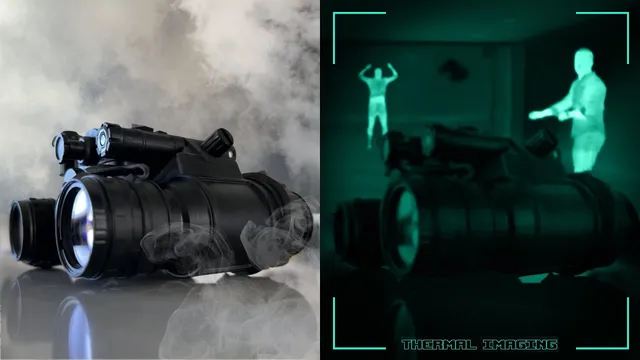
When the range is sealed and pushed toward “almost no visible light,” image intensification degrades into noise—often described as a blizzard—because there are too few photons to amplify. That’s where thermal imaging takes over. Thermal cameras detect long-infrared radiation emitted by objects themselves (governed by Planck’s law), so they can reveal people, smoke, and fog-shrouded scenes without needing any external light source. They also tend to have motion delays and can’t read sign text that relies on reflected visible light.
Finally, the technology’s evolution is framed as generations (Gen 0 through Gen 3), each improving sensitivity and tube longevity—moving from bulky early designs to microchannel plates and newer photocathode materials like gallium arsenide. The bottom line: no single night-vision method is universally best; the “right” system depends on whether the environment is photon-rich, photon-starved, or obstructed by smoke and fog—and on how much delay, concealment, portability, and resolution can be tolerated.
Cornell Notes
Night vision comes in three main approaches: active illumination (near-infrared light plus a camera/display), image intensification (amplify existing photons inside a tube), and thermal imaging (detect emitted long-infrared heat). Active illumination is cheap and common but has limited range, can be detected because it emits a beacon, and introduces latency that can cause motion sickness. Image intensification—used in military goggles like the PVS-31A—amplifies photons thousands of times with extremely low delay, making movement feel natural, but it still needs some light to amplify. In near-total darkness, image intensification produces mostly noise, while thermal imaging remains effective because objects emit infrared radiation even without external illumination. The best choice depends on light conditions, concealment needs, and acceptable delay/resolution trade-offs.
Why do active-illumination night vision goggles feel “off” during fast motion?
What physical steps let image intensification preserve an image while making it brighter?
What happens to image intensification in “almost no photons” conditions?
Why does thermal imaging work in pitch darkness when image intensification doesn’t?
How do military goggles like the GPNVG-18 address the field-of-view problem?
How did night vision “generations” improve over time?
Review Questions
- In what specific ways do active illumination systems reveal themselves to an observer, and how does that affect military use?
- Compare the failure modes of image intensification and thermal imaging when the environment approaches absolute darkness.
- What tube components in image intensification correspond to (1) electron generation, (2) electron multiplication, and (3) image output?
Key Points
- 1
Active-illumination night vision emits near-infrared light and relies on a camera/display pipeline, which creates latency and limits range to the emitted illumination distance.
- 2
Image intensification amplifies incoming photons inside a tube, producing extremely low delay and a more natural feel for movement, but it still requires some ambient light.
- 3
In near-total darkness, image intensification degrades into noise dominated by thermionic emission and field-driven electron release because there are too few photons to amplify.
- 4
Thermal imaging detects long-infrared radiation emitted by objects, so it can see in photon-starved conditions and through smoke/fog, but it can’t show sign text based on reflected visible light.
- 5
Field of view is a practical limitation for many military image-intensification goggles; multi-tube designs like the GPNVG-18 widen coverage by combining outputs into a larger effective view.
- 6
Night vision technology has evolved through generations (Gen 0–Gen 3), moving from active illumination to microchannel plates and improved photocathode materials to increase sensitivity and tube lifetime.