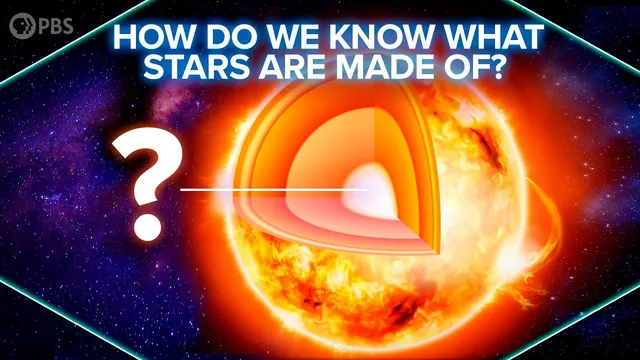
How Do We Know What Stars Are Made Of?
Based on PBS Space Time's video on YouTube. If you like this content, support the original creators by watching, liking and subscribing to their content.
Absorption lines form when atoms or ions absorb photons only at energies that match specific electron energy gaps, removing those wavelengths from the outgoing spectrum.
Briefing
Stars are made mostly of hydrogen and helium—and scientists figured that out by reading the “missing” colors in starlight, not the light itself. When sunlight (or any star’s light) passes through the Sun’s outer layers, specific photon energies get absorbed by atoms and ions. Those energy-specific losses appear as dark absorption lines in a spectrum. Because each chemical element has a unique set of electron energy levels, the pattern of absorption lines acts like a fingerprint for which elements—and which ionization states—exist in the stellar atmosphere.
The key obstacle was that stellar spectra are messy. Photons don’t travel straight out of a star; they bounce around for tens of thousands of years, scattering off free electrons. Only near the photosphere—about 100 km deep—does the density drop enough that many photons can escape without further collisions. Even then, as temperatures fall, electrons can be captured by nuclei to form atoms, which absorb photons only when the photon energy matches the exact energy gap between electron levels. That’s why the spectrum shows dark lines at particular wavelengths: those photons are “plucked out” on their way out.
Turning those absorption lines into actual chemical abundances required quantum mechanics and clever approximations. In the early 1920s, Cecilia Payne—later Cecilia Payne-Gaposchkin—used emerging quantum theory to interpret how ionization changes electron energy levels. The Sun’s intense conditions repeatedly strip electrons from atoms, creating different ions, each with its own absorption-line pattern. Payne built on ionization ideas associated with Meghdad Saha, who had developed a formula predicting the distribution of ionization states given temperature and pressure. Payne’s advance was to connect the observed line strengths to relative element abundances, using a crucial theoretical insight: the weakest absorption lines should scale more directly with the abundance of the relevant ionization state.
Payne analyzed spectra collected at the Harvard Observatory and calculated relative abundances across stars. The results were strikingly consistent with Earth’s general elemental mix—except for one major shift. Her calculations indicated that hydrogen is by far the most abundant element in the Sun, with helium close behind, while heavier elements are far less common. That contradicted the prevailing assumption that the Sun was made of the same material as Earth, just hotter.
Her thesis initially faced pushback, with advice to soften the hydrogen-and-helium conclusion. Payne reportedly downplayed it as “almost certainly not real,” attributing the result to incomplete understanding of atomic theory at the time. Within a few years, the hydrogen-and-helium composition was confirmed, and Payne became widely credited with discovering what stars are made of. Her work also produced a more precise method for estimating stellar temperatures from absorption lines rather than relying only on overall color.
With stellar composition clarified, other theorists—Arthur Eddington among them—could connect the dots to energy production. Fusion and stellar physics moved from speculation to a detailed, testable framework. The result was a rapid transformation: stars went from mysterious points of light to well-understood engines of nuclear energy, with Payne’s spectral fingerprints at the center of the breakthrough.
Cornell Notes
Scientists determine what stars are made of by analyzing absorption lines—dark features where specific photon energies are removed from the thermal light. Photons scatter for a long time inside a star, but near the photosphere they can escape; along the way, atoms and ions absorb photons only when the photon energy matches exact electron energy gaps. Each element (and each ionization state) produces a distinct pattern of absorption lines, so the spectrum acts like a chemical fingerprint. Cecilia Payne-Gaposchkin used quantum theory—especially ideas about ionization—to translate line strengths into relative abundances. Her calculations showed the Sun is dominated by hydrogen and helium, overturning the earlier belief that the Sun’s composition closely matched Earth’s.
Why do dark absorption lines reveal elements inside a star?
How does the Sun’s interior affect what reaches the photosphere?
What role does ionization play in stellar spectra?
What was Cecilia Payne’s key methodological insight for turning spectra into abundances?
Why did Payne’s conclusion about hydrogen and helium matter scientifically?
Review Questions
- How do absorption lines differ from the smooth thermal spectrum, and what physical process creates them?
- Explain how ionization states complicate the interpretation of stellar spectra and how quantum theory helps resolve that complexity.
- What was the significance of using the weakest absorption lines in Payne’s analysis, compared with relying on the strongest lines?
Key Points
- 1
Absorption lines form when atoms or ions absorb photons only at energies that match specific electron energy gaps, removing those wavelengths from the outgoing spectrum.
- 2
Photon escape from a star is slow and scattering-heavy: free electrons can delay travel from the core to the surface by tens of thousands of years.
- 3
The pattern of absorption lines depends on both elemental abundance and ionization state, since ionization changes electron energy levels.
- 4
Cecilia Payne-Gaposchkin used quantum-theory ionization ideas to translate absorption-line strengths into relative element abundances.
- 5
Payne’s analysis indicated the Sun is dominated by hydrogen, with helium close behind, overturning the earlier assumption that the Sun’s composition resembled Earth’s.
- 6
Her approach also improved temperature estimates for stars by using absorption-line information rather than relying only on overall color.