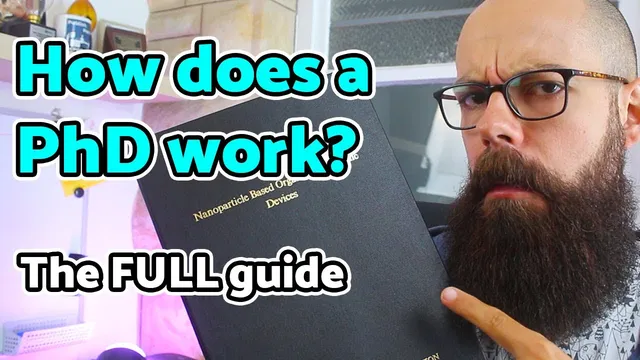
How does a PhD work? The FULL guide!
Based on Andy Stapleton's video on YouTube. If you like this content, support the original creators by watching, liking and subscribing to their content.
A PhD is typically a three-to-four-year research qualification built around original work that can withstand examiner judgment.
Briefing
A PhD typically boils down to three to four years of sustained work aimed at producing original research that can survive expert scrutiny—then packaging that work into a thesis (or a publication-based alternative) and defending it if required. From a student’s perspective, the core reality is less about coursework and more about the daily grind of generating data, analyzing it, and building a coherent scientific contribution that a panel of examiners can judge as novel, robust, and well explained.
Time commitment is the first major constraint. In the example given, an international PhD student in Australia had to finish within three years to avoid paying an additional estimated 20,000 Australian dollars for a fourth year. Scholarships and fee waivers—earned after completing a first-class master’s degree—helped cover living costs so the student could focus full-time on research. Domestic students were described as often taking longer (around four to four and a half years), and the transcript notes that PhDs can stretch dramatically if progress stalls, with one firsthand case reaching ten years.
The second pillar is originality. Original research means collecting and analyzing aspects of the world that no one has examined in the same way before. The transcript frames this as pushing a small “bump” into the broader sphere of human knowledge. Practically, that originality is tested early through a literature review: surveying existing work, identifying gaps, and choosing a research direction that meaningfully fills one of those gaps. The work can also become interdisciplinary, blending fields rather than staying inside a single traditional boundary (the speaker’s own area is described as sitting between chemistry, physics, and engineering).
The third pillar is how the work becomes a qualification. A PhD must be demonstrated through either peer-reviewed papers and/or a thesis. While thesis-based examination remains the norm, the transcript highlights a growing pathway called “PhD by publication,” where roughly three to five papers (often closer to five) can be assembled into a submission, connected by short explanatory material that ties each paper back to the overall aims. Regardless of format, the end goal is judged by a panel of examiners who assess whether the research is novel enough and sufficiently explained.
Examination then follows a structured set of outcomes. After submission, examiners return comments and the candidate may be allowed to revise. Outcomes range from outright fail to major corrections—where fundamental issues require redoing parts of the research, potentially adding about six more months of experiments—to “pass with minor corrections,” which is portrayed as the most common result. Minor corrections can be substantive (unclear explanations) or surprisingly technical (missing punctuation in references, missing middle initials, spelling mistakes). The best-case scenario is “pass with no corrections,” described as rare and reserved for work that is robust, novel, and clearly communicated.
Finally, many programs include an oral defense (“viva” or “fiver” in the transcript’s wording). Examiners may probe fundamentals, ask the candidate to explain or even draw equations, and then deliberate before inviting the candidate back for a final yes/no decision. The transcript also notes that the full submission-to-result timeline can take six to eight months (with several months for examiner feedback and additional time for panel sign-off), and that some institutions may skip an oral defense entirely, relying on the thesis alone—often influenced by the cost and logistics of flying examiners.
Cornell Notes
A PhD is framed as a qualification earned through original research plus expert evaluation. Most students complete it in about three to four years, with international students sometimes facing strict deadlines tied to tuition costs. Originality is established by identifying gaps through a literature review and then generating data that no one has analyzed in the same way before. The work is then packaged either as a traditional thesis or via “PhD by publication” using several peer-reviewed papers connected by explanatory material. After submission, examiners issue outcomes ranging from fail to major corrections, most commonly “pass with minor corrections,” and sometimes “pass with no corrections,” followed by an oral defense in many institutions.
What does “original research” mean in practice, and how does a PhD student prove it early on?
Why does the timeline matter, especially for international students?
How can someone earn a PhD without writing a traditional thesis?
What are the possible examiner outcomes after thesis submission, and what do they imply?
What happens during an oral defense, and how long can it take?
How long can the submission-to-PhD process take?
Review Questions
- How does a literature review function as a mechanism for establishing originality in a PhD?
- Compare “major corrections” and “pass with minor corrections” in terms of what examiners are likely to require.
- What practical constraints (financial, logistical, or institutional) can affect the PhD timeline and whether an oral defense is included?
Key Points
- 1
A PhD is typically a three-to-four-year research qualification built around original work that can withstand examiner judgment.
- 2
Original research is grounded in identifying gaps through a literature review and then generating novel, analyzable data to fill those gaps.
- 3
PhD submissions can be thesis-based or “PhD by publication,” where several peer-reviewed papers are connected by explanatory material.
- 4
Examiner outcomes range from fail to major corrections, with “pass with minor corrections” described as the most common result.
- 5
Minor corrections can be both substantive (unclear explanations) and technical (reference formatting, missing initials, spelling).
- 6
Oral defenses often involve probing fundamentals and can run from about one to three hours, though some institutions may skip them.
- 7
The full process from submission to final approval can take roughly six to eight months due to examiner feedback, revisions, and panel sign-off.