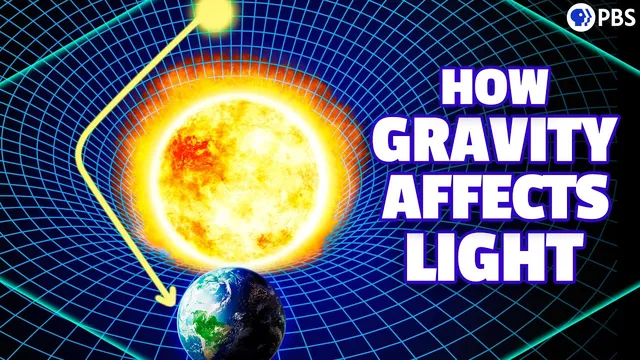
How Does Gravity Affect Light?
Based on PBS Space Time's video on YouTube. If you like this content, support the original creators by watching, liking and subscribing to their content.
Gravity affects light in at least two distinct ways: it redshifts photons escaping a gravitational field and it deflects light passing near massive objects.
Briefing
Gravity bends the path of light—and general relativity makes that outcome unavoidable. The central insight is that multiple, seemingly unrelated effects predicted by Einstein’s framework line up with older, even incorrect Newton-style reasoning: light is “redshifted” by gravity, and it also deflects when passing near massive objects. The hard part isn’t the prediction; it’s the mechanism.
Long before Einstein, John Mitchell proposed in 1783 that a sufficiently massive star’s gravity could slow a “particle of light,” stop it, and pull it back—an idea that accidentally foreshadowed black holes. Henry Cavendish pursued similar logic and predicted deflection. Their calculations relied on assumptions that don’t hold in modern physics: light was treated as a particle that experiences gravity like ordinary matter, and Newtonian gravity was assumed to be the full story. Yet the qualitative effects they predicted—light being affected by gravity—turned out to be real. General relativity explains why those outcomes emerge even when the original reasoning was wrong.
Einstein’s equivalence principle provides the backbone. It says there’s no experiment that can distinguish being in a gravitational field from being in an accelerating frame. In a thought experiment, an accelerating rocket fires a laser across the deck: because the ship keeps accelerating while the light travels, the wave peaks spread out, increasing wavelength and lowering frequency—an effect described as gravitational redshift. The same result follows if gravity slows clocks: any process that produces photons can be treated like a “clock,” and clocks run slower in stronger gravitational fields. From far away, photons emitted deeper in a gravitational well appear lower in frequency; near a black hole’s event horizon, the redshift becomes effectively infinite, pushing the escaping photon’s frequency toward zero.
Deflection is the next challenge. Time dilation alone doesn’t obviously explain bending for light traveling horizontally, since the “clock slowing” is vertical. The transcript frames the issue through spacetime: gravity can be understood as the rotation of a massive object’s four-dimensional motion so that temporal components translate into downward spatial motion. Light, however, is “frozen in time” in its own frame—massless and lacking a time component to its velocity—so intuitive clock-based pictures don’t straightforwardly apply.
To get deflection, the explanation shifts to a wave-based model using Christian Huygens’ principle. Treat light as a wavefront made of countless secondary wavelets. If the effective speed of light varies with position in a gravitational field (as seen from a distance), then wavelets emitted from different heights reach an observer with different timing, causing the reconstructed wavefront to tilt and bend. Einstein used this approach to compute the deflection angle, landing on a value twice the Newtonian prediction. That result was later tested during a solar eclipse expedition led by Sir Arthur Eddington, which measured the apparent shift of stars near the sun.
The transcript closes by emphasizing that the different pictures—time slowing, space stretching, wavefront bending, and even gravity as “free-falling waterfall” of spacetime—are not competing facts so much as different coordinate perspectives on the same self-consistent spacetime physics.
Cornell Notes
Gravity affects light in two key, measurable ways: it redshifts light climbing out of a gravitational field and it bends light’s path near massive objects. Einstein’s equivalence principle ties these effects to acceleration, making gravitational redshift a consequence of how clocks run in stronger gravity. Explaining deflection requires a different lens: using Huygens’ wave principle, a gravitational field can be modeled as changing the effective propagation of wavefronts across space, tilting the light ray. Einstein’s predicted deflection angle came out twice the Newtonian value and was confirmed observationally during a solar eclipse by Sir Arthur Eddington.
Why did early predictions by Mitchell and Cavendish—built on incorrect assumptions—still match real gravitational effects on light?
How does the equivalence principle connect gravitational redshift to acceleration?
What does “gravitational redshift” mean in terms of clocks and photons?
Why is explaining light bending harder than explaining redshift?
How does Huygens’ principle help model gravitational deflection?
What was the observational test of Einstein’s deflection prediction?
Review Questions
- How does the equivalence principle make gravitational redshift an unavoidable consequence rather than a special effect?
- What role does Huygens’ wavefront construction play in turning a gravitational field into a bending mechanism for light?
- Why does Einstein’s predicted deflection angle differ from the Newtonian value, and how was that difference tested?
Key Points
- 1
Gravity affects light in at least two distinct ways: it redshifts photons escaping a gravitational field and it deflects light passing near massive objects.
- 2
Mitchell and Cavendish predicted real gravitational light effects using Newtonian, particle-like assumptions that modern physics rejects.
- 3
Einstein’s equivalence principle links gravitational effects to acceleration, making redshift a consequence of how clocks run in different gravitational potentials.
- 4
In general relativity, stronger gravity slows clocks relative to distant observers, lowering the observed photon frequency and increasing wavelength.
- 5
Near a black hole’s event horizon, gravitational time dilation becomes so extreme that escaping photons are driven toward zero frequency from the viewpoint of a distant observer.
- 6
Light bending can be modeled with Huygens’ principle by treating the gravitational field as altering the effective propagation of wavefronts across space.
- 7
Einstein’s light-deflection calculation produced a deflection angle twice the Newtonian prediction, later measured during a solar eclipse by Sir Arthur Eddington.