How Does The Nucleus Hold Together?
Based on PBS Space Time's video on YouTube. If you like this content, support the original creators by watching, liking and subscribing to their content.
Protons and neutrons are color-neutral, so they can’t exchange a single color-charged gluon without violating color neutrality.
Briefing
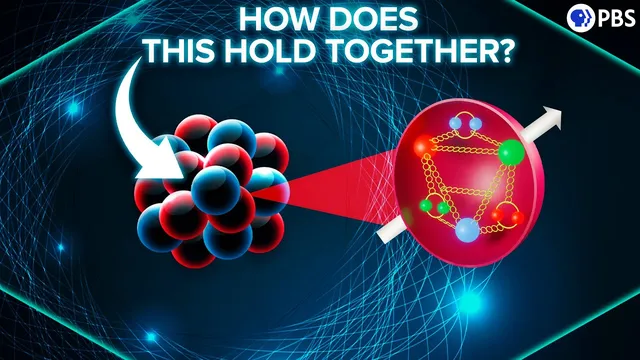
Atomic nuclei stay bound because the strong force can’t act directly between color-neutral protons and neutrons; instead, it works through short-lived, color-neutral mesons—especially pions—that effectively pass momentum and energy between nucleons. The key insight is that the strong interaction between quarks is mediated by massless gluons, but gluons carry color charge, so two nucleons can’t exchange a single gluon without breaking color neutrality. Nature’s workaround is to generate a quark–antiquark pair during a brief “flux tube” rearrangement, producing a meson that can be absorbed by a neighboring nucleon. Because mesons have mass, the exchange is short-range: if nucleons get too far apart, meson exchange becomes ineffective and large nuclei decay.
The story traces back to Hideki Yukawa, who in the 1930s tried to understand why an extremely strong force appears to operate only inside nuclei. Yukawa focused on beta decay, where a neutron turns into a proton by emitting an electron. Since electromagnetic interactions are mediated by photon exchange, he reasoned that nuclear forces should also be mediated by an exchanged particle. He tested the idea that the mediator might be the electron, but the resulting force strength and range didn’t match nuclear binding. Using quantum uncertainty, he then built a model for a short-range force mediated by a heavier particle than the electron—one whose mass would limit how long a “virtual particle” could exist. The calculation pointed to a new particle type: the meson, with a mass between that of the proton and electron.
Yukawa’s theory predicted three meson charge states: a positively charged, a negatively charged, and a neutral meson. It also correctly anticipated the existence of two nuclear forces: the strong force responsible for holding nuclei together and the weaker force involved in beta decay. Yet the theory initially failed to explain beta decay directly, and it was largely ignored after publication in 1935—until experimental searches began. Early attempts relied on cosmic rays, since particle accelerators weren’t yet capable of producing enough data. Researchers using photographic plates at high altitudes in India and Tibet reported mesons consistent with Yukawa’s predicted mass, and British scientists later confirmed mesons in 1947.
As accelerators improved, the “Particle Zoo” exploded: many more mesons and baryons appeared than Yukawa’s simple picture suggested. The resolution came when Murray Gell-Mann recognized that mesons and baryons are composite hadrons made from quarks. In this framework, the strong force binds quarks via gluons, and the variety of observed particles reflects the many possible quark combinations. With quarks and gluons in place, the earlier puzzle—how a short-range nuclear force emerges from a theory with massless gluons—became understandable: color neutrality forces nucleons to communicate through massive, neutral mesons (like pions) rather than direct gluon exchange.
The result is a coherent mechanism for nuclear stability: meson exchange provides an effective residual strong nuclear force between nucleons, and the meson’s mass sets the nucleus’s size limit. Without this “quirk” of nature—an emergent, indirect exchange channel—complex atoms would collapse into hydrogen alone.
Cornell Notes
Nuclei are held together by an effective residual strong nuclear force that operates only over short distances. Quarks inside protons and neutrons interact through gluons, but gluons carry color charge, so color-neutral nucleons can’t exchange a single gluon directly. When nucleons get close, the strong interaction rearranges quark connections (“flux tube” behavior) so a color-neutral quark–antiquark pair forms—a meson such as a pion—which can be absorbed by the neighboring nucleon. Because mesons have mass, their virtual exchange is short-ranged, limiting the size of stable nuclei. Yukawa’s 1935 meson theory predicted the need for a heavier mediator than the electron and anticipated both the strong and weak nuclear forces, later supported by cosmic-ray and accelerator observations.
Why can’t protons and neutrons exchange the strong force by trading gluons directly?
How does the meson workaround work when two nucleons approach each other?
What role does the uncertainty principle play in Yukawa’s meson idea?
Why did Yukawa reject the electron as the mediator of nuclear binding?
What caused the “Particle Zoo,” and how was it resolved?
How does meson mass determine the size of atomic nuclei?
Review Questions
- How does color neutrality constrain which particles can be exchanged between nucleons?
- In Yukawa’s framework, how do mediator mass and the uncertainty principle jointly set the force’s range?
- What does the quark model add that resolves the mismatch between Yukawa’s minimal particle expectations and the observed “Particle Zoo”?
Key Points
- 1
Protons and neutrons are color-neutral, so they can’t exchange a single color-charged gluon without violating color neutrality.
- 2
The strong interaction communicates between nucleons indirectly by generating color-neutral mesons (pions) through a flux-tube rearrangement and quark–antiquark pair creation.
- 3
Meson exchange transfers energy and momentum between nucleons, producing the effective residual strong nuclear force that binds nuclei.
- 4
Mesons have mass, so their virtual exchange is short-ranged; this sets the maximum size of stable nuclei.
- 5
Yukawa’s 1935 meson theory used uncertainty-principle reasoning to predict a heavy mediator with a range comparable to nuclear dimensions.
- 6
Cosmic-ray observations and later accelerator experiments provided evidence for mesons in the mass range Yukawa predicted, including the expected charge states.
- 7
The “Particle Zoo” of many hadrons became understandable once mesons and baryons were recognized as quark composites rather than elementary particles.