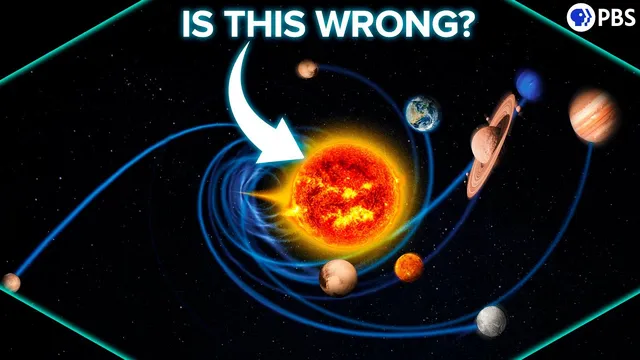
How Earth REALLY Moves Through the Galaxy
Based on PBS Space Time's video on YouTube. If you like this content, support the original creators by watching, liking and subscribing to their content.
Galilean relativity removes the idea of an absolute rest frame: multiple inertial reference frames can describe the same physics.
Briefing
Earth’s “real” motion through space is less a single helix and more a stack of reference frames—each useful for a different question. The common corkscrew diagrams are not wrong, but they’re often presented as if one viewpoint is fundamentally superior, even though physics treats all inertial frames as equally valid. Once the right frames are chosen, Earth’s path becomes a measurable choreography: the solar system wobbles around the Milky Way’s center, the Sun drifts through the galactic disk, and the whole local group barrels toward larger cosmic structures.
Inside the solar system, the key correction is that the Sun is not fixed. Planets tug the Sun, so the best “center” for describing orbital motion is the solar system barycenter—the center of mass. From that frame, the Sun performs a complex pirouette driven largely by Jupiter and Saturn. Earth’s orbit then shows subtle stretching and squashing over the timescales of those giant planets (about 5 and 12 Earth years), while the orientation of Earth’s orbital ellipse slowly rotates over thousands of years. This is complicated, but it’s still comparatively straightforward because the Sun dominates the gravitational bookkeeping.
Through the Milky Way, the motion becomes harder because gravity comes from everything. The solar system travels at roughly 230 km/s relative to the Milky Way’s center, implying an orbital period on the order of 230 million years. But the Sun’s orbit is not perfectly circular. Astronomers use the Local Standard of Rest—a hypothetical circular orbit from the Sun’s current position—to quantify the Sun’s “peculiar motion,” finding it drifts forward by about 5 km/s, inward toward the galactic center by about 8 km/s, and upward/out of the disk by about 7 km/s. Those small offsets matter: the Sun doesn’t follow a simple ellipse. Instead, it traces an epicyclic “flower” pattern, reflecting the Milky Way’s distributed mass.
The most dramatic component is vertical motion through the galactic disk. With more mass below than above, the disk’s gravity slows the Sun’s upward climb; in a few million years the solar system rises to roughly 300 light-years above the disk center, then falls back, plunges through, overshoots, and pops out again. This vertical oscillation happens about once every 60 million years. Some researchers link such disk crossings to mass-extinction timing, arguing that the denser stellar environment near the disk midplane increases the odds of nearby supernovae or destabilizing stellar encounters.
Those same oscillations also double as a probe of dark matter. If dark matter self-interacts weakly, it could concentrate more in the disk, making the disk more massive and altering how high stars can rise. Measurements of nearby stars’ vertical speeds and maximum heights so far show no evidence for extra disk density, supporting models where dark matter behaves more like a non-interacting, “puffy” component.
Finally, the solar system’s motion is only part of the story. The Milky Way is pulled toward Andromeda while the local group heads toward a large-scale overdensity dubbed the Great Attractor. To define a clean cosmic rest frame, astronomers use the cosmic microwave background, which implies Earth is moving at about 368 (+/− 2) km/s relative to the universe’s average rest frame. In short: Earth’s path is a layered dance—helix-like locally, flower-like in the galaxy, and fast relative to the cosmic microwave background—only fully coherent when the right reference frames are chosen.
Cornell Notes
Earth’s motion through space isn’t captured by a single “vortex” picture. Physics allows many inertial reference frames, so the best description depends on the question. Within the solar system, the Sun moves too, so the barycenter (center of mass) is the most accurate reference; Earth’s orbit subtly stretches, squashes, and slowly rotates due to Jupiter and Saturn. Through the Milky Way, the Sun’s peculiar motion relative to the Local Standard of Rest—about 5 km/s forward, 8 km/s inward, and 7 km/s upward—drives an epicyclic “flower” trajectory and a vertical oscillation through the disk roughly every 60 million years. Those vertical motions can test dark matter models because a more massive disk would change how far stars rise, and observations so far favor non-interacting dark matter.
Why do “helix” diagrams risk misleading people about Earth’s motion?
What’s the most accurate reference point for describing motion inside the solar system?
How do astronomers describe the Sun’s orbit through the Milky Way without needing the galaxy’s exact center?
What causes the solar system to bounce above and below the Milky Way’s disk?
How can vertical oscillations of stars test dark matter models?
What sets the “cosmic rest frame” used to measure Earth’s motion through the universe?
Review Questions
- What role does the solar system barycenter play in correcting the idea that planets orbit a fixed Sun?
- How do the Sun’s peculiar-velocity components relative to the LSR change the shape of its galactic path?
- Why would weakly self-interacting dark matter increase the predicted mass of the galactic disk, and how would that alter stellar vertical oscillations?
Key Points
- 1
Galilean relativity removes the idea of an absolute rest frame: multiple inertial reference frames can describe the same physics.
- 2
Inside the solar system, the barycenter (center of mass) is the best reference because the Sun moves in response to planetary gravity.
- 3
Earth’s orbit shows small, measurable effects from the solar system barycenter’s motion, especially driven by Jupiter and Saturn.
- 4
The Sun’s motion through the Milky Way is described relative to the Local Standard of Rest, revealing a “peculiar motion” of roughly 5 km/s forward, 8 km/s inward, and 7 km/s upward/out of the disk.
- 5
Vertical oscillations through the galactic disk occur on ~60 million-year timescales and may relate to extinction-risk hypotheses tied to disk density.
- 6
Vertical stellar motion can constrain dark matter: a more massive disk (from self-interacting dark matter) would change maximum heights and vertical speeds.
- 7
Earth’s speed relative to the universe’s average rest frame is measured using the cosmic microwave background, giving about 368 (+/− 2) km/s.