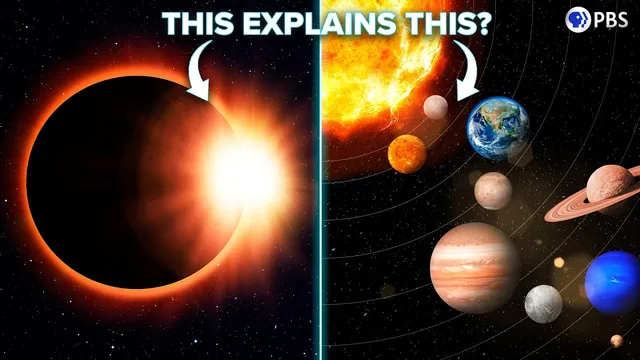
How Eclipses Revealed Our Solar System
Based on PBS Space Time's video on YouTube. If you like this content, support the original creators by watching, liking and subscribing to their content.
Total solar eclipses and lunar eclipses provided measurable geometry—shadow shapes, eclipse frequency, and shadow-crossing durations—that constrained orbital structure.
Briefing
Total solar eclipses did more than deliver a dramatic sky show: their timing, geometry, and shadow sizes helped ancient astronomers build the first workable model of the Earth–Moon–Sun system—and, eventually, the real scale of the solar system. The core insight is that eclipses act like natural measuring devices. By tracking how often eclipses occur, how Earth’s shadow looks, and how long the Moon takes to move through shadow, people could infer the Moon’s orbit, Earth’s roundness, and the relative distances and sizes of celestial bodies.
The story begins with the ancient Greeks, who already understood the planet is round from everyday observations—boats disappearing hull-first and the way star positions shift with latitude. Lunar eclipses provided the decisive clue: Earth’s shadow has a distinctly round shape, which fits a spherical Earth. Greeks also connected eclipse mechanics to orbital geometry. In the fifth century BCE, Anaxagoras concluded that the Moon must orbit Earth, be spherical, and sit closer to Earth than the Sun. That arrangement explains lunar phases (the changing illuminated portion of the Moon) and eclipse behavior (the Moon crossing Earth’s shadow for lunar eclipses, and Earth’s shadow for the Moon).
Yet the most revealing details came from patterns. Eclipses do not happen every lunar orbit; they occur only about twice per year. That periodicity points to a misalignment between the Moon’s orbital plane and Earth’s orbit around the Sun. Twice a year, the Moon’s orbital tilt lines up so the Moon passes through the Sun–Earth line’s geometry—on the “line of nodes”—allowing solar and lunar eclipses to occur, sometimes more than once depending on the Moon’s position.
Aristarchus of Samos then pushed eclipses beyond “what causes them” into “how big and how far.” In the third century BCE, he used three shadow-based methods: the duration of lunar phases, the exact size ratio implied by total solar eclipses (when the Moon fully blocks the Sun), and measurements from lunar eclipses—specifically how many Moon diameters fit across Earth’s shadow. He found the Moon’s diameter is about one-third of Earth’s, and he estimated the Sun’s distance and size using the same geometric ratios, though his Sun distance came out too small (about 20 times the lunar distance rather than the modern ~400).
To convert relative scales into actual distances, Eratosthenes of Alexandria supplied the missing anchor: Earth’s radius. Using the fact that the Sun was reportedly directly overhead at noon on the summer solstice in Syene (measured via a deep well with no shadow) while Alexandria still had measurable shadow from a vertical pole, he calculated Earth’s size with under 2% error. Combining Earth’s real size with Aristarchus’s relative measurements tightened the Moon’s physical scale.
The final step toward the Astronomical Unit came with planetary motion and transits. Kepler’s laws linked orbital speed to distance from the Sun, but the Earth–Sun distance still needed a number. That number emerged from solar parallax during Venus transits. Edmund Halley argued Venus would be easier than Mercury because it’s closer to Earth, even though it transits only twice per century. When the 1769 transit arrived, observers across the globe—Philadelphia, St Petersburg, Tahiti, and more—measured the transit’s apparent position shift from different latitudes. Combining those observations yielded the Sun–Earth distance as about 153 million km, within roughly 2% of the modern value, letting the rest of the planets’ orbital radii fall into place.
In the end, eclipses and related shadow phenomena turned mystery into measurement. Instead of attributing the sky to gods and myths, generations of observers used geometry, repeated events, and careful watching to build a quantitative solar system.
Cornell Notes
Total solar eclipses and related shadow events became early “measurement tools” for the solar system. Ancient astronomers used the round shape of Earth’s shadow in lunar eclipses to infer Earth is spherical, and the fact that eclipses happen only about twice per year to infer Earth orbits the Sun. Aristarchus of Samos used eclipse geometry—especially the Moon’s phase timing and how many Moon diameters fit across Earth’s shadow—to estimate the Moon’s size relative to Earth and to constrain Sun distance and size. Eratosthenes then provided a real physical scale by calculating Earth’s radius from shadow measurements between Alexandria and Syene. Finally, Venus transits enabled solar parallax measurements that produced the Astronomical Unit (about 153 million km), completing the model’s physical scale.
How did lunar eclipses help establish that Earth is round?
Why do eclipses occur only about twice per year, and what does that imply?
What did Aristarchus of Samos gain from comparing crescent and gibbous phase durations?
How did total solar eclipses constrain the Sun–Moon distance ratio?
What measurement from a lunar eclipse let Aristarchus estimate the Moon’s size relative to Earth?
How did Venus transits produce the Astronomical Unit?
Review Questions
- What specific eclipse pattern (timing or geometry) points to Earth’s orbit around the Sun?
- How do phase-duration asymmetries (crescent vs gibbous) reveal the Sun’s finite distance?
- Why did global coordination during the 1769 Venus transit matter for calculating the Astronomical Unit?
Key Points
- 1
Total solar eclipses and lunar eclipses provided measurable geometry—shadow shapes, eclipse frequency, and shadow-crossing durations—that constrained orbital structure.
- 2
Anaxagoras linked eclipse observations to three requirements: the Moon orbits Earth, is spherical, and is closer to Earth than the Sun.
- 3
The roughly twice-per-year occurrence of eclipses follows from the Moon’s orbital tilt relative to Earth’s orbit, aligning only at the line of nodes.
- 4
Aristarchus of Samos used eclipse and phase geometry to estimate relative distances and sizes, including the Moon’s diameter as about one-third of Earth’s.
- 5
Eratosthenes converted relative astronomy into real scale by calculating Earth’s radius using shadow measurements between Alexandria and Syene.
- 6
Solar parallax during Venus transits enabled a direct estimate of the Astronomical Unit, yielding about 153 million km within ~2% of the modern value.
- 7
Kepler’s laws then allowed the rest of the planets’ orbital radii to be calculated once the Earth–Sun distance was known.