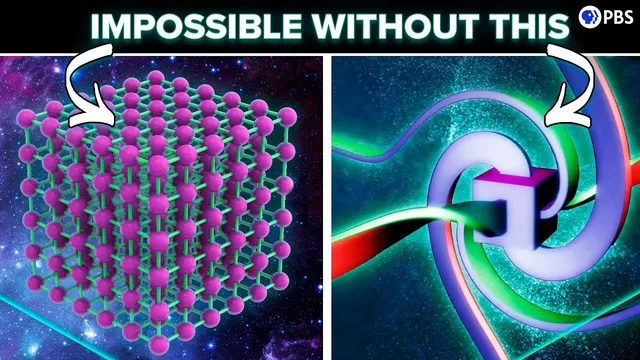
How Electron Spin Makes Matter Possible
Based on PBS Space Time's video on YouTube. If you like this content, support the original creators by watching, liking and subscribing to their content.
Spin-½ particles behave as spinors: they return to their original configuration only after a 720° rotation, not 360°.
Briefing
Electrons don’t let matter collapse because their quantum “spinor” nature forces their multi-particle wavefunctions to behave antisymmetrically—an odd rule that becomes the Pauli exclusion principle and, ultimately, the stability of atoms, solids, and chemistry. The core chain runs from a single rotational quirk: spin-½ particles return to their original configuration only after a 720° rotation, not 360°. That topological feature—captured by the belt trick—turns into a phase flip in the electron’s quantum wavefunction, and that phase flip dictates what happens when identical electrons are combined.
The explanation starts by sorting particles into two families. Integer-spin particles (bosons) have wavefunctions that return after a normal 360° rotation and can pile into the same quantum state without restriction—photons in a laser are the classic example. Half-integer-spin particles (fermions) include electrons, quarks, and neutrinos, and they obey a different rule: no two fermions can share the same quantum state. Without that restriction, electrons in multi-electron atoms would all sink into the lowest energy level, shrinking atoms to a minimum size and wiping out the energy structure that makes chemistry possible.
Why fermions must refuse to share states comes down to two ingredients: “weird rotational symmetry” and indistinguishability. Indistinguishability means swapping two electrons produces no observable change. But the belt trick shows that for spinors, a 360° rotation is effectively equivalent to exchanging two identical spinors. For electron spinors, a 360° rotation introduces a minus sign (a phase shift of half a cycle) in the spinor wavefunction. That negative sign is the mathematical lever behind the fermion/boson divide.
To connect the minus sign to exclusion, the account builds a two-electron wavefunction. If one electron occupies a ground state wavefunction g and the other occupies an excited state wavefunction f, then the combined two-particle state must be antisymmetric under particle interchange: swapping the labels flips the sign, so Ψ(A,B) = −Ψ(B,A). Crucially, the minus sign is not directly observable because measurements depend on |Ψ|², which removes the sign. Yet the antisymmetry has a dramatic consequence when both electrons try to occupy the same state. In that case the two terms in the antisymmetric superposition become identical except for the minus sign, so they cancel perfectly—meaning the “both in the same state” wavefunction is forced to vanish. Since electrons can’t disappear, that configuration is forbidden.
The result is the Pauli exclusion principle for half-integer-spin particles: antisymmetric wavefunctions prevent multiple fermions from sharing a single quantum state. The broader spin-statistics theorem is described as consistent with the Dirac equation for spin-½ particles; attempting to use symmetric wavefunctions leads to pathological physics, including an energy spectrum unbounded from below. With that rule in place, matter gains the stable structure that keeps chairs from turning into confetti—plus the episode ends with the usual Space Time community wrap-up and comment responses.
Cornell Notes
Half-integer-spin particles (fermions) like electrons behave as spinors: they return to their original configuration only after a 720° rotation. That rotational property implies a 360° rotation flips the sign of the electron’s spinor wavefunction. Because electrons are indistinguishable, swapping two electrons corresponds to that same 360°-equivalent operation, forcing the two-particle wavefunction to be antisymmetric: Ψ(A,B) = −Ψ(B,A). When two fermions try to occupy the same single-particle state, the antisymmetric superposition cancels to zero, making that arrangement physically impossible. This antisymmetry is the mechanism behind the Pauli exclusion principle and therefore the stability of atomic structure and chemistry.
What does the belt trick demonstrate about spinors, and why does it matter for electrons?
How do bosons and fermions differ in what happens when you add many particles to the same quantum state?
Why is the minus sign in a fermion wavefunction not directly observable, yet still physically decisive?
How does antisymmetry under exchange lead to the Pauli exclusion principle?
What role does indistinguishability play in turning the belt-trick idea into a rule about wavefunctions?
Why does the Dirac equation matter for the spin-statistics connection?
Review Questions
- How does the belt trick connect a 360° rotation to exchanging two spinors, and what phase consequence does that have for electron wavefunctions?
- In the antisymmetric two-electron construction using f and g, what specifically causes the wavefunction to cancel when both electrons attempt to occupy the same single-particle state?
- Why does indistinguishability prevent the minus sign from being directly observable, even though it still enforces exclusion through interference?
Key Points
- 1
Spin-½ particles behave as spinors: they return to their original configuration only after a 720° rotation, not 360°.
- 2
For spinors, a 360° rotation corresponds to a phase flip (a factor of −1) in the wavefunction.
- 3
Because electrons are indistinguishable, exchanging two electrons must produce no observable change, forcing the two-particle wavefunction to be antisymmetric under interchange.
- 4
Antisymmetric wavefunctions make it impossible for two fermions to occupy the same single-particle quantum state: the would-be state cancels to zero.
- 5
Pauli exclusion follows from that cancellation mechanism and explains why atoms have stable energy levels instead of collapsing.
- 6
The spin-statistics theorem is consistent with the Dirac equation: using the wrong symmetry leads to unphysical results like an energy spectrum unbounded from below.