How Entropy Powers The Earth (Big Picture Ep. 4/5)
Based on minutephysics's video on YouTube. If you like this content, support the original creators by watching, liking and subscribing to their content.
Work depends on energy’s low-entropy, out-of-equilibrium form, not on total energy alone.
Briefing
Earth receives roughly 90 petajoules of solar energy every second, yet it also radiates essentially the same amount back into space as heat. That near-perfect energy balance raises a puzzle: if energy in equals energy out, where does the “work” that powers weather, ecosystems, and technology come from? The key isn’t total energy—it’s the *usefulness* of that energy, which tracks how ordered (low-entropy) or degraded (high-entropy) it is.
Energy becomes useful when it arrives in a low-entropy, out-of-equilibrium form that can drive change. A dam’s water sits at different heights and can flow until both sides match; hot tea can melt an ice cube until temperatures equalize. In both cases, the total energy is conserved, but the system moves from an uneven distribution to a more uniform one. What never happens is the reverse: tepid tea does not spontaneously generate ice cubes while warming up, because that would require a decrease in entropy—an improbable reversal of the natural direction of change.
Useless energy, by contrast, is what’s left after useful gradients have been erased. It shows up as waste heat, noise, or a ball resting on the ground—energy that may still exist, but can’t be reliably converted into mechanical motion or other organized effects. The gasoline-and-air example makes the point: chemical energy can accelerate a car, but once the fuel burns and the car stops, the energy has been converted into high-entropy heat and noise. The world’s total energy remains the same, but the fraction that can do further work has been irreversibly degraded.
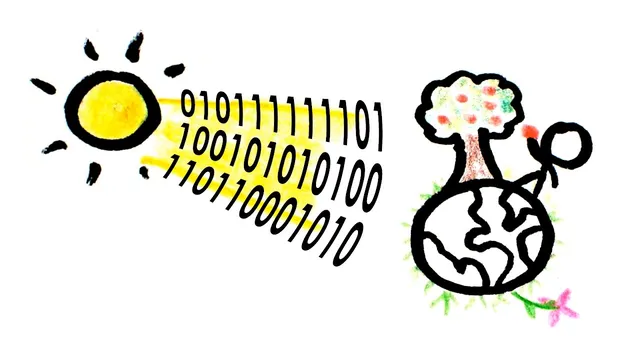
Earth’s situation mirrors that logic on a planetary scale. The Sun delivers energy mainly as visible-light photons, a hot, concentrated source embedded in a cold, dark sky. Earth absorbs that low-entropy radiation and then re-emits it in a much higher-entropy form—mostly infrared photons. For each visible photon received, Earth emits about twenty infrared photons. The energy amount balances, but the entropy associated with that energy rises dramatically: the “packaging” changes from concentrated, temperature-contrasting light to widely spread, lower-usefulness radiation.
This is why the Sun is more than an energy supplier—it is a provider of *useful* energy. If the entire sky were as hot as the Sun, Earth would quickly settle into thermal equilibrium at a single averaged temperature. In that equilibrium state, there would be no persistent gradients to exploit, so driving, living, and other time-dependent processes would effectively stall. The deeper takeaway is that entropy doesn’t just measure disorder; it marks the direction in which energy loses its ability to power change, giving time its arrow by making reversals extraordinarily unlikely.
Cornell Notes
Earth’s energy budget balances—about 90 petajoules of solar energy arrive each second and nearly the same amount leaves as heat. Yet life and motion still happen because the relevant quantity is not total energy but *useful energy*: low-entropy, out-of-equilibrium energy that can drive change. Gradients—like water behind a dam or hot tea melting ice—naturally relax, converting usable energy into high-entropy waste heat that can’t be reclaimed for more work. Earth receives low-entropy visible light from a hot Sun and re-emits it as high-entropy infrared radiation, emitting about twenty infrared photons for each visible photon absorbed. Without the Sun–sky temperature contrast, Earth would reach equilibrium and processes requiring time-dependent change would largely stop.
Why doesn’t “energy in equals energy out” prevent Earth from doing work?
What’s the difference between useful and useless energy in everyday examples?
How does burning gasoline illustrate entropy’s role in limiting future work?
Why does Earth emit more infrared photons than it receives visible photons?
What would happen if the whole sky had the Sun’s temperature?
Review Questions
- How do the dam and ice-melting examples demonstrate that entropy increase limits the reversibility of natural processes?
- Explain why Earth’s re-emission as infrared photons represents a loss of “useful energy” even when total energy is conserved.
- What role does the Sun–sky temperature contrast play in maintaining the direction of change on Earth?
Key Points
- 1
Work depends on energy’s low-entropy, out-of-equilibrium form, not on total energy alone.
- 2
Natural processes move systems from uneven conditions (low entropy) toward uniform conditions (high entropy).
- 3
Energy can be conserved while its ability to do future work is irreversibly reduced.
- 4
Earth’s absorption of low-entropy visible light and re-emission as high-entropy infrared radiation increases entropy despite energy balance.
- 5
The Sun is valuable because it provides a persistent temperature contrast against a cold sky, sustaining gradients.
- 6
Thermal equilibrium eliminates exploitable gradients, making time-dependent change effectively stop.