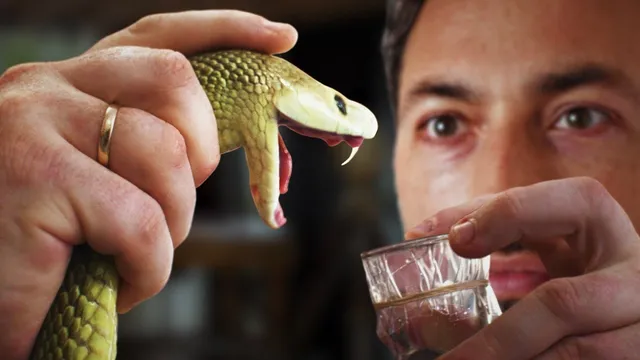
How Horses Save Humans From Snakebites
Based on Veritasium's video on YouTube. If you like this content, support the original creators by watching, liking and subscribing to their content.
Venom can kill through multiple pathways—neurotoxic, hemotoxic, cytotoxic, and myotoxic effects—often at the same time.
Briefing
Snakebite prevention and treatment hinge on a grim reality: venom is engineered for specific prey, and the resulting chemistry can overwhelm the human body in multiple ways. In Australia, where snakebite risk is high and antivenom access is treated as a public-health necessity, venom is collected from live snakes so it can be processed into antivenom that saves lives.
At the Australian Reptile Park, handlers demonstrate how venomous snakes are milked inside a room built for containment—thin glass and small locks keep animals from escaping, while staff use hooks and controlled handling to trigger venom release into vials. The process is fast and visibly dangerous; even a scratch can be lethal. The stakes are underscored by mortality estimates: Australia loses roughly 1–3 people per year to snakebite, while global estimates from the World Health Organization put snakebite at about 120,000 deaths internationally. The park’s work feeds into a federally funded antivenom program that provides antivenom for free regardless of a patient’s identity.
Venom collection is also a numbers game. Making one vial of antivenom can require venom from around 15 snakes, and handlers try to maximize yield by massaging venom glands to coax out extra drops. The transcript ties this labor to the biology of venom delivery: many snakes are rear-fanged, with venom glands located behind the eye, so ducts run down to the back of the upper jaw. Over evolutionary time, some lineages developed grooves that became hollow fangs—turning teeth into injection tools—though only about one-seventh of the world’s snakes have hollow fangs. Australia’s venomous snakes largely fall into the hollow-fang category, which helps explain why bites there are so medically urgent.
The most dramatic examples come from coastal taipans and the inland taipan (“fierce snake”), described as among the most toxic land snakes. The inland taipan’s venom is portrayed as capable of incapacitating large numbers of adult humans from a single drop, while the transcript also cites older lab-mouse studies used to estimate human risk. But “most venomous” is complicated: venom potency depends on the snake species, the amount injected, and the victim’s biology.
Mechanistically, snake venom can kill through four broad pathways: neurotoxicity (disrupting neurotransmitter signaling), hemotoxicity (damaging blood coagulation and causing internal bleeding), cytotoxicity (destroying cells and causing necrosis), and myotoxicity (destroying muscle and leading to paralysis). Many venoms contain up to 200 compounds, meaning treatment must neutralize a cocktail rather than a single toxin.
Antivenom itself is built on immune-system targeting. The transcript traces key historical work to Edward Nicholson, who observed that older snake handlers were less affected by bites, and to Albert Calmette, who developed the concept of producing antibodies by gradually exposing animals to cobra venom. Modern antivenom production still relies on this principle: venom is collected and frozen, then diluted and injected into donor animals—often horses—over months so they develop antibodies. Blood plasma is harvested, antibodies are isolated, and the resulting antivenom binds toxic compounds in humans.
The process is effective but not risk-free. Some people are allergic to antivenom, and the transcript includes an account from a long-time handler who suffered a severe reaction after a minor scratch. Scientists are now exploring alternatives such as genetically modified bacteria that could produce specific antibodies, but traditional horse-based production remains the standard. In the end, the work is portrayed as both technically demanding and life-saving—turning dangerous venom into a targeted medical countermeasure.
Cornell Notes
Snakebite treatment depends on turning highly specific venom into antivenom that can neutralize many toxic compounds at once. At the Australian Reptile Park, handlers milk venomous snakes into vials, sometimes needing venom from roughly 15 snakes to make a single vial of antivenom. Venom can kill through multiple pathways—neurotoxic, hemotoxic, cytotoxic, and myotoxic effects—because many venoms contain dozens to hundreds of compounds. Antivenom is produced by immunizing donor animals (often horses) with gradually increasing doses of venom so their antibodies can be harvested from plasma and used to bind and neutralize venom in humans. The approach works, but allergic reactions can occur, and collecting venom is inherently dangerous.
Why does “most venomous snake” not translate cleanly into “most dangerous bite” for humans?
What are the four major ways snake venom can kill, and why does that complicate treatment?
How does the venom-collection process at the Australian Reptile Park work, and what determines how much venom is needed?
Why are rear-fanged snakes common, and how does fang anatomy relate to venom delivery?
How is antivenom made, and why do horses play a central role?
What risks come with antivenom, and what does the handler’s experience illustrate?
Review Questions
- What biological factors make venom potency and bite outcomes vary between snake species, victims, and injection amounts?
- How do the four venom mechanisms (neurotoxic, hemotoxic, cytotoxic, myotoxic) map onto the kinds of symptoms clinicians must manage?
- Why does antivenom production rely on antibodies generated in donor animals, and what role does plasma harvesting play in the final treatment?
Key Points
- 1
Venom can kill through multiple pathways—neurotoxic, hemotoxic, cytotoxic, and myotoxic effects—often at the same time.
- 2
Many snake venoms contain dozens to hundreds of compounds, so antivenom must neutralize a complex mixture rather than a single toxin.
- 3
Venom collection for antivenom is labor-intensive and yield-dependent; roughly 15 snakes’ venom may be needed for one vial.
- 4
Snake fang anatomy (rear-fanged ducts and, in some lineages, hollow fangs) influences how efficiently venom is delivered.
- 5
Antivenom is produced by immunizing donor animals (often horses) with gradually increasing venom doses so their antibodies can be harvested from plasma.
- 6
Antivenom can cause severe allergic reactions in some patients, requiring emergency management such as adrenaline and repeated dosing.
- 7
Australia’s antivenom program is federally funded, aiming to ensure access to antivenom for patients regardless of personal circumstances.