How I create literature notes from Kindle books
Based on Martin Adams's video on YouTube. If you like this content, support the original creators by watching, liking and subscribing to their content.
Capture Kindle highlights and momentary annotations as raw “fleeting notes,” including questions and analogies that the text sparks.
Briefing
A practical workflow turns Kindle highlights and quick “catcher” notes into durable literature notes written in the reader’s own words—so the ideas can be rebuilt, tested, and later connected across an entire Zettelkasten-style knowledge base. The core move is shifting from fleeting capture (quotes, sparks, and momentary thoughts) to literature notes that reflect the reader’s thinking process while staying grounded in the source material.
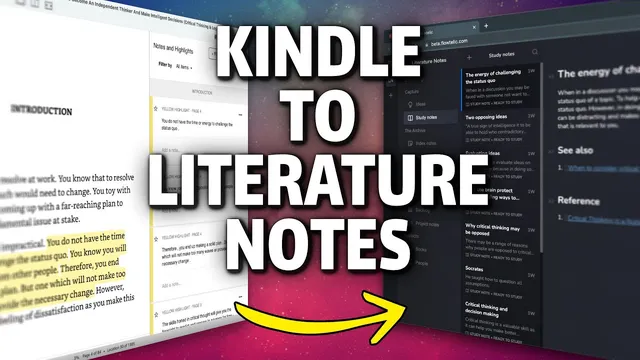
The process starts during reading in the Kindle app. As the reader highlights passages that matter, they sometimes add annotations—questions, analogies to personal experience, or even unrelated ideas that the text triggers. These annotations are intentionally messy and immediate: they preserve what stood out at the moment, not a polished understanding. When it’s time to extract the material, Kindle export is handled through the Kindle desktop app, which outputs a web page containing highlights, page locations, and any comments.
From there, the workflow becomes a reconstruction exercise. The exported highlights are copied as text and pasted into a note-taking system (in the demo, into a new study note within a “literature notes” collection). Formatting may be crude, but the goal is workable raw material. The reader then creates new study notes that translate the source’s ideas into “Atomic” notes—small, single-concept entries that are written in the reader’s language and reflect the meaning they derived from the book.
Using the example book “Critical Thinking in a Nutshell,” the reader rebuilds understanding by turning specific highlighted ideas into named Atomic nodes. One highlight about not having the time or energy to challenge the status quo becomes a note on “the status quo and critical thinking,” capturing how conversations can derail into arguments about consensus narratives rather than the real issue—because challenging the status quo costs time and energy. Another highlight about opposition during dialogue becomes a note on when critical thinking is worth attempting, factoring in whether the other person is open or likely to push back. A further passage about trade-offs leads to a note emphasizing that engaging critically may require compromising scope to avoid “making too many waves.”
The reconstruction expands beyond simple definitions into meta-level questions: why people resist critical thinking, whether the brain protects itself by opposing uncomfortable ideas, and how to evaluate ideas on their merits alone. The reader also references Socrates as a prompt to examine assumptions, and adds reminders to reduce bias by temporarily setting aside one’s own belief system before judging an idea.
After building these study notes, the reader recommends revisiting them to simplify and compress them further, then organizing them into a map or index (e.g., an outline note like “What is critical thinking?” with buckets such as challenges, benefits, questions, and exceptions). That structure becomes the reader’s personal understanding of the book. Later, these literature notes can be integrated into the broader Zettelkasten—checking for overlaps, links, and contradictions with existing notes, and placing new ideas into the larger network.
Finally, the workflow doubles as product feedback: the reader is developing “flotelic” and identifies gaps in current tooling—such as better automatic referencing from book-level notes into Atomic notes, and a focus-mode experience that lets progress through a book in small, trackable steps. The takeaway is not just how to import Kindle highlights, but how to repeatedly rebuild meaning in one’s own words so knowledge becomes searchable, linkable, and cumulative.
Cornell Notes
Kindle highlights and quick annotations are treated as raw material, not finished knowledge. The workflow exports Kindle notes, pastes them into a literature-notes workspace, then rewrites key ideas as Atomic study notes in the reader’s own language. Using “Critical Thinking in a Nutshell,” highlights about challenging the status quo, facing opposition in dialogue, and the trade-offs of critical engagement become separate notes with names, tags, and sometimes follow-up questions. The reader then organizes these notes into an outline/index to rebuild a personal “map” of the book, and later links or merges them into the larger Zettelkasten. This matters because it turns fleeting captures into durable, connectable understanding grounded in the source but shaped by the reader’s thinking.
What’s the difference between “fleeting notes” and “literature notes” in this workflow?
How does the workflow move from Kindle to a note-taking system in a usable way?
How are Atomic notes created from a specific highlighted idea?
Why does the workflow include questions like “does the brain protect itself” against critical thinking?
What’s the purpose of reorganizing notes into an index or outline?
What tooling improvements does the reader want for the flotelic workflow?
Review Questions
- When should a Kindle highlight be rewritten into an Atomic note, and what does that rewrite accomplish?
- How does the workflow decide what to name and structure as separate Atomic notes (e.g., status quo, opposition, trade-offs)?
- What steps turn a set of study notes into a coherent “map” of a book before linking it into the larger Zettelkasten?
Key Points
- 1
Capture Kindle highlights and momentary annotations as raw “fleeting notes,” including questions and analogies that the text sparks.
- 2
Export Kindle highlights via the Kindle desktop app, then paste the exported content into a literature-notes workspace for reconstruction.
- 3
Rewrite key passages into Atomic study notes in the reader’s own words to force real understanding grounded in the source.
- 4
Use named notes and tags to separate concepts (e.g., status quo dynamics, when dialogue is productive, trade-offs of critical engagement).
- 5
Record meta-level questions (like why people resist critical thinking) to guide future research and linking.
- 6
Revisit and compress notes into simpler forms, then build an index/outline to reconstruct the book’s internal map.
- 7
Integrate literature notes later by checking overlaps, links, and contradictions with existing notes in the broader Zettelkasten network.