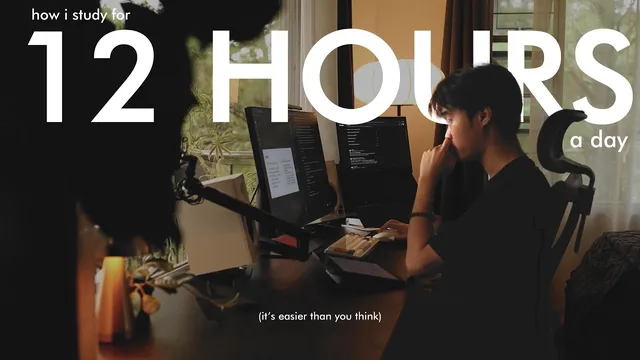
how i study 12 hours a day. (it's easier than you think)
Based on Kai Notebook's video on YouTube. If you like this content, support the original creators by watching, liking and subscribing to their content.
Most students don’t need to study 12 hours; 2–3 hours of focused work is often enough for strong results.
Briefing
Studying for 12 hours a day sounds impossible until it’s reframed: most people don’t need to study that long, and the “endurance” comes from structure—purpose, pacing, planning, and physical movement—rather than nonstop willpower. The core message is that long study blocks are less about raw intensity and more about designing a routine that keeps attention from collapsing.
The first key correction is that 12 hours isn’t a realistic requirement. Even highly productive students can get most of the benefit from 2–3 hours of focused work per day. The transcript points to a common misconception: Korean students are often treated as the benchmark for extreme study time, but their schedules are shaped by an education system built around test performance rather than real-world application. Career National tests, for example, include English passages far longer than the SAT, yet many students struggle to maintain an English conversation for more than 10 minutes—an illustration that test prep and learning outcomes don’t always align.
Endurance, in this framing, comes from normalization and environment. Korean students typically attend regular school, then go to “Crab school” (extra, more advanced classes after class), and sometimes study again after arriving home, with many days stretching to midnight. That routine makes long hours feel ordinary rather than heroic. The transcript also notes that high marks aren’t necessarily proof of genius; they can reflect studying ahead of the game.
To make long study sessions sustainable, the transcript then lays out a practical formula. First is “drive” and “grit.” Drive is treated as purpose (why the work matters), distinct from motivation, which is a temporary boost. Without direction—better grades, genuine learning, or preparation for an exam—motivation fades. Grit, drawn from the idea of passion and perseverance, is the ability to keep working even when studying doesn’t deliver the same dopamine as social media or games.
Second is pacing through breaks. The transcript argues that brains lose efficiency if time is spent continuously, so long sessions should be broken into increments. A Pomodoro-style approach is recommended, with a sweet spot of 40 minutes of study followed by a 12-minute break, using a Pomodoro timer on a laptop, phone, or a website. Keeping the timer visible also reduces phone distractions.
Third is planning. A simple checklist for session topics helps prevent getting lost and creates small wins by checking items off. Fourth is leaving the chair: light physical activity—walking, lifting weights, or working out around lunch—can reduce stress and boost energy, and it can even split a long session into two halves. Finally, social accountability is offered as a “bonus” lever: joining a study community such as study Discords, where students share screens or study together, can make sustained focus easier.
The closing note undercuts the premise: the goal isn’t to chase 12 hours for its own sake. Good results don’t require that level of time, and the transcript encourages viewers to enjoy life while aiming high academically.
Cornell Notes
The transcript argues that “12 hours a day” is less a magic ability and more a system: purpose-driven effort, structured breaks, and routines that prevent attention from collapsing. It warns that most people don’t need 12 hours—2 to 3 focused hours can be enough—while explaining that Korean students often study long because it’s normalized through regular school plus “Crab school” and late-night studying. To sustain long sessions, it emphasizes drive (purpose) over fleeting motivation, plus grit (perseverance despite low dopamine compared with games or social media). It also recommends Pomodoro pacing (e.g., 40 minutes study, 12 minutes break), checklists for planning, physical movement during the day, and study communities like Discord for accountability.
Why does the transcript say 12 hours of studying isn’t actually the goal for most people?
What’s the difference between motivation and drive, and why does it matter for long study sessions?
How does “grit” fit into the drive/purpose idea?
What break strategy is recommended to avoid losing efficiency during long study blocks?
How does planning (checklists) help someone study longer?
What role do physical activity and study communities play in endurance?
Review Questions
- What specific distinction does the transcript make between motivation and drive, and how does each affect a long study routine?
- Why does the transcript recommend Pomodoro-style breaks instead of studying continuously for many hours?
- List three non-study-time strategies mentioned (e.g., planning, movement, community) and explain how each supports endurance.
Key Points
- 1
Most students don’t need to study 12 hours; 2–3 hours of focused work is often enough for strong results.
- 2
Korean students’ long hours are partly explained by a normalized system: regular school plus “Crab school,” and sometimes late-night studying.
- 3
Drive (purpose) is more reliable than motivation (a temporary boost) for sustaining long study efforts.
- 4
Grit helps people keep working even when studying feels less rewarding than high-dopamine distractions like games or social media.
- 5
Use structured breaks—such as a Pomodoro rhythm (40 minutes study, 12 minutes break)—to prevent efficiency from dropping.
- 6
Plan sessions with simple checklists to avoid getting lost and to create momentum through small wins.
- 7
Physical movement and study communities (e.g., study Discords) can reduce stress, raise energy, and improve accountability.